
Health Insurance Claims Automation Case Studies2026-05-17T01:57:39+08:00

Case Studies · Health Insurance Claims Automation

Every Claim Tells a Story. InterPixels AI Closes It Faster.

See how TPAs across Asia Pacific automated their claims intake and settlement workflows , without rebuilding their core systems.

InterPixels AI Case Study InsurTech

Case Study 1

How a leading InsurTech services provider cut claim adjudication time by 8× using InterPixels AI.

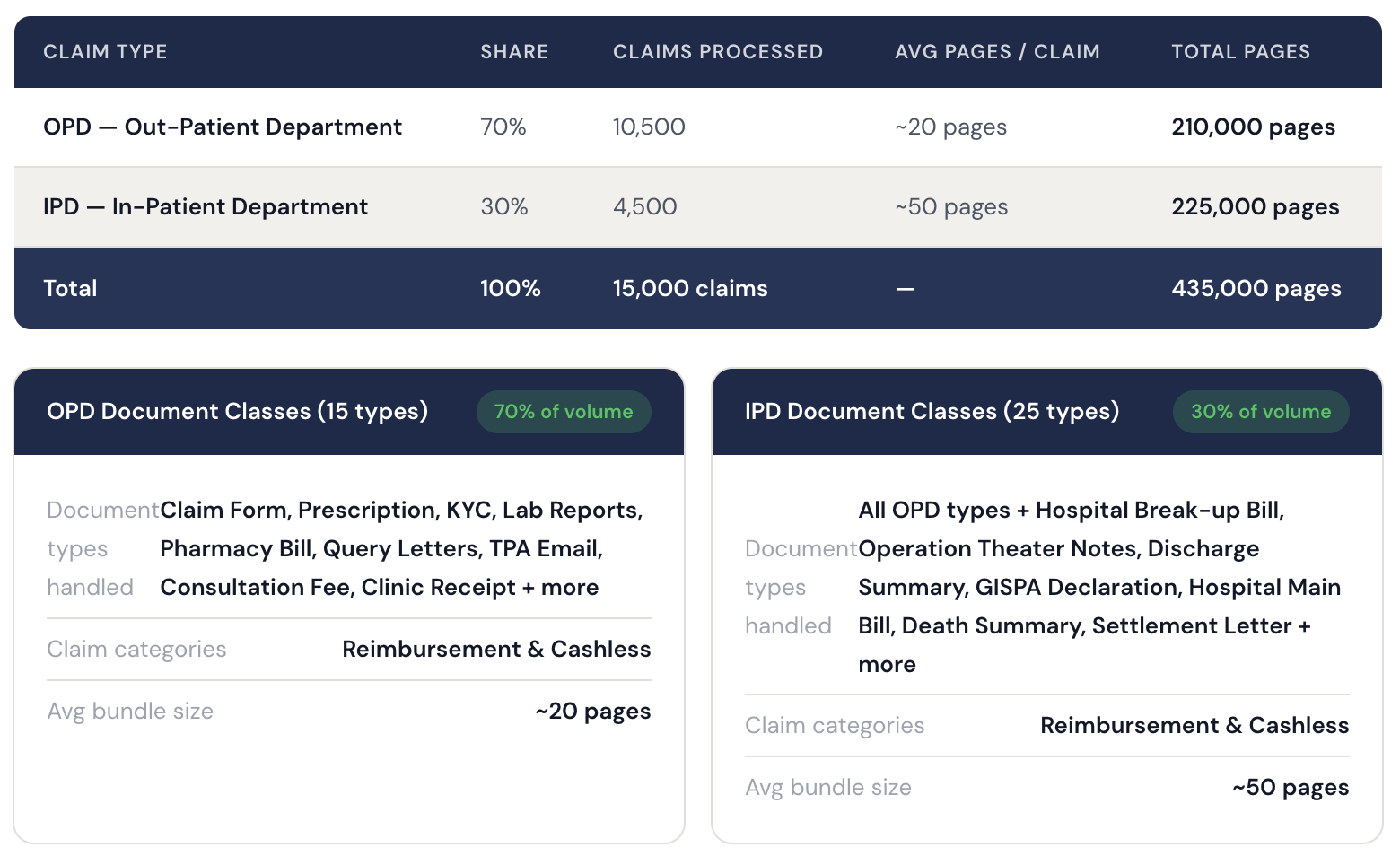
The client is a leading InsurTech services provider in India, delivering end-to-end claims technology and managed services to health insurance Third-Party Administrators (TPAs). At the core of their business is claims adjudication , reviewing, classifying, and processing a continuous volume of In-Patient Department (IPD) and Out-Patient Department (OPD) health insurance claims submitted by policyholders and hospitals.

With claim volumes in the tens of thousands per month, the client manages both Reimbursement and Cashless claim types, each arriving as multi-page document packages across heterogeneous formats , scanned PDFs, handwritten prescriptions, digital hospital bills, lab reports, and KYC documents. The scale, document diversity, and time-sensitivity of this work made manual adjudication operationally unsustainable.
InterPixels AI Scale and Volume Case Study
COMMON QUESTIONS

Frequently asked by TPA decision makers

Yes, a health insurance TPA can implement AI claims automation without any changes to their existing claims management platform. InterPixels AI is designed as an API-first solution that sits between the document intake channel and the TPA's existing adjudication system. Claim documents are submitted via email, SFTP, AWS S3, or REST API, and structured JSON output is returned directly to the TPA's existing workflow. No changes to the TPA's user interface, database, or core processing system are required. The integration layer connects to whichever ingestion channel the TPA already uses. In production deployment, this approach allowed a leading InsurTech services provider in India to achieve 8x faster claim adjudication without any modification to their core claims platform.
AI claims processing is significantly faster than manual processing. In production deployment with a leading InsurTech services provider in India, InterPixels AI reduced claim processing time from 40 minutes per claim to 5 minutes per claim, an 8x improvement across more than 15,000 claims. Manual processing requires staff to sort documents, enter data, validate fields, and spot-check submissions before adjudication can begin. InterPixels AI automates all of these upstream steps simultaneously, processing every document in the claim bundle in three to five seconds per document. The time saved comes from eliminating manual document sorting, data entry, and validation, not from changing the adjudication decision itself, which remains fully under TPA control throughout.
Reimbursement and cashless health insurance claims follow different processing paths and require different document sets, and AI handles both claim types automatically. In a reimbursement claim, the policyholder pays the hospital directly and submits documents for refund, requiring a full document bundle including bills, prescriptions, and discharge summaries. In a cashless claim, the hospital bills the TPA directly and approval must be granted before or during treatment, requiring faster document validation at intake. InterPixels AI classifies the claim type at Gate 1, identifies the required document set for that claim category, and routes the extraction accordingly. Both reimbursement and cashless claims are processed through the same API pipeline with claim-type-specific validation rules applied automatically.
Yes, AI claims automation is specifically designed to scale with claim volume in a way that manual processing cannot. InterPixels AI operates as a REST API, meaning claim submissions are processed in parallel rather than sequentially. As claim volume increases, processing capacity scales without requiring additional operations staff, additional infrastructure procurement, or any changes to the TPA platform. In production deployment, InterPixels AI has processed tens of thousands of health insurance claims for a leading InsurTech services provider in India, maintaining consistent processing times of three to five seconds per document regardless of volume. This makes AI claims automation particularly suited to TPAs managing high and variable claim volumes across multiple policyholders, insurers, and hospital networks simultaneously.
Implementation of the InterPixels AI Claims Intelligence API typically takes four to six weeks from initial technical engagement to production go-live. The process involves four stages: document type review, where the InterPixels AI team maps the TPA's specific document classes; JSON schema definition, where the TPA specifies the data fields and output format required; AI model configuration, where extraction is aligned to the TPA's requirements; and validation, where outputs are tested against real claim samples before go-live. No changes to the TPA's existing platform, user interface, or core workflow are required at any stage. The four to six week timeline reflects configuration and validation work, not a technical rebuild of any existing system.
AI claims automation significantly reduces the manual effort required in TPA claims intake and processing, though the specific impact on headcount depends on each TPA's existing team structure and claim volume. InterPixels AI eliminates the upstream document work that typically consumes the majority of a claims processor's time, specifically document sorting, data entry, field validation, and cross-referencing. In production deployment, processing time was reduced from 40 minutes to 5 minutes per claim. This allows existing claims teams to process significantly higher claim volumes without additional hires, or to redirect staff capacity from document handling toward adjudication quality and exception management. Most TPAs use AI automation to scale throughput rather than reduce headcount directly.
Yes, AI claims processing is accurate enough for health insurance adjudication at production scale, provided the system includes confidence scoring and Human-in-the-Loop governance for uncertain extractions. InterPixels AI achieves high percent document classification accuracy and returns per-field confidence scores for every extracted value. Fields extracted with high confidence are passed directly to the TPA system. Fields below the configured confidence threshold are automatically routed to a human reviewer before proceeding. This hybrid approach ensures AI handles the high-confidence majority of extractions automatically while human accountability is retained at every uncertain decision point. In production, this model has been validated across more than 15,000 health insurance claims processed for a leading InsurTech services provider in India.
When InterPixels AI cannot process a health insurance claim automatically with sufficient confidence, it routes the specific low-confidence fields to a Human-in-the-Loop reviewer rather than failing or rejecting the claim entirely. The reviewer sees only the fields requiring a decision, with the relevant document image region highlighted alongside the extracted value and its confidence score. Once the reviewer confirms or corrects the field, the claim proceeds through the normal workflow. Claims that fail Gate 1 completeness validation are returned to the submitter with a specific list of missing documents rather than being discarded. In both scenarios, no claim is abandoned due to AI uncertainty, and the TPA retains full visibility and control over every claim outcome.
The ROI from health insurance claims automation depends on claim volume, current manual processing cost, and existing rejection rates. Based on production results, InterPixels AI delivered an 8x reduction in processing time per claim for a leading InsurTech services provider in India, reducing upstream processing from 40 minutes to 5 minutes per claim across more than 15,000 claims. For a TPA processing 10,000 claims per month at 40 minutes per claim, this reduction represents approximately 58,000 hours of manual processing time saved annually. Additional ROI comes from reduced claim leakage through real-time fraud detection, lower rejection rates through completeness validation at intake, and the ability to scale claim volumes without proportional headcount increases.
A health insurance TPA should evaluate five areas when choosing an AI claims automation vendor. First, APAC document coverage: does the vendor support the specific document classes, languages, and handwriting styles used in your market? Second, integration model: does it require platform changes or connect via API to your existing system? Third, confidence and governance: does it return per-field confidence scores and support Human-in-the-Loop routing for uncertain extractions? Fourth, production proof: has it been validated at scale with real health insurance claims, not just in a demonstration environment? Fifth, fraud detection: does it run validation concurrently during extraction or as a separate post-processing step? InterPixels AI addresses all five areas and has been validated in production across more than 15,000 health insurance claims.
Go to Top