
Purpose-built APAC claims automation is document intelligence trained specifically on the identity documents, handwriting patterns, languages, and regulatory formats that Asia-Pacific health insurance TPAs process daily, rather than generic OCR adapted from Western paperwork. It handles Aadhaar, MyKad, and vernacular prescriptions natively, and maps extracted fields to IRDA, BNM, or OJK requirements without manual reconfiguration.
The tool works in London.
APAC health insurance claims automation is supposed to be a solved problem by now. Insurers have spent five years buying intelligent document processing platforms built and proven in the US and UK. Yet McKinsey research on Asian insurers found that 87 percent of surveyed companies either capture less than 5 percent uplift in operating profit from AI or do not track value capture at all (2023).
That gap is not a training problem or a change management problem. It is a document problem. In practice, teams that deploy a Western IDP tool for APAC health insurance claims automation typically find it works well on typed English invoices and falls apart on the documents that actually make up an Indian, Malaysian, or Indonesian claim file.
A tool tuned for a US insurance form has never seen an Aadhaar card, a MyKad, or a handwritten Malayalam prescription.
The document problem Western tools weren’t built for
Handwritten prescriptions, national ID formats, and vernacular scripts break generic OCR before extraction even starts. A TPA in Kerala receives a claim with a prescription written in a doctor’s shorthand, mixing English drug names with Malayalam notes. A TPA in Kuala Lumpur receives a MyKad, not a passport or a driver’s license, as the primary identity document. A TPA in Mumbai commonly receives Aadhaar as a KYC document, since Aadhaar is one of several officially valid documents Indian insurers accept for identity and address verification in a single document, though it is voluntary rather than mandatory.
Western claims automation platforms were trained on the document mix of US and UK insurers: typed claim forms, driver’s licenses, standardized invoice layouts. Their OCR models have rarely seen a MyKad or an Aadhaar card in training data, let alone the handwriting conventions of a physician trained in Chennai or Jakarta.
This is not a minor accuracy dip. Recent academic benchmarking on low-resource South Asian scripts found that multilingual OCR systems still face real difficulty recognising text in complex or low-quality images and low-resource languages, even as accuracy for high-resource languages like English has advanced significantly (2025). Health insurance TPAs process claims where the handwriting, the script, and the ID format are simultaneously unfamiliar to a Western-trained model.
Pull quote: A platform can advertise 100 languages and still misread every Aadhaar card it sees, because language coverage and document-format coverage are not the same thing.
Why 200+ languages on a spec sheet doesn’t mean APAC-ready
Language count on a vendor’s website measures character recognition, not real-world claim accuracy. Most IDP vendors market broad language support. Few disclose per-language accuracy on the specific document types a health insurance TPA processes: discharge summaries, pharmacy bills, hospital break-up bills, lab reports.
Specialized research bears this out. A 2025 benchmark from IIT Bombay researchers found that Tesseract, a widely used general-purpose OCR engine, correctly detected handwritten Indic-script words at only 4.45 percent F1 accuracy at a strict overlap threshold, while a script-specific fine-tuned model reached 97.23 percent on the same test set. Separately, an ACL 2025 workshop paper on a multilingual OCR framework for Indic scripts demonstrated preservation of both textual content and document structure, substantially outperforming general-purpose vision-language models on the same class of documents.
In practice, this shows up as a TPA piloting a Western tool, watching it perform well in the demo on printed English documents, then watching accuracy collapse once real claim volume arrives with mixed-script, handwritten, and multi-document submissions.
Regulatory variance: IRDA, BNM, and OJK are not interchangeable
A single extraction schema cannot serve India, Malaysia, and Indonesia, because each regulator defines different mandatory fields and KYC thresholds. IRDAI’s Master Guidelines on Anti-Money Laundering and Counter-Financing of Terrorism, effective since January 2023, make KYC mandatory for all life, general, and health insurance policies. Insurers may accept Aadhaar-based e-KYC as one of several voluntary verification methods, alongside Digital KYC, Video KYC, and other officially valid documents, and none of this maps directly onto Bank Negara Malaysia’s or Indonesia’s OJK requirements.
Deloitte’s 2025 Asia Pacific Financial Services Regulatory Outlook describes increasing complexity and ongoing fragmentation in regulatory approach and priorities across the region (2025). A claims automation tool configured for one country’s compliance fields does not automatically satisfy another’s. Teams building for a multi-market TPA typically find that regulatory mapping, not model accuracy, becomes the longest line item in an implementation timeline.
This is where a generic global IDP platform, evaluated for its Completeness of Vision in Gartner’s inaugural Magic Quadrant for Intelligent Document Processing Solutions (2025), differs from a tool purpose-built for APAC health insurance regulatory variance. Global vendors are benchmarked on document handling breadth. They are rarely benchmarked on IRDA, BNM, or OJK field-mapping accuracy specifically.
Pull quote: Regulatory compliance in APAC claims processing is not a checkbox. It is a different schema for every market a TPA operates in.
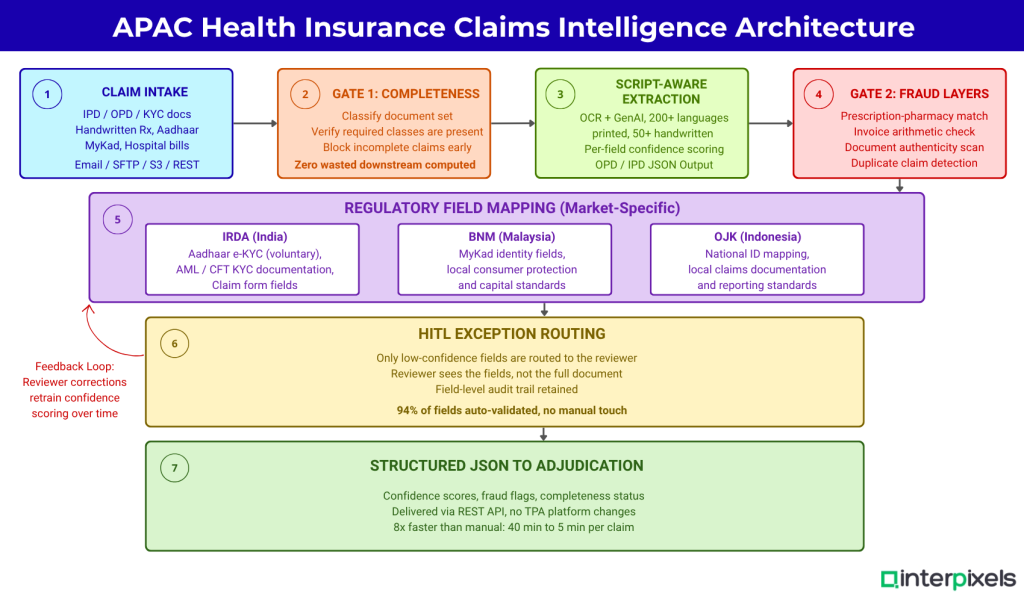
The diagram traces a claim from intake through completeness validation, script- and format-specific extraction, regulatory field mapping across IRDA, BNM, and OJK, human review of low-confidence fields, and structured output. Each gate blocks incomplete or high-risk submissions before they consume downstream processing resources. The feedback loop from human review retrains confidence scoring over time.
What purpose-built claims intelligence actually does differently
Purpose-built platforms validate completeness, extract with document-specific models, and route only uncertain fields to humans. InterPixels AI, a claims intelligence API built specifically for APAC health insurance TPAs, illustrates the architecture difference. It processes IPD, OPD, and KYC submissions across 40 or more health insurance document types, covering both printed and handwritten formats across 200 or more languages for printed text and 50 languages for handwriting.
The platform applies a two-gate validation model. Gate 1 checks completeness at intake, blocking incomplete submissions before they consume processing resources. Gate 2 extracts structured data and applies three real-time fraud detection layers: prescription-pharmacy cross-validation, invoice arithmetic verification, and document authenticity analysis. Only low-confidence fields route to a human reviewer, who sees the specific field in question rather than the whole document.
In a production deployment with TrueCover India across more than 15,000 claims, this architecture cut per-claim processing time from 40 minutes to 5 minutes, an eight-times improvement, while automatically validating 94 percent of fields without manual review. That result did not come from a bigger language list. It came from training on the actual document mix, format variance, and fraud patterns of APAC health insurance claims specifically, then deploying via REST API with no changes to the TPA’s existing platform.
Evaluating a claims automation vendor: what to ask
The right evaluation question is not “how many languages” but “which document types, at what confidence, on which claim category.” Ask any vendor for accuracy figures broken out by document type and script, not an aggregate language count. Ask whether regulatory field mapping for your specific market is pre-built or a custom implementation project. Ask how exceptions are routed and whether reviewers see full documents or isolated fields.
| Option | Key Strength | Best Used When |
|---|---|---|
| Generic Western IDP platforms | Broad enterprise document handling, strong on typed English forms | Claims volume is low, documents are mostly typed, single-market operation |
| Open-source multilingual OCR (self-hosted) | No licensing cost, full control over deployment | Team has ML engineering capacity to fine-tune and maintain accuracy on local scripts |
| Purpose-built APAC claims intelligence API | Native handling of handwriting, regional ID formats, and multi-regulator field mapping | TPA processes high-volume health insurance claims across multiple APAC markets |
Pull quote: Buying claims automation for APAC health insurance without asking about document-type accuracy is buying a demo, not a deployment.
Frequently Asked Questions
Why do Western OCR tools fail on Indian and Southeast Asian health insurance documents? Western OCR tools are trained primarily on typed English documents and Western identity formats. They rarely see Aadhaar cards, MyKad, or handwritten vernacular prescriptions during training, so accuracy drops sharply on the exact documents APAC TPAs process daily.
What is the difference between IRDA, BNM, and OJK claims requirements? IRDA governs India’s insurance KYC and claims rules, BNM governs Malaysia’s, and OJK governs Indonesia’s. Each defines different mandatory fields, KYC thresholds, and documentation standards, so a single extraction schema cannot serve all three markets without market-specific mapping.
Can general-purpose multilingual OCR handle handwritten medical prescriptions? Most general-purpose OCR tools handle printed text well but struggle with handwriting, especially mixed-script handwriting common in APAC prescriptions. Purpose-built systems trained specifically on handwritten Indic and Southeast Asian scripts perform meaningfully better on this document type.
What does purpose-built health insurance claims automation actually mean? It means the platform is trained on the specific document types, ID formats, languages, and claim categories that health insurance TPAs process, rather than adapted from generic enterprise document automation built for a different industry or region.
How long does it take to deploy claims automation for a TPA? Purpose-built API-based platforms can deploy in four to six weeks with no changes to the TPA’s existing system, since they integrate via REST API and return structured JSON output rather than requiring a platform migration.
The document is the decision point, not the afterthought
Three things are true at once. APAC health insurance TPAs process a document mix that Western-trained OCR has rarely seen. Regulatory requirements vary by market in ways a single schema cannot absorb. And the tools built for this specific complexity outperform generic platforms on the metrics that matter: fields auto-validated, minutes per claim, and exceptions caught before settlement.
The question for any TPA evaluating claims automation is not whether AI works for health insurance claims. It clearly does. The question is whether the AI was built for the claims your TPA actually receives.
Table of Content