
InsurTech India Case Study: 8x Faster Health Insurance Claims2026-05-17T12:04:29+08:00

Case Study · Health Insurance Claims Automation

How a leading InsurTech services provider cut claim adjudication time by 8× using InterPixels AI.

Client : Leading InsurTech Services Provider, India

Sector : Health Insurance – TPA Claims Automation

Integration : AWS S3 + REST API

InterPixels AI Case Study InsurTech

Client Background

A high-volume health insurance claims operation demanding intelligent automation

The client is a leading InsurTech services provider in India, delivering end-to-end claims technology and managed services to health insurance Third-Party Administrators (TPAs). At the core of their business is claims adjudication , reviewing, classifying, and processing a continuous volume of In-Patient Department (IPD) and Out-Patient Department (OPD) health insurance claims submitted by policyholders and hospitals.

With claim volumes in the tens of thousands per month, the client manages both Reimbursement and Cashless claim types, each arriving as multi-page document packages across heterogeneous formats , scanned PDFs, handwritten prescriptions, digital hospital bills, lab reports, and KYC documents. The scale, document diversity, and time-sensitivity of this work made manual adjudication operationally unsustainable.

InterPixels AI case study challenges tpa

The Challenge

Manual adjudication could not scale with document complexity or claim volumes

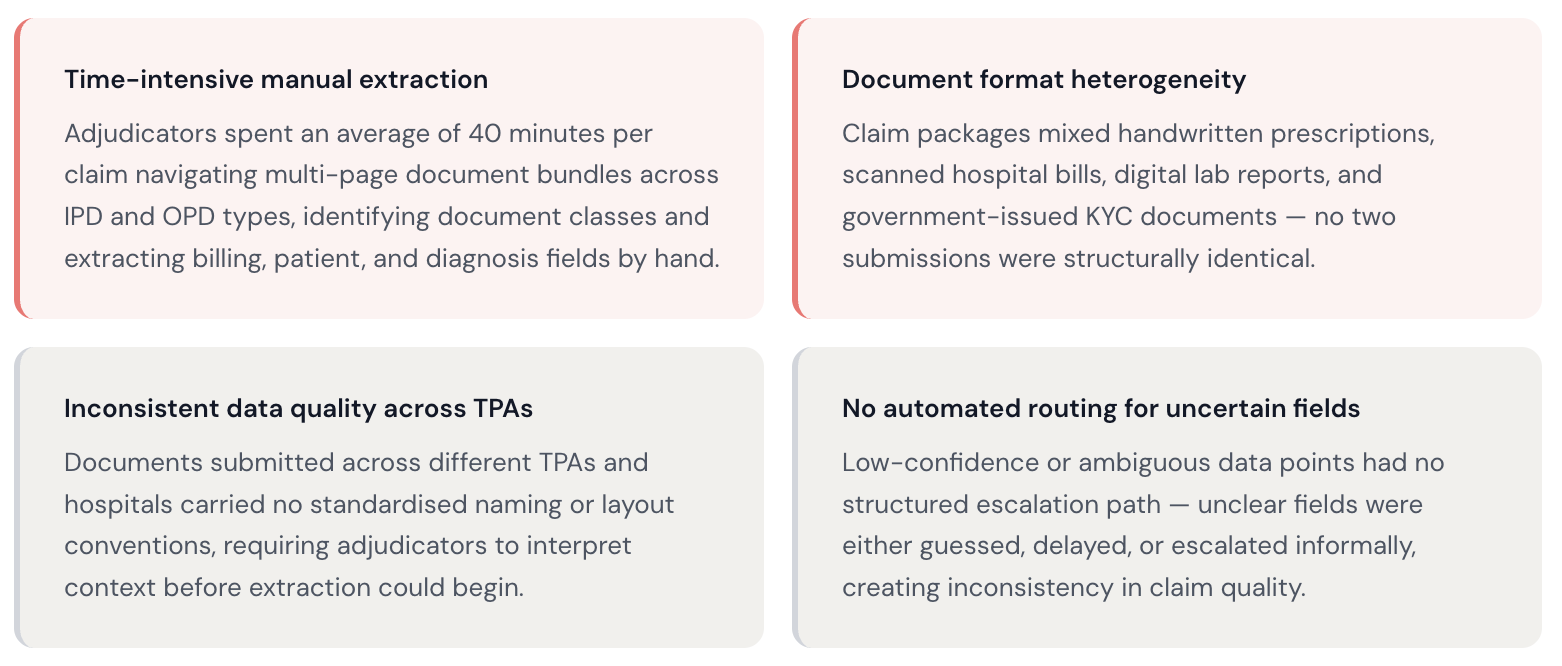
Every claim arriving at the client’s platform carried a unique challenge. OPD claims averaged 20 pages; IPD claims averaged 50 pages , each requiring a skilled adjudicator to manually open, read, classify, cross-reference, and extract data from every document before any decision could be made.
InterPixels AI Case Study InsurTech Challenge

The Solution

An API-first claims intelligence layer integrated directly into the existing workflow

The client integrated InterPixels AI’s Claims Intelligence API into their existing claims platform via AWS S3 and REST API , with no changes to their core TPA system. Claim document packages are deposited into an AWS S3 bucket, triggering the InterPixels processing pipeline automatically. Results are returned as structured JSON, ready for direct ingestion into the client’s claims portal.

The InterPixels pipeline handles both IPD (25 document classes) and OPD (15 document classes) claim types, across Reimbursement and Cashless categories. OCR with Deep Learning and Large Language Models handles handwritten, scanned, and digital documents consistently , adapting to the format variations typical of Indian health insurance submissions.
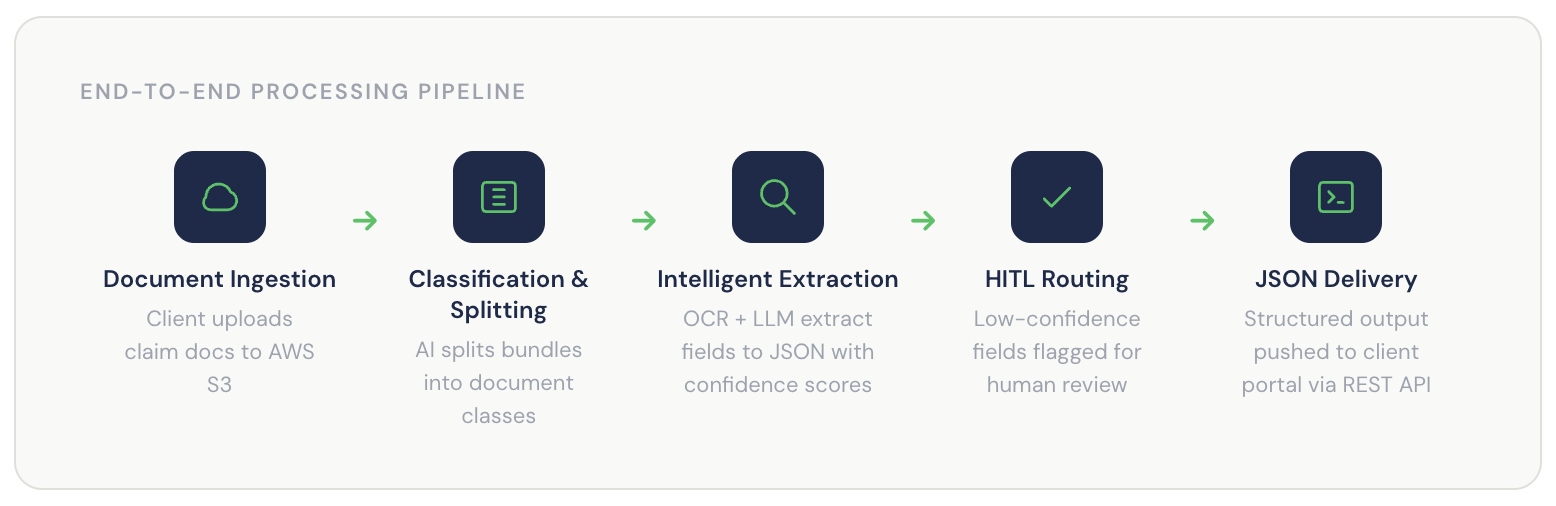
InterPixels AI End to End Processing Pipeline
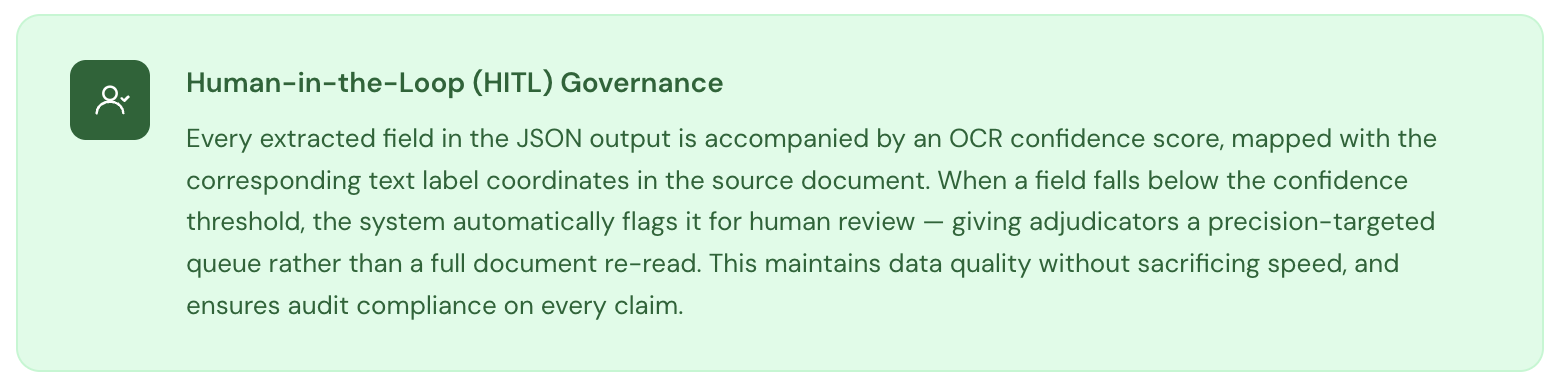
InterPixels AI Human in the Loop (HITL) Governance

Scale & Volume

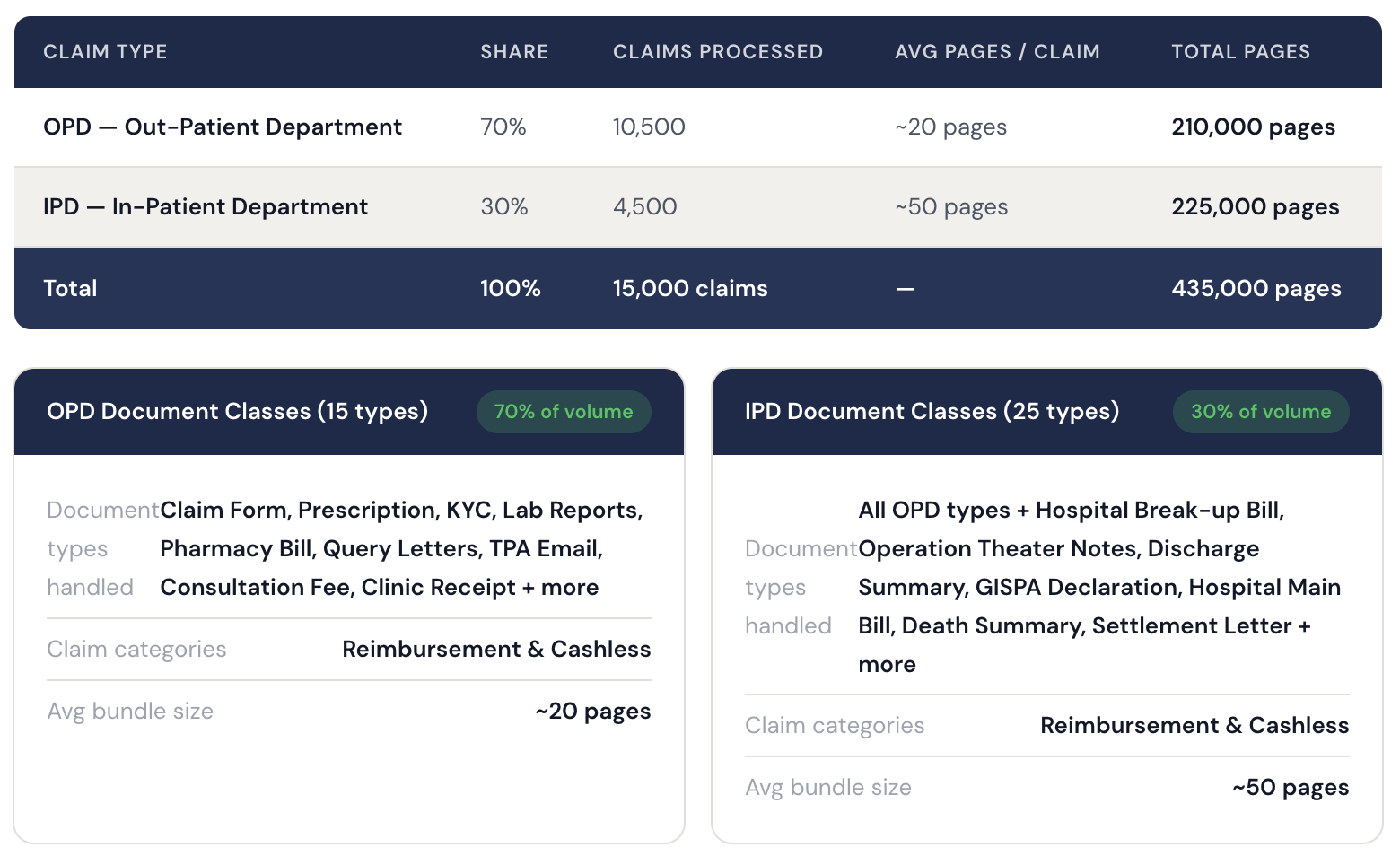
15,000 claims. 435,000 document pages. Processed in one month.

Across a single month in production, the InterPixels API processed 15,000 health insurance claims for the client’s TPA base , spanning both OPD and IPD claim types at significant document volume.
InterPixels AI Scale and Volume Case Study

Results

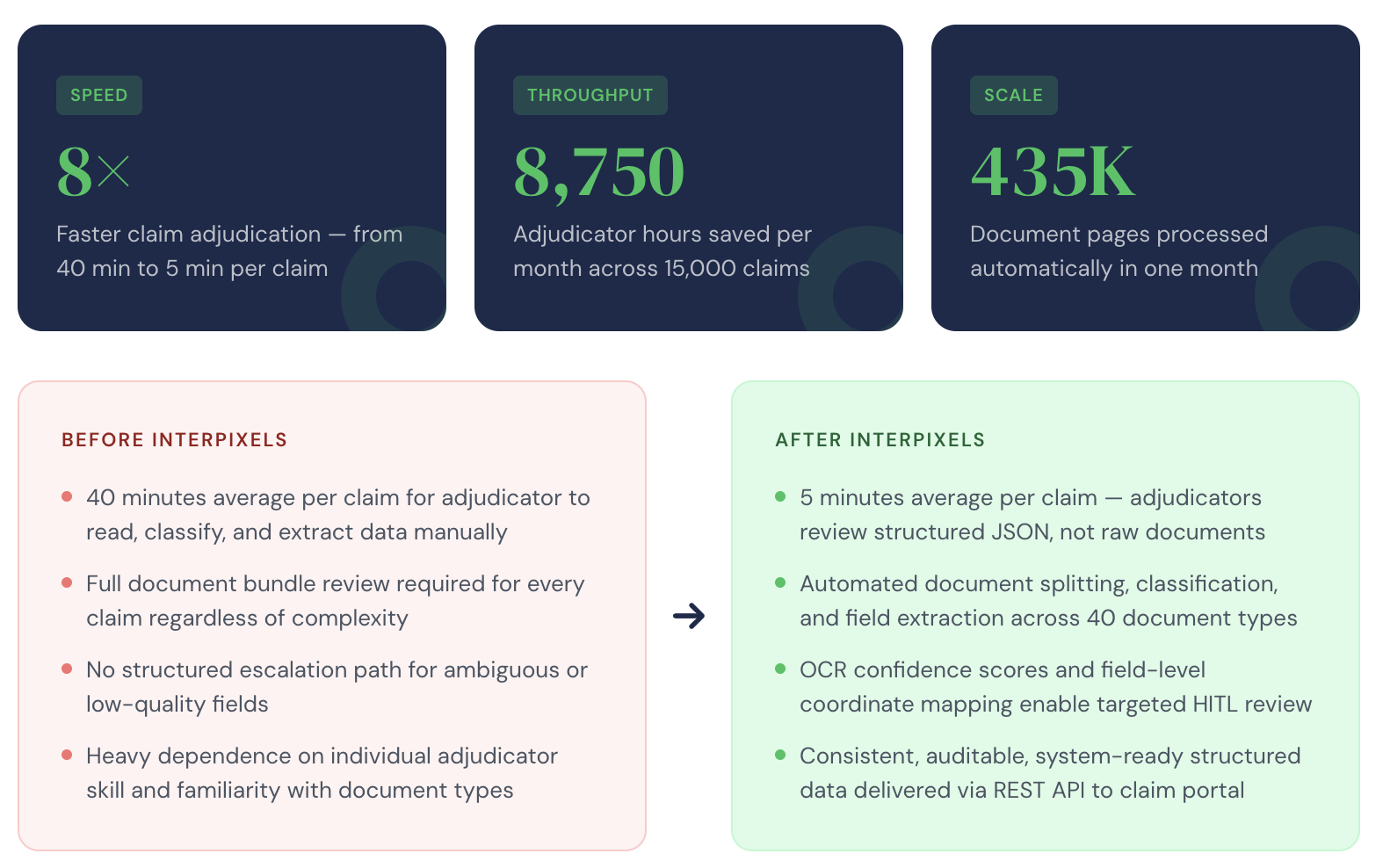
From 40 minutes to 5 minutes, an 8× reduction in claim adjudication time

The impact of the InterPixels AI integration was measurable from the first month of production. With document classification, data extraction, and confidence-flagged routing handled automatically, adjudicators no longer read entire claim bundles, they reviewed pre-structured JSON outputs, resolving only the fields that required human judgement.
InterPixels AI Results Case Study
COMMON QUESTIONS

Frequently asked by TPA decision makers

Yes, AI claims automation is proven in the Indian health insurance market at production scale. InterPixels AI processed 15,000 health insurance claims and 435,000 document pages in a single month for a leading InsurTech services provider in India, covering both IPD and OPD claim types across Reimbursement and Cashless categories. The deployment reduced claim adjudication time from 40 minutes to 5 minutes per claim, an 8x improvement, without any changes to the client's existing TPA platform. The system handled the full range of document formats common in Indian health insurance submissions, including scanned PDFs, handwritten prescriptions, digital hospital bills, lab reports, and KYC documents, across a continuous high-volume claims operation with tens of thousands of monthly submissions.
AI handles handwritten prescriptions in Indian health insurance claims using OCR combined with Deep Learning models trained on the handwriting styles, regional language scripts, and medical abbreviations common across Indian doctor-written prescriptions. Standard OCR fails on handwritten Indian prescriptions because it cannot interpret inconsistent letterforms, regional language scripts, or abbreviated drug names written differently across states and specialties. InterPixels AI applies Deep Learning and Large Language Models to read the prescription as a document with context, not just as a sequence of characters. Drug names, dosages, quantities, and prescribing doctor details are extracted with per-field confidence scores. Fields where handwriting is ambiguous are automatically routed to a human reviewer rather than passed through with a potentially incorrect value.
Indian health insurance claims are among the most document-complex in Asia-Pacific for three reasons. First, document volume per claim is high: OPD claims average 20 pages and IPD claims average 50 pages, requiring classification and extraction across every page before adjudication can begin. Second, format heterogeneity is extreme: scanned PDFs, handwritten prescriptions, digital hospital bills, and KYC documents arrive within the same claim bundle with no consistent formatting standard. Third, language diversity is significant: prescriptions and clinical notes are written across multiple Indian regional language scripts alongside English. Each of these factors individually challenges standard automation tools. Combined within a single claim submission, they make rule-based OCR systems unreliable and require Deep Learning and Large Language Models to process accurately.
Manual health insurance claims adjudication becomes unsustainable at scale because the time required per claim does not decrease as volume increases. Every claim requires a skilled adjudicator to manually open, read, classify, cross-reference, and extract data from every document in the bundle before any decision can be made. For OPD claims averaging 20 pages and IPD claims averaging 50 pages, this consumed an average of 40 minutes per claim before adjudication even began. At tens of thousands of claims per month, the upstream document work alone required a team operating continuously at full capacity with no tolerance for absence, error, or volume spikes. Headcount could not scale fast enough to match claim volume growth, making operational collapse a structural inevitability rather than an edge case.
AI fundamentally changes the adjudicator's role from document reader to decision maker. Before AI claims automation, adjudicators spent the majority of their time opening claim bundles, sorting documents, entering data manually, and cross-referencing fields across multiple pages before reaching the actual adjudication decision. With InterPixels AI in production, adjudicators no longer read entire claim bundles. They receive pre-structured outputs containing all extracted fields, confidence scores, and flagged anomalies, and they review only the fields that require human judgement. This shift concentrates adjudicator time on decisions rather than document processing. The result is that the same team can adjudicate significantly higher claim volumes without additional hires, while maintaining the human oversight required for regulatory compliance and audit readiness.
Yes, AI claims processing is reliable enough to handle tens of thousands of health insurance claims per month at consistent accuracy. InterPixels AI processed 15,000 claims and 435,000 document pages in a single month in production for a leading Indian InsurTech services provider, maintaining processing times of three to five seconds per document regardless of volume. Reliability at this scale depends on three system properties: parallel processing via REST API so submissions do not queue sequentially, per-field confidence scoring so uncertain extractions are flagged rather than silently passed through, and Human-in-the-Loop routing so low-confidence fields reach a human reviewer before the claim proceeds. Together these properties ensure that high volume does not compromise accuracy and that every claim is accounted for, processed or flagged, with no silent failures.
AI manages large multi-page health insurance claim bundles by processing every page in parallel rather than sequentially, eliminating the linear time cost that makes manual processing of high-page-count claims slow. In production, InterPixels AI handled IPD claim bundles averaging 50 pages per claim and OPD bundles averaging 20 pages, across 15,000 claims in a single month. Each page is individually classified against a library of 40-plus document classes, then grouped with other pages of the same document type before field extraction begins. This means a 50-page IPD bundle is not processed as a single sequential document but as a structured collection of classified pages, each processed according to the extraction rules for its specific document class. The result is consistent processing time regardless of bundle size.
Traditional OCR extracts text character by character from printed documents and fails on handwritten content, mixed formats, and context-dependent fields. AI claims processing uses OCR as the reading layer but adds Deep Learning and Large Language Models on top to understand what each document is, what each field means in context, and whether the extracted values are consistent with each other. For health insurance, this distinction is critical. A traditional OCR system can read the characters on a prescription but cannot verify whether the quantity matches the pharmacy bill, whether the drug name is clinically plausible, or whether the document has been digitally altered. InterPixels AI performs all of these contextual validations concurrently during extraction, not as a separate post-processing step, making fraud detection and accuracy assurance simultaneous with data capture.
A TPA can see measurable results from AI claims automation within the first month of production deployment. In the InterPixels AI production case in India, the 8x reduction in claim adjudication time from 40 minutes to 5 minutes per claim was measurable from month one across 15,000 claims. The reason results appear quickly is that the integration does not require rebuilding existing workflows. InterPixels AI connects to the TPA's existing platform via AWS S3 or REST API, and claim documents begin flowing through the AI pipeline immediately after go-live. There is no parallel running period where manual and AI processing co-exist at full cost. From the first production claim, document classification, data extraction, and fraud validation are handled automatically, and adjudicators begin working from structured outputs rather than raw document bundles.
In practice, a health insurance AI claims automation deployment integrates as an API layer between the TPA's existing document intake channel and their claims management system, with no changes to the underlying platform. For the InterPixels AI production deployment in India, claim document packages were deposited into an AWS S3 bucket by the TPA's existing intake process. This deposit automatically triggered the InterPixels AI processing pipeline, which classified every document, extracted all required fields with confidence scores, ran fraud validation, and returned structured JSON to the client's claims portal within seconds. Adjudicators logged into the same claims portal they had always used and found pre-structured claim data ready for review rather than raw document bundles. From the adjudicator's perspective, the documents had already been read, sorted, and checked before they opened the claim.
Go to Top