
Two-gate claims validation is a claims processing architecture that separates document completeness checking from data extraction into two sequential stages. Gate 1 confirms every required document is present before any extraction begins. Gate 2 runs OCR and generative AI extraction only on claims that pass Gate 1, returning structured JSON with per-field confidence scores. This staging protects both extraction accuracy and compute spend.
Why Claims Intake Needs Two Separate Checks
TPAs across India, Malaysia, Indonesia, Singapore, Thailand and the Philippines process thousands of health insurance claims a week, each bundled with a different mix of prescriptions, hospital bills and discharge summaries. Running full extraction on every submission wastes compute the moment a required document is missing. Two-gate claims validation solves this by splitting the pipeline into a completeness gate and an extraction gate. Deloitte’s 2026 Global Insurance Outlook points to real margin pressure heading into 2026, which is exactly the kind of pressure that pushes claims operations toward staged automation instead of a single monolithic pass. For a TPA CTO evaluating a claims intelligence API, understanding what happens at each gate is the fastest way to judge whether the architecture will hold up in production.
What Problem Does Completeness Validation Solve?
Completeness validation checks that every required document for a claim type is present before extraction starts. It blocks incomplete submissions so extraction resources are never spent on claims that cannot be adjudicated anyway.
In practice, this is the job of a “Gate 1” or Sentinel-style stage. Incoming files are auto-rotated, dewarped and cropped, then classified against a fixed list of document classes for the claim type. IPD claims typically require up to 25 document classes, including discharge summaries and hospital break-up bills. OPD claims need up to 15, including prescriptions, lab reports and consultation receipts. If a required document is missing, the claim is blocked and a specific list of missing documents is returned immediately, before a single field gets extracted.
This isn’t a theoretical concern. Fullerton Health’s AI team, which runs claims document pipelines across nine APAC markets, found that document classification has to run first because it determines which extraction schema applies and whether a claim is complete enough to proceed (Cheng et al., 2026). Their production system reported 97% overall document-classification accuracy in testing, 93% in Singapore and 97% in Vietnam, across more than 4,000 multilingual claim documents. Get classification wrong, and every downstream extraction inherits that error.
A claim that is missing one document wastes the same compute as a complete one, and it still fails.
How Does Gate 2 Extract Data From Claim Documents?
Gate 2 runs OCR and generative AI extraction on every document in a claim that has already passed completeness validation, returning a per-field confidence score for each extracted value.
The extraction engine processes each document, identifies its type, and reads every required field in a single pass, handling printed forms, low-quality scans and handwritten prescriptions across dozens of languages. Gartner’s inaugural Magic Quadrant for Intelligent Document Processing Solutions evaluated 18 vendors in this newly formalized category, a sign IDP has moved from a niche tool into a real procurement decision for enterprise buyers. McKinsey’s 2025 research on AI in insurance describes a comparable “AI-powered decision-making layer” that improves claims accuracy by evaluating adjuster notes, damage images, documents and claim histories together, rather than as separate manual steps (McKinsey, 2025). The Fullerton Health pipeline cited above combines a multilingual OCR engine with a compact vision-language model and reports field-level extraction accuracy of 87% in Singapore and 75% in Vietnam, at under two seconds per document, a useful benchmark for what a production-grade Gate 2 should deliver.
Structured JSON is the output, not a PDF annotation or a spreadsheet. Every field arrives with a confidence value, a source document reference, and enough metadata for a downstream adjudication system to consume it without reformatting.
The Two-Gate Architecture End to End
A claim moves through four stages: ingestion, Gate 1 completeness validation, Gate 2 extraction and fraud detection, and structured output delivery.
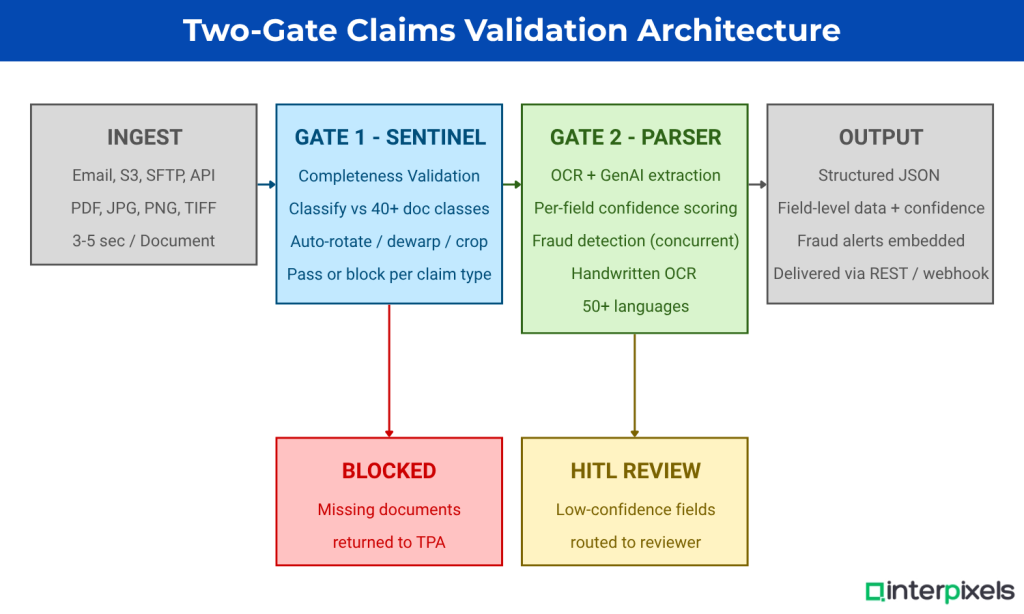
The diagram traces a claim from multi-channel ingestion through Gate 1 Sentinel, which blocks incomplete submissions, into Gate 2 Parser, which extracts fields and runs fraud checks concurrently, and finally into structured JSON delivered to the TPA’s adjudication system. Arrows mark the one-way flow; only claims that pass Gate 1 ever reach Gate 2.
Which Validation Approach Fits Your Claims Volume?
| Option | Key Strength | Best Used When |
|---|---|---|
| Rules-based OCR bolted onto the core system | Cheap to pilot, no new vendor relationship | Claim volume is low and document formats rarely change |
| Generic single-pass IDP platform | Broad document-type coverage, fast to configure | Documents are mostly typed, single-language, and completeness is rarely an issue |
| Purpose-built two-gate claims API | Blocks bad submissions before compute is spent; fraud checks run inside extraction | Claim volume is high, documents are multilingual and handwritten, and audit trails are a regulatory requirement |
How Does Confidence-Based Routing Avoid Full Manual Review?
Per-field confidence scoring lets a Human-in-the-Loop layer route only the specific fields a system is unsure about, not the whole document, to a reviewer.
A field from a clean printed invoice might carry 98% confidence and pass straight through. A field from a smudged handwritten prescription might carry 87% and get flagged, with the relevant image region highlighted for the reviewer. This is the mechanism behind claims like “94% of fields auto-validated” that vendors advertise: it is a direct function of how well the confidence model separates trustworthy extractions from risky ones. Recent research on LLM-based field extraction backs this up empirically. A multi-signal confidence engine combining OCR grounding, spatial layout and cross-call agreement reached 99.1% automated accuracy at 80% coverage on a 55-field invoice benchmark, a 25.8-point improvement over the benchmark’s uncalibrated base accuracy rate (Kumar, 2026).
Reviewers should see only the fields a system is unsure about, never the whole document.
PwC’s research on the insurance workforce notes that automation of claims intake is already starting to eliminate entry-level roles that once existed to do exactly this kind of manual review. That shift only works safely if the routing logic underneath it is precise, not just fast.
How Does The Architecture Stop Fraud Before Settlement?
Fraud detection that runs inside Gate 2, concurrently with extraction, catches irregularities before a claim ever reaches an adjudicator rather than after payment.
Three checks are typical. Prescription-pharmacy cross-validation compares prescribed drug quantities against pharmacy billing line items to catch mismatches. Invoice arithmetic validation sums extracted line items and compares the total against the stated amount, catching invoices where the printed total doesn’t match its own components. Document authenticity analysis looks for editing artifacts and mismatches between a passport’s machine-readable zone and its printed fields, a detection problem that recent survey work on identity document forgery treats as an active research area with a persistent gap between benchmark accuracy and real deployment conditions (Das et al., 2026).
A duplicate-claim check runs alongside these, comparing patient, date, hospital and amount against previously processed claims within the same account. Because this all happens during extraction, not as a separate downstream audit step, the fraud alert and the evidence for it land in the same structured JSON output the adjudicator already sees.
What Should CTOs Check Before Adopting a Two-Gate Claims API?
Look for REST-first integration, SDK support for the languages your team already uses, and a realistic go-live timeline, typically four to six weeks from API access to production for a well-scoped deployment.
In practice, teams building this kind of pipeline in-house typically underestimate how much of the effort sits in Gate 1, not Gate 2. Document classification against 40-plus document classes, multilingual OCR, and confidence calibration are each substantial engineering problems on their own. Open-source components exist for parts of this: PaddleOCR for multilingual text recognition, Docling for layout and table structure, Label Studio for the human-review interface. Assembling and tuning them into a compliance-grade pipeline is a different scope of work than deploying a purpose-built API.
Pilot-stage tooling and production-grade tooling are not the same purchase.
BCG’s research on AI adoption in insurance found only 7% of insurers have successfully scaled an AI system past the pilot stage. The gap is rarely the model. It’s the surrounding architecture: completeness checks, confidence calibration, audit trails and fraud logic that a pilot script never had to handle.
Frequently Asked Questions
What is Gate 1 in claims validation? Gate 1 is the completeness validation stage every incoming claim passes through before extraction. It classifies submitted documents against the required set for that claim type and blocks submissions that are missing a required document, returning the specific gaps immediately.
What is Gate 2 in claims validation? Gate 2 is the extraction stage that runs only on claims that already passed Gate 1. It uses OCR and generative AI to read every field in every document, returns per-field confidence scores, and runs fraud checks concurrently before output is delivered.
Why not process claims in a single pass? A single pass wastes extraction compute on submissions that turn out to be incomplete and reduces the precision of each check. Staging lets Gate 1 solve the structural problem first, so Gate 2 runs extraction knowing the document set is already confirmed complete.
What is HITL in claims processing? Human-in-the-Loop is a governance layer where fields extracted below a confidence threshold are automatically routed to a human reviewer instead of passing straight through. Reviewers see only the flagged fields, not the entire document, with the source region highlighted for context.
How long does claims extraction take with a two-gate API? Structured JSON output is typically delivered within seconds per document once a claim passes Gate 1. Manual document review, by comparison, commonly takes 30 to 45 minutes per claim before adjudication can even begin.
The Gates Matter More Than The Model
Three things distinguish a production-grade claims validation architecture from a pilot. First, completeness has to be checked before extraction ever runs, or compute gets wasted on submissions that can’t be adjudicated. Second, confidence scores only help if they route specific fields to reviewers, not entire documents. Third, fraud detection belongs inside extraction, not bolted on as a separate audit step afterward.
If your team is evaluating a claims intelligence API, ask exactly where completeness checking happens in the pipeline and how confidence thresholds were validated, not just what the headline accuracy number is.
Table of Content