Claims Intelligence API for Health Insurance TPAs2026-05-17T23:29:12+08:00

Claims Intelligence API

Claims Intelligence API for Health Insurance TPAs

No UI changes to your TPA platform required. Simple REST API integration.

  • REST API-token-based auth, webhook callbacks
  • SDK support: Python • Node.js • Java • REST
  • Multi-source ingest: Email, AWS S3, SFTP, API
  • Formats: PDF, JPG, PNG, TIFF
  • Integration: 4–6 weeks from API access to production
interpixels data extraction api tpa

HOW IT WORKS

Follow a Claim Through InterPixels AI

From document upload to structured JSON ready for your TPA system, every step automated, every fraud type caught.

INGEST

Document Upload

Claims arrive via multiple channels. Avg. 3–5 seconds per document.

*Email, AWS S3, SFTP, REST API

*PDF, JPG, PNG, TIFF supported

*Multi-page PDFs auto-split

*Webhook callbacks for async

GATE 1 – SENTINEL

Completeness Validation

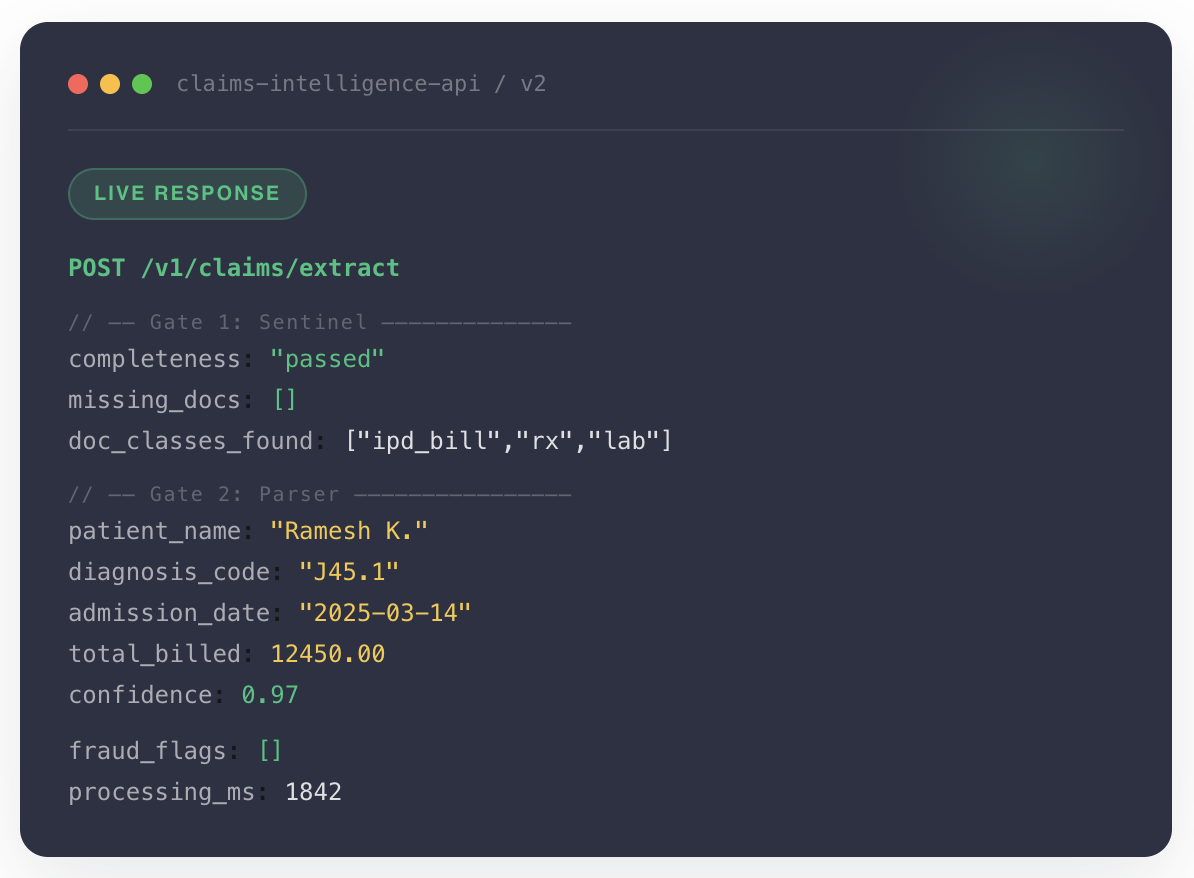
Validates required documents are present. Blocks incomplete submissions before extraction begins.

*Auto-rotate, dewarp, crop

*Missing document detection

*Pass / block per claim type

*40+ doc class coverage

GATE 2 – PARSER

Extraction & Fraud Detection

Claim Intelligence API extracts all fields with per-field confidence scoring. *High classification accuracy *Handwritten OCR (50+ languages) *Reduced number of claims to HITL *Fraud detection at extraction

OUTPUT

TPA System

Structured JSON delivered to your TPA platform via REST API in seconds.

*Field-level data + confidence

*Fraud alerts embedded

*Webhook delivery

*Zero reformatting required

Fraud intelligence

Real Fraud Detection Examples

InterPixels AI detects fraud patterns, before claims are paid. See how different fraud types are caught automatically.

Rx Mismatch

SCENARIO 1

Prescription – Pharmacy Mismatch

Ahmad bin Abdullah.

Prescription: Paracetamol 10 tablets.

Pharmacy bill: Paracetamol 30 tablets.

Quantity mismatch detected: Prescribed 10, billed 30.

Arithmetic

SCENARIO 2

Invoice Arithmetic Error

Line items:

Medicine SG$45 + Consultation SG$60 + Lab SG$80 = Subtotal SG$185.00.

Stated total: SG$215.00.

Arithmetic mismatch: line items sum to SG$185, total claims SG$215.

KYC Tamper

SCENARIO 3

KYC Document Tampering

Passport:

Name ✓ DOB ✓

Photo ✓ Signature ✓

Nationality ✓

Mismatch between MRZ and visible data

Duplicate

SCENARIO 4

Duplicate Claim Detection

Patient: Wong Li Ming.

Date: Feb 15, 2025.

Hospital: Mount Elizabeth. Amount: SG$450. Identical claim submitted a second time.

Duplicate claim: same patient, date, hospital, amount.

Multi-language OCR

Same Prescription, 50+ Languages

Process handwritten prescriptions across Asia-Pacific markets with the high accuracy.

96%

Confidence

Hindi

पेरासिटामोल 500mg

97%

Confidence

Bahasa Indonesia

Parasetamol 500mg

94%

Confidence

Thai

พาราเซตามอล 500mg

95%

Confidence

Tamil

பாராசெட்டமால் 500mg

98%

Confidence

Tagalog

Paracetamol 500mg

93%

Confidence

Mandarin

扮热息痛 500mg

COMMON QUESTIONS

Frequently asked by TPA decision makers

InterPixels AI extracts data from health insurance claim documents using a combination of OCR and Generative AI applied simultaneously across every document in the claim bundle. Once a claim passes Gate 1 completeness validation, the extraction engine processes each document, identifies its type, reads all required fields, and returns a per-field confidence score for every value. This applies to printed documents, low-quality scans, and handwritten prescriptions across 50-plus languages. The system understands document context, not just character patterns, correctly extracting diagnosis codes, drug quantities, and invoice totals within the same claim in a single pass. The output is structured JSON delivered to the TPA platform in three to five seconds per document, with no manual data entry required.
Gate 1 Sentinel is the completeness validation stage every incoming claim passes through before data extraction begins. It auto-rotates, dewarps, and crops all submitted documents, then classifies each file against 40-plus document classes to identify what is present and what is missing. If a required document is absent, for example a discharge summary missing from an IPD claim, Gate 1 blocks the submission and returns a specific list of missing documents to the TPA system immediately. Extraction only proceeds for claims that pass. Running full extraction on an incomplete submission wastes processing resources and produces unusable output. Gate 1 ensures that extraction resources are only consumed on claims that are structurally complete and ready for adjudication.
The two-gate architecture separates two distinct problems at claim intake. Gate 1 Sentinel solves the structural problem: is this submission complete and classifiable? Gate 2 Parser solves the intelligence problem: what does each document say and is the data consistent and fraud-free? Processing both in a single pass would waste extraction compute on incomplete submissions and reduce the precision of each validation layer. By staging the process, Gate 1 stops bad submissions early, and Gate 2 runs with full confidence that the document set is known, classified, and complete. This staging also improves fraud detection accuracy, as the extraction engine cross-validates across document types knowing the document inventory is definitive.
Prescription-pharmacy mismatch fraud is detected during Gate 2 extraction by cross-referencing fields extracted from the prescription against fields extracted from the pharmacy bill within the same claim. InterPixels AI reads the drug name, quantity, and dosage from the prescription, then compares those values against corresponding line items on the pharmacy invoice. If the pharmacy bill shows a higher quantity than prescribed, for example 30 tablets billed against a prescription for 10, the system flags a quantity mismatch automatically. The fraud alert is embedded in the structured JSON output returned to the TPA system, specifying the prescribed quantity, billed quantity, and source document references for each discrepancy. The claim is routed for human review before reaching the adjudication stage.
Invoice arithmetic fraud is detected by verifying that every line-item total on a hospital bill is mathematically consistent with the stated grand total. InterPixels AI extracts each individual line item, for example a medicine charge, consultation fee, and laboratory fee, sums them programmatically, and compares the result against the stated total printed on the document. If the stated total exceeds the sum of the extracted line items, the system classifies this as an arithmetic mismatch and blocks the claim for manual verification. This type of fraud is common in manually prepared invoices where an inflated total is written while line items do not support it. The check runs at extraction time on every invoice, requiring no separate audit step.
KYC document tampering is detected during Gate 2 extraction through document authenticity analysis, running concurrently with field extraction on every identity document submitted with a claim. InterPixels AI analyses each document image for indicators of digital editing, including font inconsistencies within the same field, pixel-level artifacts around modified text regions, and mismatches between Machine Readable Zone data and human-readable fields on passports or identity cards. A discrepancy between MRZ data and printed fields, for example a date of birth differing between the barcode strip and the printed text, is a reliable indicator of manipulation. When tampering is detected, the specific field discrepancies are flagged in the fraud alert within the JSON output and the claim is routed for identity verification before settlement.
InterPixels AI supports handwritten OCR across 50-plus languages, with high-confidence performance across the Asia-Pacific markets it is purpose-built for. This includes Hindi, Bahasa Indonesia, Thai, Tamil, Tagalog, and Mandarin Chinese, which are the primary handwritten prescription languages encountered across India, Indonesia, Thailand, Malaysia, the Philippines, and Singapore. Every extracted value from a handwritten field is returned with a per-field confidence score, typically ranging from 93 to 98 percent in production deployments. Fields falling below the configured confidence threshold are automatically routed to a Human-in-the-Loop reviewer rather than passed through automatically, ensuring multilingual handwritten prescriptions are processed with the same accuracy and governance standards as printed documents.
The InterPixels AI Claims Intelligence API accepts claim documents in PDF, JPG, PNG, and TIFF formats, covering the full range of file types health insurance TPAs receive across APAC markets. Multi-page PDFs are split automatically at ingestion, with each page classified individually before being grouped into the correct document class. Documents can be submitted via four ingestion channels: direct REST API call, email, AWS S3 bucket, and SFTP. TPAs do not need to change how they receive documents from policyholders or hospitals, as InterPixels AI connects to whichever channel the TPA already uses. Webhook callbacks notify the TPA system when extraction results are ready. Average processing time from ingestion to structured JSON output is three to five seconds per document.
Duplicate claim detection works by comparing extracted key identifiers from each incoming claim, specifically patient name, treatment date, hospital name, and total claimed amount, against the same fields from previously processed claims within the same TPA account. When all four identifiers match an existing processed claim, the system classifies the submission as a duplicate and blocks it automatically before any settlement action is triggered. The duplicate fraud alert is embedded in the JSON output, with a reference to the original claim identifier it matches. This prevents the same claim submitted through multiple channels, for example by both email and direct API upload, from being paid twice. Detection runs at extraction time during Gate 2, before the duplicate claim ever reaches an adjudicator.
Per-field confidence scoring means every data field extracted from a claim document, including patient name, diagnosis code, prescribed medication, invoice amount, and date of admission, is returned in the JSON output alongside a numerical confidence value for that specific extraction. A field from a clean printed document may carry 98 percent confidence. A field from a low-quality handwritten scan may carry 87 percent. This enables precise Human-in-the-Loop governance: InterPixels AI routes only specific low-confidence fields to human reviewers, with the relevant document image region highlighted for the reviewer. The result is a complete audit trail showing which fields were extracted automatically, which were human-reviewed, and what decision was made, satisfying regulatory compliance requirements across APAC health insurance markets.
Go to Top