TPA Platform Integrations – Claims Intelligence API2026-05-15T23:46:29+08:00

TPA Integration

InterPixels AI Plugs Into Your Claims Stack, No Rip, No Replace, No Disruption

InterPixels AI is an API-first claims intelligence layer. It sits between your document intake and your claims management system , extracting, classifying, and returning structured data without requiring changes to your existing platform.
interpixels data extraction api tpa

Your Claims Stack

Your Existing Platform Stays. We Fit Around It.

Most integration projects fail because they demand platform migration. InterPixels does not. Your TPA system, your workflows, your adjudication logic,  untouched. We connect to what you already have and return clean, structured claim data into it. The only change your operations team notices is that documents stop requiring manual handling.

AI-Powered Data Extraction: How It Works and Why It Matters

Your Claims Documents

How Claims Documents Reach Us, Your Way

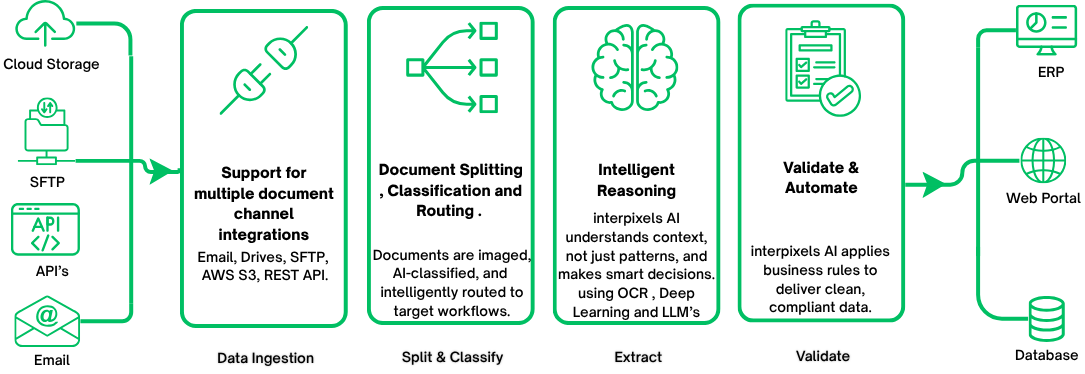
Documents enter the InterPixels pipeline through whichever channel your infrastructure already uses:

  • REST API – Send documents programmatically from your claims intake system
  • SFTP  – Drop document batches via scheduled file transfer
  • AWS S3  – Connect directly from your cloud storage bucket
  • Email Ingestion –  Forward claim document emails to a dedicated processing address
  • Webhook – Receive real-time callbacks when extraction is complete

No single method is mandatory. Most clients use one primary channel with a secondary fallback.
Interpixels Product Overview

Structured Data

How Structured Data Comes Back, Every Time

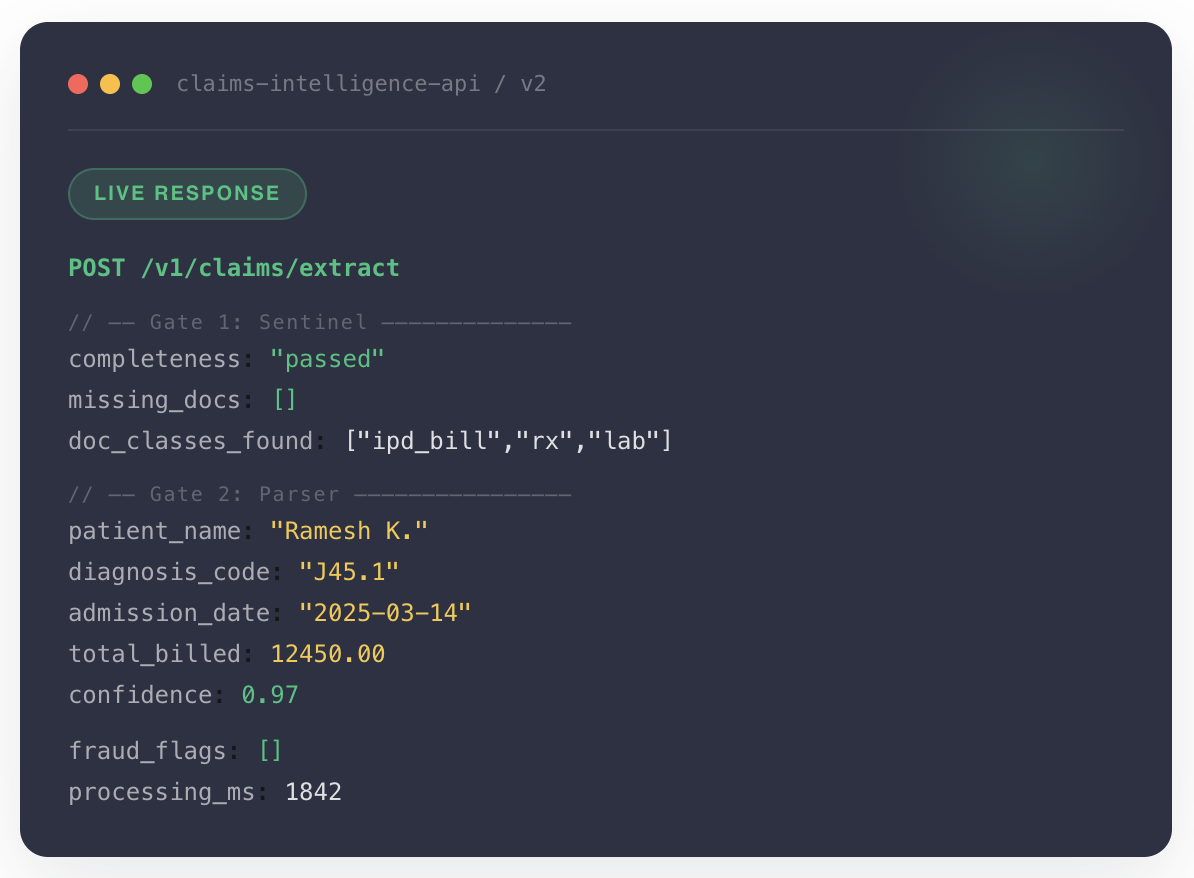
Every document processed returns a standardised JSON response. Fields are consistent across claim types , IPD, OPD, KYC , regardless of document format, language, or whether the source was handwritten, scanned, or digital. Your downstream system receives the same predictable data structure every time, ready for adjudication without manual reformatting.
Interpixels AI IDP workflow

Integration

What a Typical Integration Looks Like End-to-End

The diagram represents the standard flow. Variations exist for clients using batch SFTP versus real-time API, or those routing HITL exceptions to a validation queue before final output.
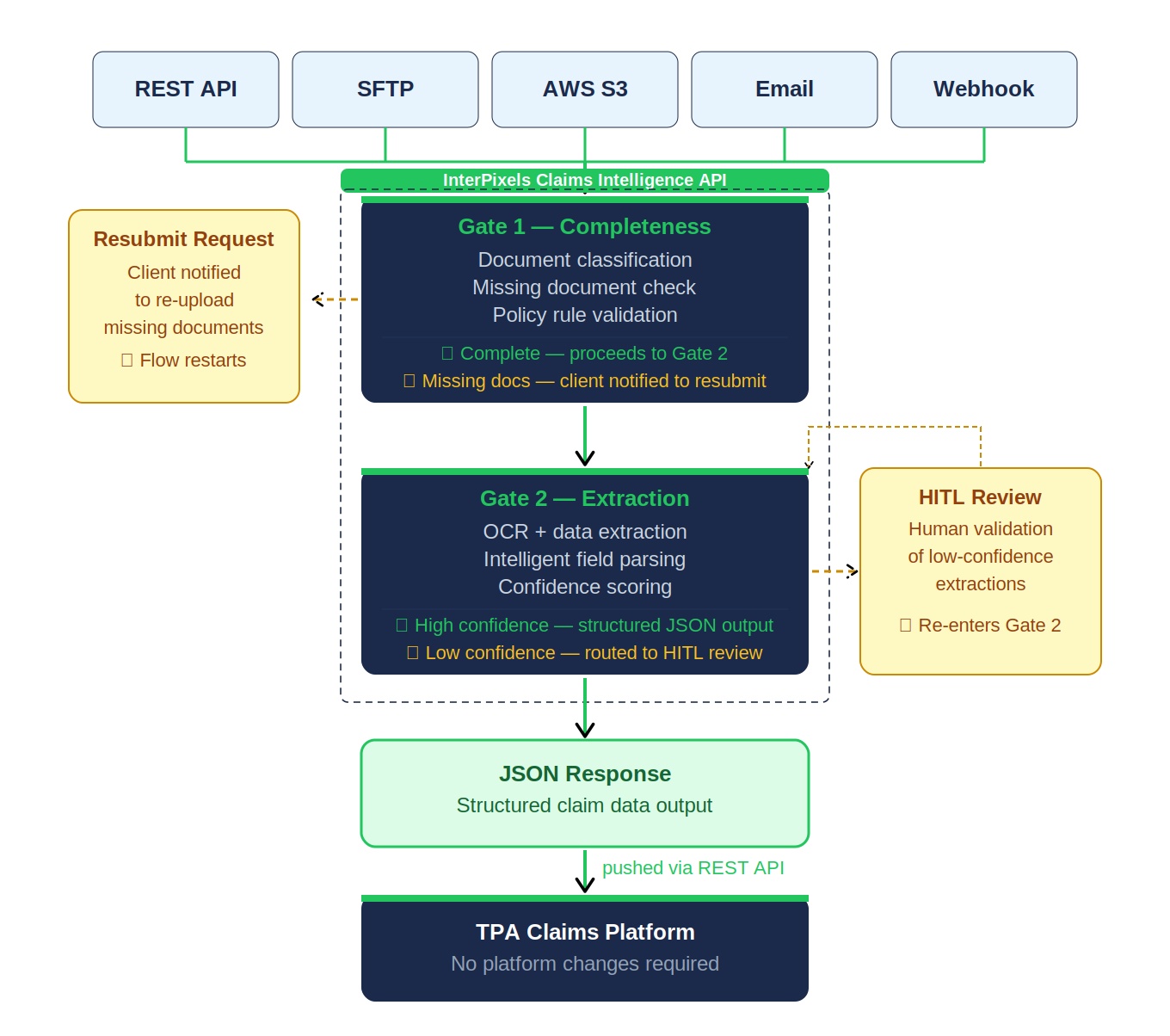
interpixels ai integration architecture TPA

Integration Journey

From Contract to Live Claims Processing, The Integration Journey

The integration scope varies by your existing infrastructure, document volumes, and internal IT capacity. InterPixels AI provides a dedicated integration engineer from kickoff through to production go-live. The stages are consistent across all clients:

  1. Document audit – We review your document types, formats, and language variations
  2. JSON schema definition – You confirm the output fields your system requires
  3. Sandbox configuration – Classification and extraction models aligned to your document set
  4. UAT and accuracy validation – Outputs tested against real claim samples
  5. Production deployment  – Live processing begins at agreed volume thresholds

Interpixels Claim Leakage in Health Insurance

Tech Team Scope

What Your Tech Team Actually Needs to Do, And What We Handle

Your team is responsible for:

  • Providing sample documents (minimum 50 per document class)
  • Confirming the JSON output schema your platform requires
  • Configuring the ingestion channel on your side (API credentials, SFTP keys, or S3 bucket access)
  • UAT sign-off before production

InterPixels handles:

  • Document classification model configuration
  • Extraction logic per your defined schema
  • HITL routing rules for low-confidence fields
  • Integration support through to go-live
  • Ongoing accuracy monitoring post-deployment
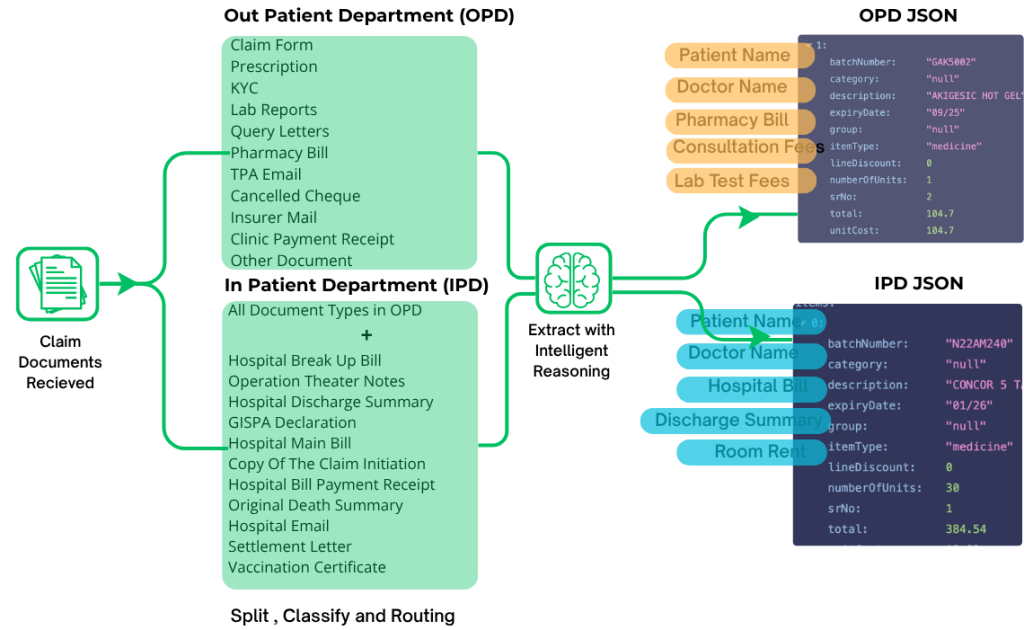
Interpixels AI Document Classifier Workflow

Security

Security, Data Residency & Compliance Considerations

Health insurance claim documents contain sensitive patient and financial data. InterPixels AI is built with this as a baseline assumption, not an afterthought.

  • Data encrypted in transit (TLS 1.2+) and at rest (AES-256)
  • APAC-region hosting available –  data does not leave your required jurisdiction
  • Token-based API authentication with role-level access controls
  • Audit trail on every document processed – timestamped, traceable
  • Data Processing Agreements available for enterprise and regulated clients

Full security documentation available on request.

InterPixels AI security complaince
COMMON QUESTIONS

Frequently asked by TPA decision makers

Intelligent document processing (IDP) in health insurance is the automated extraction, classification, and validation of data from claim documents, including hospital bills, prescriptions, discharge summaries, and KYC records. Instead of manual data entry, IDP uses OCR and Generative AI to read documents, identify document types, extract key fields with confidence scores, and flag anomalies for human review. For health insurance TPAs, IDP eliminates the upstream document burden that typically consumes the majority of claims processing time before adjudication even begins. InterPixels AI is purpose-built to deliver IDP specifically for health insurance claims.
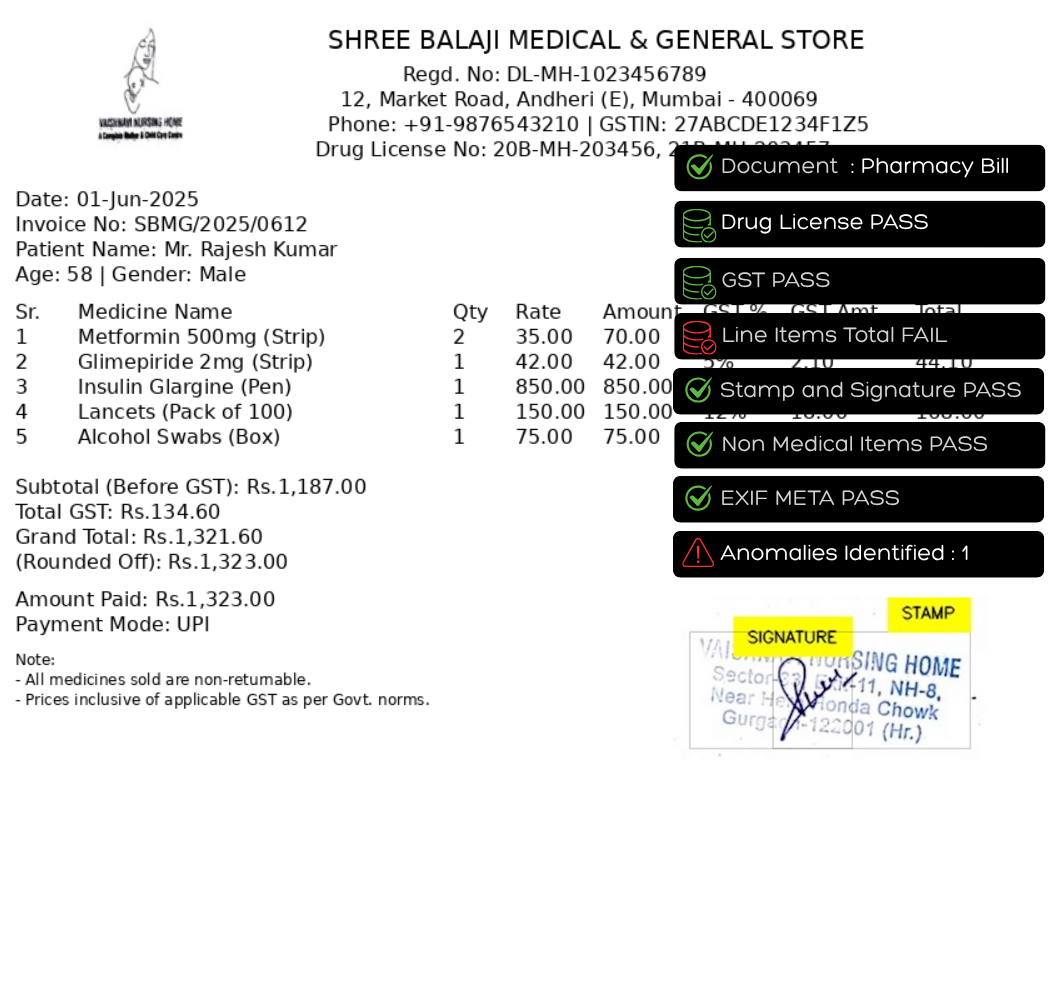
Claim leakage is financial loss from health insurance claims paid incorrectly, through overbilling, fraud, processing errors, or duplicate submissions that should have been caught during validation. It is one of the largest sources of avoidable cost for health insurance TPAs. InterPixels AI prevents leakage by applying three real-time validation layers during extraction: prescription-pharmacy cross-validation, invoice arithmetic verification, and document authenticity analysis. These checks run before any claim reaches an adjudicator, catching irregularities at the source and not after settlement.
IPD (In-Patient Department) claims cover medical treatment requiring hospital admission, including surgeries, overnight stays, and inpatient procedures. OPD (Out-Patient Department) claims cover outpatient consultations, pharmacy visits, diagnostic tests, and clinic treatments that do not require admission. IPD claims involve a larger and more complex document bundle, up to 25 document classes including discharge summaries, operation theatre notes, hospital bills, and GISPA declarations. OPD claims typically involve 15 document classes including prescriptions, pharmacy bills, lab reports, and consultation receipts. InterPixels AI processes both claim types fully automatically, classifying and extracting data from every document class in each category.
AI detects fraud in health insurance claims by applying validation logic during the data extraction process itself, not after. InterPixels AI runs three concurrent fraud detection layers on every claim. Prescription-pharmacy cross-validation compares prescribed medications against pharmacy dispensing records to catch quantity mismatches and phantom prescriptions. Invoice arithmetic validation verifies that all line-item totals are mathematically consistent and match stated amounts. Document authenticity analysis detects editing artifacts, font inconsistencies, and tampering indicators in KYC and financial documents. Duplicate claim detection identifies identical submissions across patient, date, hospital, and amount. All fraud flags are embedded in the structured JSON output returned to the TPA system, with specific fields and evidence cited for each alert.
Human-in-the-Loop (HITL) in insurance claims processing is a governance layer where an AI system automatically routes low-confidence field extractions to a human reviewer for verification, rather than processing them automatically. In InterPixels AI, when a field is extracted below a confidence threshold, such as an ambiguous handwritten amount or an unclear diagnosis code, that specific field is flagged and sent to a TPAs operations team member for review. The reviewer sees only the fields requiring a decision, not the entire document. Once confirmed or corrected, the claim proceeds. HITL ensures that human accountability is retained at every uncertain decision point, making the system audit-ready and aligned with regulatory compliance requirements in health insurance markets.
Manual health insurance claims processing typically takes 30 to 45 minutes per claim for document review, data entry, and validation before adjudication begins. With InterPixels AI, the same upstream document work takes under 5 minutes. In production deployment with TrueCover India, processing time was reduced from 40 minutes to 5 minutes per claim across 15,000+ claims, an 8x improvement. The reduction comes from eliminating manual document sorting, data entry, and spot-check validation, which are fully automated by the InterPixels AI Claims Intelligence API. Adjudication speed then depends on the TPAs internal workflows, but the document bottleneck is removed entirely.
A Third-Party Administrator (TPA) in health insurance is a company that manages the claims processing function on behalf of insurers, self-insured employers, or government health schemes. TPAs act as the operational layer between policyholders and insurers, receiving claim submissions, validating documents, extracting data, adjudicating claims, and managing settlement. TPAs handle large volumes of claims daily across multiple document types, languages, and claim categories including IPD, OPD, and KYC. InterPixels AI is purpose-built for health insurance TPAs, automating the upstream document intelligence work that consumes the majority of a TPAs operational capacity before any adjudication decision is made.
OCR (Optical Character Recognition) for handwritten medical prescriptions uses a combination of image preprocessing and AI models trained specifically on handwritten text to identify and extract characters, drug names, dosages, and quantities from doctor-written prescriptions. Unlike printed document OCR, handwritten prescription OCR must handle inconsistent handwriting styles, medical abbreviations, multilingual scripts, and low-quality scans. InterPixels AI is powered by Gemini OCR, which supports 50+ languages for handwritten text recognition. Prescriptions written across a wide range of languages and scripts are processed with the same extraction pipeline, with per-field confidence scores returned for every extracted value so that low-confidence fields are automatically routed to human review.
Completeness validation in health insurance claims is the process of checking that all required documents are present in a claim submission before data extraction begins. Different claim types, IPD, OPD, and KYC, require different document sets. A missing discharge summary, absent prescription, or incomplete KYC document will cause downstream delays or rejections if not caught at intake. InterPixels AI performs completeness validation at Gate 1, the first processing stage, classifying all submitted documents, identifying the claim type, and verifying that every required document class is present. Incomplete submissions are blocked and flagged with a list of missing documents before any extraction resources are consumed, preventing wasted processing on claims that cannot be adjudicated.
A claims automation API integrates with a TPA platform via a REST API connection that sits between the document intake channel and the TPAs existing claims management system. TPAs send claim documents to the API via email, SFTP, AWS S3, or direct REST call, and receive structured JSON output containing extracted fields, confidence scores, completeness status, and fraud flags. No changes to the TPAs existing platform, UI, or workflows are required. The structured JSON output is formatted to the TPAs own schema requirements, so it plugs directly into their adjudication workflow without reformatting. Integration requirements and timelines vary based on each client's existing platform architecture and technical environment. SDKs are available for Python, Node.js, and Java.
Go to Top