
A third-party administrator (TPA) in Indian health insurance is a licensed entity that processes claims, verifies documents, and manages settlement on behalf of insurers. Market research firm Next Move Strategy Consulting estimates India’s TPA market at $5.91 billion in 2023, projected to reach $9.29 billion by 2030, even as most claims processing remains manually intensive.
India’s health insurance TPA market is growing faster than its operations can keep up
India’s health insurance TPA market size in 2026 sits inside a $5.91 billion to $9.29 billion growth curve running through 2030, a 5.6% CAGR, according to market research firm Next Move Strategy Consulting (2026). This is a vendor market-size estimate rather than a government-published figure, so treat it as directional. What is independently verifiable is the claims side: IRDAI’s own FY24-25 Annual Report puts the overall incurred claims ratio across the non-life insurance industry at 82.88%, up from 82.52% the previous year, with aggregate net incurred claims rising 9.46% to roughly Rs 1.88 lakh crore according to the IRDAI Annual Report 2024-25. Volume is climbing. Manual processing has not kept pace.
More claims are entering the system every year than most TPA operations were built to absorb.
What the IRDAI FY24-25 numbers actually show
According to IRDAI’s own Annual Report 2024-25, general and health insurers settled about 87% of the health claims registered in their books during the year, repudiated roughly 8%, and had about 5% still pending as of March 31, 2025. That 8% repudiation rate, close to one in twelve claims, is most often tied to room-rent capping or non-medical expense exclusions rather than genuine coverage disputes, per the same IRDAI Annual Report 2024-25.
That gap between “settled” and “settled cleanly” matters. A claim that gets approved after multiple back-and-forth document requests still counts as settled, but it consumes far more TPA staff time than a straight-through approval. IRDAI issued its Master Circular on Health Insurance Business on May 29, 2024, which industry summaries describe as introducing a one-hour cashless pre-authorization window and a three-hour discharge approval window. This detail is worth a caveat: I could not locate the exact one-hour and three-hour figures directly in the IRDAI Annual Report text itself, only in secondary industry summaries, so treat the specific timelines as reported rather than independently confirmed.
Where the manual bottleneck sits in the claims lifecycle
Manual health insurance claims processing is commonly estimated at 30 to 45 minutes per claim for document review, data entry, and validation before adjudication even begins, a range that recurs across multiple intelligent document processing analyses, including a 2025 IDP study in the International Journal of Science and Research Archive. That range comes from industry analysis rather than a single authoritative benchmark, so it should be read as a working estimate.
TPAs handle IPD, OPD, and KYC documents across dozens of formats and, in India, several regional languages. None of that variability is a policy problem. It is a document intake problem, and document intake is where most of that processing time goes.
In practice, teams building claims intake pipelines typically find that the bottleneck is never the adjudication logic itself. It is getting clean, structured data out of a stack of scanned prescriptions, discharge summaries, and hospital bills before adjudication can even start.
The automation gap: India vs. the global benchmark
McKinsey’s claims research estimates that more than 50% of current claims activities could be automated by 2030, with straight-through processing becoming standard for routine claims according to McKinsey (2025). BCG frames the same shift as a structural “automation gap” that most insurers have not closed, even in mature markets, according to BCG Platinion (2026).
The global benchmark for claims automation by 2030 is straight-through processing as the default, not the exception.
India’s TPA sector is not there yet, and the reasons are structural rather than technological. Deloitte’s 2026 Global Insurance Outlook projects Asia-Pacific life premiums growing 5.3% annually through 2035, led by India, China, and Southeast Asia, according to Deloitte (2025). Growth at that pace without a parallel automation push simply pushes more volume through the same manual bottleneck.
Architecture of an automated claims intake layer
A production claims intake pipeline needs four components working together: multi-channel document capture, AI-based extraction and classification, automated validation against policy rules, and a human-in-the-loop layer for exceptions. The diagram below shows how these stages connect and where automation replaces manual review.
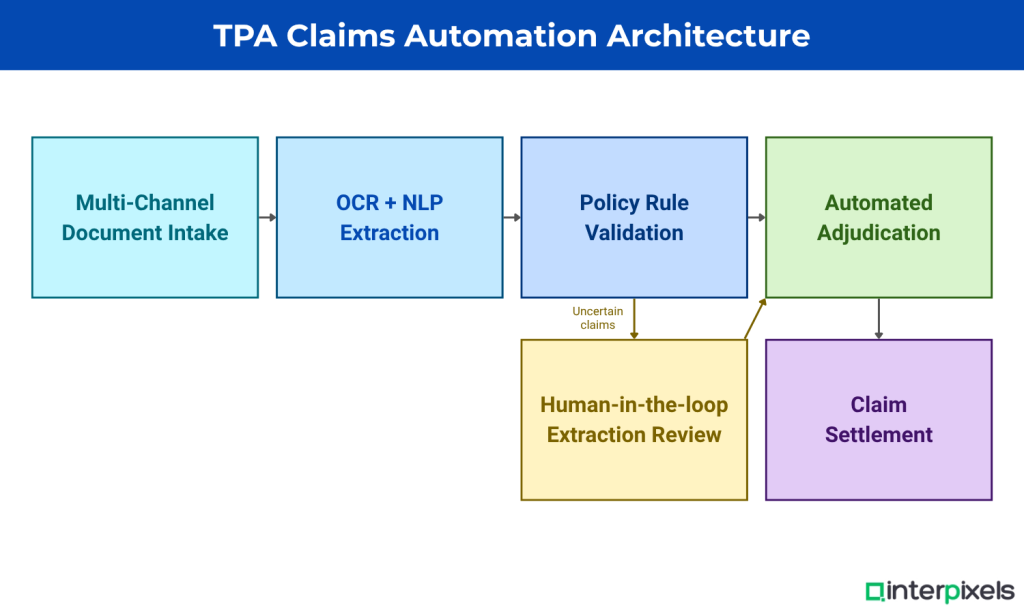
The pipeline routes incoming claim documents through OCR and NLP extraction before policy validation. Only claims flagged as uncertain reach a human reviewer, keeping accountability intact while removing routine manual work. This structure is what allows a TPA to scale claim volume without scaling headcount at the same rate.
What production deployment looks like
Academic work is starting to catch up with what TPAs need in practice. A 2025 arXiv paper on InsurTech and NLP shows how unstructured text can be converted into de-biased, structured signal that enriches traditional risk factors according to Dong and Quan (2025). A related 2026 paper on LLM-driven claim automation found that domain-specific fine-tuning produces materially more consistent, auditable output than generic model prompting according to Mo and Quan (2026). Separate case-based research on predictive analytics in insurance operations reinforces the same pattern of AI reducing manual risk-assessment work according to Arora and Purohit (October 2025).
Fine-tuned, domain-specific models consistently outperform generic LLM wrappers on claims-specific tasks.
In production, InterPixels AI’s Claims Intelligence API automates the upstream document work TPAs handle before adjudication starts, covering IPD, OPD, and KYC claim categories. Per InterPixels AI’s own published case study, a deployment with a client identified on their site as TrueCover India saw claim processing time drop from 40 minutes to 5 minutes per claim across more than 15,000 claims, an 8x improvement, with human review retained at every uncertain decision point for audit-readiness. Editorial note: confirm internally whether “TrueCover India” is cleared for public use as a named client reference before this goes live.
Comparison: manual vs. RPA vs. AI document intelligence
| Option | Key strength | Best used when |
|---|---|---|
| Manual review | Full human judgment on every claim | Claim volume is low or highly non-standard |
| Rule-based RPA | Fast on fixed-format documents | Document layouts rarely change |
| AI document intelligence (InterPixels AI) | Handles format and language variability at scale | Claim volume and document diversity are both high |
FAQ
How long does health insurance claims processing take in India? Manual processing is commonly estimated at 30 to 45 minutes per claim for document review and validation, though this figure comes from industry analysis rather than a single official benchmark. With AI-based document intelligence, that upstream work can drop to under 5 minutes in production deployments, though final adjudication timing still depends on claim complexity and policy terms.
What is IRDAI’s pre-authorization time limit? IRDAI’s Master Circular on Health Insurance Business, issued May 29, 2024, is reported in industry summaries to mandate a one-hour window for cashless pre-authorization and a three-hour window for discharge approval. IRDAI’s own Annual Report confirms the circular’s issue date; the specific one-hour and three-hour figures are drawn from secondary industry sources.
Why do health insurance claims get rejected in India? According to IRDAI’s Annual Report 2024-25, about 8% of health insurance claims are repudiated, close to one in twelve. Room-rent capping and non-medical expense exclusions are common drivers, and many rejections stem from incomplete or inconsistent documentation rather than coverage disputes.
How big is India’s health insurance TPA market? Market research firm Next Move Strategy Consulting estimates the TPA market at $5.91 billion in 2023, projected to reach $9.29 billion by 2030 at a 5.6% CAGR. This is a private market-sizing estimate rather than a government-published figure.
What is straight-through processing in insurance claims? Straight-through processing means a claim is validated and adjudicated without manual intervention. McKinsey projects more than half of claims activities could reach this state globally by 2030.
Conclusion
India’s TPA market is heading toward roughly $9.29 billion by 2030 on vendor estimates, and claim volume is outpacing manual processing capacity right now on IRDAI’s own numbers. IRDAI’s Annual Report 2024-25 shows the real picture: an 82.88% incurred claims ratio, Rs 1.88 lakh crore in net incurred claims, and an 8% repudiation rate that often traces back to documentation gaps rather than coverage disputes. Closing that gap depends on automating document intake, not adjudication logic.
TPAs that treat document intelligence as core infrastructure, not a side project, are the ones positioned to handle 2030-level claim volume without 2030-level headcount. Where does your claims operation sit on that curve today?
Table of Content