Health Insurance Claims Automation · Indonesia
OJK has set the compliance baseline for 2026. Is your claims workflow there?
InterPixels AI automates the full upstream document workflow for Indonesian private health insurance TPAs. Completeness validation, OCR extraction, and fraud detection across Bahasa Indonesia and English, IPD and OPD, KTP to hospital bill. API-first. No changes to your existing platform.

Regulatory and Operational Reality · Indonesia
Indonesia recorded the highest medical cost inflation in Asia in 2025. The claims queue is where losses begin.
Indonesia’s private health insurance loss ratios are among the most severe in Asia. The problem is structural, not cyclical.
According to WTW, the average health claims loss ratio in Indonesia reached 105.7% in Q1 2024, meaning insurers paid out more in claims than they collected in premiums for that period. By H1 2025, individual health insurance policies had recorded loss ratios exceeding 200%, according to IFG Progress data cited by Mordor Intelligence. Indonesia recorded the highest medical cost inflation in Asia in 2025 at 13.6% after general price inflation, according to the Global Asia Insurance Partnership (GAIP) report. Claims ratios have consistently exceeded 90% in recent years. OJK has publicly acknowledged the trend, with the Chief Executive of OJK’s Insurance, Guarantee, and Pension Fund Supervisory Agency stating that companies must strengthen underwriting, claims management, and healthcare cost controls to maintain performance quality.
For private health insurance TPAs, unsustainable loss ratios mean every claim processed without accurate completeness checking and extraction contributes directly to insurer losses. Overpayment, over-servicing, and incomplete validation at intake are operational failures with direct financial consequences.
How InterPixels AI addresses it: Gate 1 completeness validation ensures every claim entering extraction is correctly documented before extraction resources are consumed. Gate 2 runs three concurrent fraud and validation checks on every claim. Prescription-pharmacy cross-validation, invoice arithmetic verification, and document authenticity analysis. Structured, auditable output per claim reduces the downstream leakage that contributes to unsustainable loss ratios.

OJK Circular Letter 7/SEOJK.05/2025, effective January 2026, has restructured what TPAs are required to deliver operationally.
OJK issued Circular Letter No. 7/SEOJK.05/2025 on 19 May 2025, effective January 1, 2026, under the umbrella of POJK No. 36/2024. The circular sets out new operational requirements with direct implications for every TPA handling private health insurance claims in Indonesia.
TPA agreements with insurers must now meet specific minimum OJK standards covering data confidentiality, service level expectations, and dispute resolution procedures. Insurers are required to maintain comprehensive claims performance databases for a minimum of 10 years following the end of each coverage period. Quarterly reporting to OJK commences from Q2 2026, covering detailed claims experience metrics and loss ratios. Existing insurers and their TPAs have a transition period through December 2026 to align products and operations with the new requirements.
The circular also introduces co-payment provisions requiring policyholders to bear a portion of each claim (at least 10% as specified in the circular, capped at IDR 300,000 for outpatient and IDR 3,000,000 for inpatient care). Implementation of the co-payment mechanism is subject to ongoing Parliamentary discussions. No official postponement decree had been issued by OJK as of the time of publishing this page. Insurers must monitor OJK communications for definitive implementation status.
How InterPixels AI addresses it: InterPixels AI returns structured JSON output per claim with full HITL audit logging. Every field reviewed or overridden by a human reviewer is recorded and retrievable. The 10-year claims database retention obligation requires structured, retrievable records. Manual workflows produce neither the structure nor the retrievability that OJK’s requirements demand. The structured JSON output also provides the claims experience data that quarterly OJK reporting will require.

OJK mandates fraud detection systems as an operational prerequisite, not a discretionary investment.
Circular Letter 7/2025 requires insurers offering health insurance products to implement IT systems capable of detecting potential fraud across health insurance claims. This is a systems prerequisite for eligibility to offer health insurance products, not a recommendation. Insurers must also establish a Medical Advisory Board (Dewan Penasihat Medis) to oversee utilisation reviews and provide inputs on health services. TPAs are explicitly identified in the circular as entities through which insurers may collaborate in establishing the Medical Advisory Board function.
Indonesia’s private health insurance claims environment has documented fraud patterns including over-servicing at private hospitals, pharmacy quantity inflation, duplicate claims across JKN and private insurance coordination of benefits, and document fabrication. These are cited by OJK and industry bodies as primary contributors to claims ratios consistently exceeding 90%.
How InterPixels AI addresses it: Three concurrent fraud detection checks run on every claim during Gate 2 extraction. Prescription-pharmacy cross-validation, invoice arithmetic verification, and document authenticity analysis. Fraud flags are embedded in the structured JSON output with the specific fields and evidence cited per alert. The fraud detection layer runs during extraction, on every claim, before anything reaches an adjudicator. This is not a post-processing flag. It is embedded in the extraction workflow.

Coordination of benefits between private insurance and JKN creates a dual-layer adjudication requirement that manual processing cannot handle accurately at volume.
Private health insurance in Indonesia operates as a supplementary layer on top of BPJS Kesehatan’s JKN public coverage, which covered 283 million participants, representing 99.34% of Indonesia’s population, as of October 2025. The coordination of benefits framework under KMK 1366 of 2024 defines how private insurers cover cost differences when JKN participants upgrade hospital classes or access services beyond standard JKN tariffs.
Every private health insurance claim therefore requires validation against both the private policy terms and the underlying JKN entitlement to determine what the private insurer owes. This dual-layer adjudication requirement increases the data extraction burden per claim. Getting it wrong in either direction is a financial and compliance error. OJK’s Circular Letter 7/2025 explicitly mandates digital integration with healthcare providers and coordination of benefits governance as part of the new operational requirements.
How InterPixels AI addresses it: Gate 2 extraction captures all structured fields required for coordination of benefits adjudication and outputs them in a JSON schema formatted to your system’s requirements. The data your adjudication system needs to apply coordination of benefits logic correctly is present, extracted, and confidence-scored in every claim output.

The Product
Two gates. Every claim. No exceptions.
Gate 1: Completeness Validation
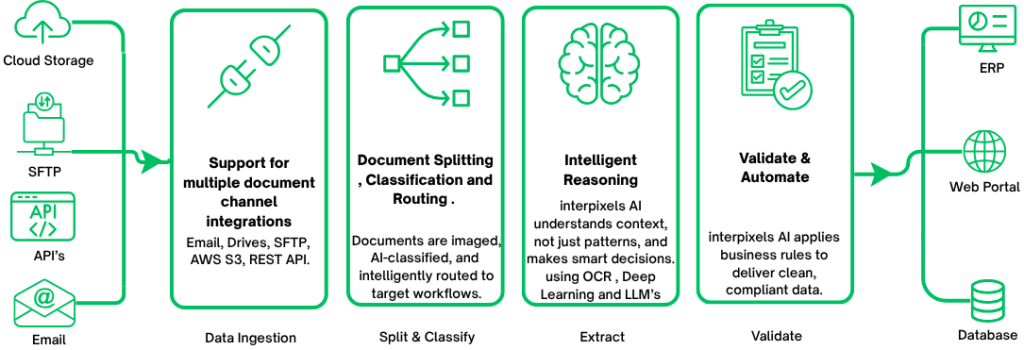
Every claim submission passes through Gate 1 first. InterPixels AI classifies all submitted documents, identifies the claim type (IPD, OPD, or KYC), and verifies that every required document class is present. Incomplete submissions are blocked immediately and returned with a specific list of missing documents. No processing resources are consumed on a claim that cannot be adjudicated.
Gate 2: Extraction and Fraud Detection
Claims that pass Gate 1 enter extraction. InterPixels AI reads every document using OCR and Generative AI, extracts all fields with per-field confidence scoring, and runs three concurrent fraud detection checks during extraction. Prescription-pharmacy cross-validation, invoice arithmetic verification, and document authenticity analysis. Structured JSON output is returned per claim, ready for your adjudication system.
HITL: Human-in-the-Loop
Fields extracted below confidence threshold are automatically flagged and routed to your operations team for review. Reviewers see only the fields requiring a decision, not the entire document. Every reviewed decision is logged for audit and compliance.
API-First
REST API. No UI changes to your existing TPA platform. No retraining of staff. Integration in 4 to 6 weeks.
Document Coverage · India
Built for the documents Indian health insurance TPAs actually process.
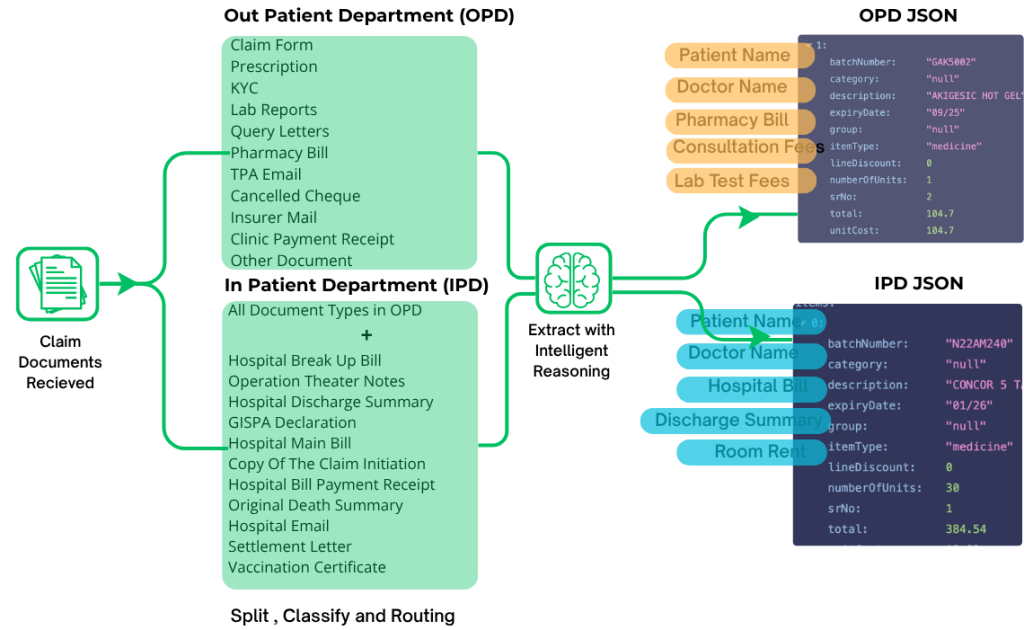
IPD: In-Patient Department 25 document classes
Cashless Claim Form, Hospital Main Bill, Hospital Break-Up Bill, Operation Theatre Notes, Hospital Discharge Summary, GISPA Declaration, Room Rent Receipt, Pharmacy Bill (inpatient), Laboratory Reports, Radiology and Imaging Reports, Doctor Consultation Notes, Anaesthesia Notes, Pre-authorisation Letter, TPA Authorisation Letter, Settlement Letter, Original Death Summary, Vaccination Certificate, Hospital Email Correspondence, Hospital Bill Payment Receipt, Copy of Claim Initiation, Cancelled Cheque, Insurer Mail, Query Letters, KYC Documents, Other Supporting Documents.
OPD: Out-Patient Department 15 document classes
Claim Form, Prescription, Pharmacy Bill, Laboratory Reports, Radiology Reports, Consultation Fee Receipt, Clinic Payment Receipt, TPA Email, Cancelled Cheque, Insurer Mail, Query Letters, KYC Documents, Referral Letter, Diagnostic Test Report, Other Supporting Documents.
KYC Documents
Aadhaar Card (front and back), PAN Card, Passport, Voter ID, Driving Licence.
Language OCR
Hindi, English, Tamil, Telugu, Bengali. Printed and handwritten. Handwritten prescriptions processed with per-field confidence scoring across all supported scripts.
Case Study · India
InsurTech : 40 minutes to 5 minutes per claim.
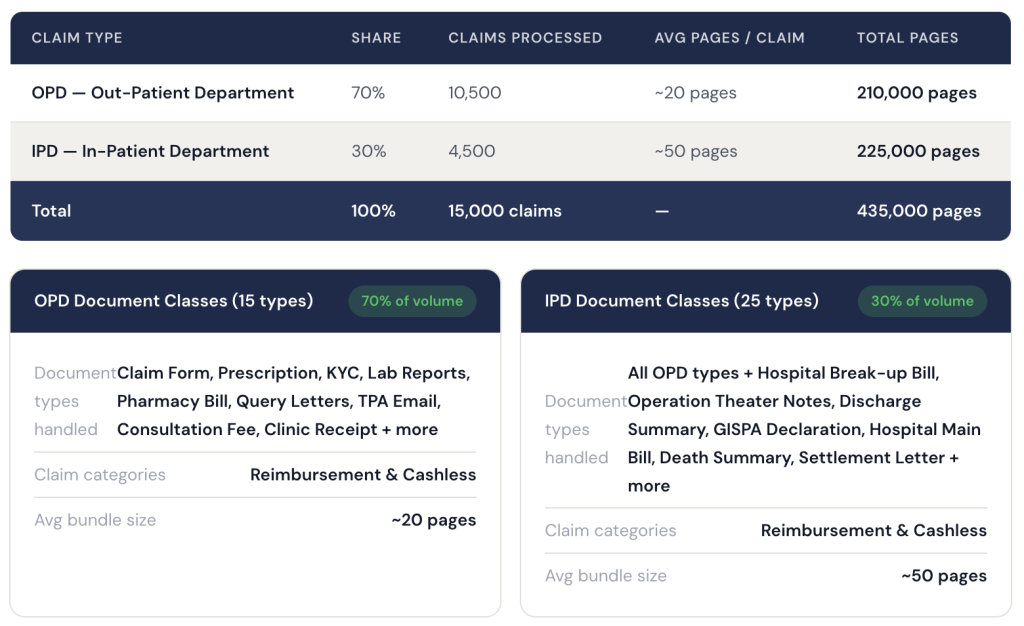
Stat 1: 15,000+ Claims processed in production
Stat 2: 8x Faster claim processing
Stat 3: 40 min to 5 min Per claim, data extraction
InsurTech India was processing health insurance claims manually. Sorting documents, entering data, validating fields before adjudication could begin. After integrating the InterPixels AI Claims Intelligence API, the full upstream document workflow was automated across IPD and OPD claim types. The operations team now reviews only flagged exceptions. Adjudication starts where the document work ends.
Integration Reality
Live in 4 to 6 weeks. No changes to your existing system.
REST API. Structured JSON output formatted to your schema.
Send claims via Email, SFTP, AWS S3, or direct API call.
PDF, JPG and PNG formats supported.
No changes to your TPA platform, UI, or staff workflows.
HITL review interface included. No separate tooling required.

INSIGHTS & INTELLIGENCE
Thinking on Claims, Documents & TPA Operations
Perspectives and analysis from the InterPixels AI team on health insurance claims automation, document intelligence, and operational efficiency across Asia-Pacific.