
Health insurance claims adjudication is the end-to-end process by which a Third-Party Administrator (TPA) receives a claim submission, validates its completeness, extracts and verifies data from supporting documents, checks policy coverage, reviews medical necessity, calculates the payable benefit, and issues a payment decision. The process governs every rupiah or ringgit paid or denied, making it the operational and financial core of every health insurance TPA.
Why Adjudication Speed Is Now a Compliance Requirement
Health insurance claims adjudication sits at the intersection of financial accuracy, regulatory compliance, and patient trust. Lag at any stage triggers consequences that compound: policyholders complain, regulators fine, and claim leakage quietly inflates payouts.
IRDAI’s 2024 master circular mandates cashless pre-authorisation within one hour and final discharge authorisation within three hours. TPAs that miss these windows pay the resulting extra charges from their own funds, not from the insurer’s pocket.
The scale of the opportunity is clear. The global Health Insurance TPA market was valued at USD 223.03 billion in 2024 and is projected to reach USD 273.99 billion by 2030 at a 5.50% CAGR. APAC TPAs processing claims across India, Malaysia, Indonesia, and the Philippines sit at the growth front.
The TPA that understands adjudication as a data pipeline, not a paper shuffle, is the one that survives the next decade of volume growth.
The Seven Stages of the Claims Adjudication Process
Health insurance claims adjudication follows seven sequential stages: claim receipt and intake, completeness check, document extraction, policy coverage verification, medical necessity review, benefit calculation, and payment decision. Each stage carries distinct decision points and failure modes that compound if not resolved upstream.
| Stage | Name | Key Action | Common Error | AI Automation |
|---|---|---|---|---|
| 1 | Claim Receipt and Intake | Accept submission via email, portal, SFTP, or S3; create claim record | Duplicate submission not caught at entry | Auto-deduplication; intake channel normalisation |
| 2 | Completeness Check | Verify all required documents are present for claim type (IPD/OPD) | Missing discharge summary wastes extraction resources | Gate 1 classifier; missing-document flag with checklist returned |
| 3 | Document Extraction | OCR and GenAI extract structured fields with confidence scores | Manual re-keying errors; handwriting misread | InterPixels AI: 40+ document types, 200+ languages, per-field confidence |
| 4 | Fraud Detection | Cross-validate prescription vs pharmacy; check arithmetic; verify doc authenticity | Soft fraud passes undetected in manual review | 3 real-time validation layers during extraction |
| 5 | Policy Coverage Check | Match claim against active policy, waiting periods, exclusions, network status | Coverage denied for expired policy not caught early | Rules engine auto-checks policy eligibility and benefit limits |
| 6 | Medical Necessity Review | Clinical team validates that treatment was medically required | Over-approval of elective procedures | HITL: AI flags borderline cases; clinician makes final call |
| 7 | Benefit Calculation | Apply deductibles, co-pays, sub-limits, and coordination of benefits | Arithmetic errors in manual calculation | Rules engine computes payable amount from structured JSON |
| 8 | Payment Decision | Approve, partially approve, or deny; generate EOB; trigger settlement | Delay in signing off causes IRDAI TAT breach | Auto-approval for clean claims; human queue for exceptions |
Table 1: Stage-by-stage claims adjudication workflow with AI automation mapping for APAC TPAs.
Stage 1: Claim Receipt and Intake
The claim enters the TPA’s system through an email, SFTP upload, REST API call, or insurer portal. At this point, the primary risk is duplicate submission. Two receipts of the same claim, common when a hospital re-sends after a transmission error, create a double-payment exposure that a manual intake team routinely misses under volume pressure.
A production-grade intake layer auto-deduplicates on patient name, date of service, provider, and claim amount before creating a claim record. Every second saved here scales across thousands of daily submissions.
Duplicate submissions are the silent tax on manual intake. One undetected duplicate in 200 claims erases the margin on 10 clean ones.
Stage 2: Completeness Check (Gate 1)
Gate 1 is the most cost-efficient stage in the entire workflow. Completeness validation stops incomplete submissions before they consume extraction resources. An IPD claim missing a discharge summary or a KYC document with a missing identity proof cannot be adjudicated. Catching the gap here costs microseconds. Catching it after manual data entry costs 40 minutes.
The check must be type-aware. IPD claims require a different document set than OPD claims. A rules-based completeness classifier identifies the claim type from the submission bundle and verifies each required document class is present. Missing documents generate a structured return notice specifying exactly what is absent.
Stage 3: Document Extraction
Document extraction converts unstructured documents into structured data. For an IPD claim, that means reading the hospital main bill, discharge summary, operation theatre notes, pharmacy receipts, and KYC documents, and extracting hundreds of fields across all of them with sufficient accuracy to support an automated adjudication decision downstream.
This is where most manual TPA operations spend the majority of their time. InterPixels AI processes 40+ health insurance document types across 200+ languages for printed text and 50 languages for handwritten content, returning per-field confidence scores that determine whether a value goes straight to the rules engine or is flagged for human review.
Stage 4: Policy Coverage Verification
Once structured data is available, the rules engine checks the claim against the active policy. This covers eligibility status, waiting periods for specified diseases, network hospital status, room rent sub-limits, pre-existing condition declarations, and any exclusion clauses that apply to the claimed treatment.
A coverage failure at this stage generates a denial with a specific reason code. Reason codes must be precise: a generic “not covered” response triggers regulator complaints. A precise “waiting period for hernia repair not elapsed; coverage commences on [date]” response is defensible and informative.
Stage 5: Medical Necessity Review
Medical necessity review asks whether the treatment claimed was clinically required for the patient’s diagnosed condition. A three-day ICU stay for a minor procedure that standard clinical guidelines resolve in outpatient settings is a classic medical necessity flag. So is a pharmacy bill containing medications unrelated to the discharge diagnosis.
This stage is where human judgment is non-negotiable. According to IBM Research’s 2024 study published in Nature Scientific Reports, AI systems are most effective when they identify and route anomalous claims to trained reviewers rather than making autonomous approval decisions on borderline clinical scenarios.
In practice, teams building this workflow find that AI can auto-clear the 80-85 percent of claims where the diagnosis code, treatment type, and billed amount align with clinical norms. The remaining 15-20 percent, where they do not, should surface immediately to a clinical reviewer with the specific discrepancy pre-flagged.
Medical necessity is the stage where AI asks the right question and a clinician closes it. No rules engine replaces that judgment on a borderline case.
Stage 6: Benefit Calculation
Benefit calculation applies the policy’s financial terms to the approved medical services. For a standard IPD claim this includes: subtracting the applicable deductible, applying the room rent sub-limit or actual room charge (whichever is lower), calculating co-insurance where it applies, coordinating benefits if the patient holds secondary cover, and producing the net payable amount.
Errors here are expensive and often invisible until audited. According to a 2024 academic framework for AI-ML driven claims processing, rules engine-based benefit calculation seeded with structured JSON from an extraction layer reduces arithmetic errors by eliminating manual re-keying from free-text documents.
Stage 7: Payment Decision and Settlement
The payment decision stage issues the Explanation of Benefits (EOB), triggers the settlement transaction, and logs the complete audit trail. For approved claims, payment is released. For partial approvals, the breakdown is documented. For denials, the reason code is recorded with the supporting evidence that triggered the denial.
IRDAI’s Health Insurance Regulations 2024 set a 30-day TAT from the date of final document submission for reimbursement claims. Missing this deadline triggers penal interest on the claim amount plus regulatory exposure. Clean straight-through processing on complete claims eliminates this risk.
Where Human Judgment Is Non-Negotiable: The Role of HITL
Medical necessity review is the one adjudication stage where AI raises the question and a human closes it. A Human-in-the-Loop (HITL) layer does not mean every claim touches a human reviewer. It means every uncertain field or clinically ambiguous case does.
InterPixels AI routes only low-confidence extractions and exception cases to the TPA’s operations team. Reviewers see the specific flagged field and the evidence for the flag, not the entire document bundle. Once a reviewer confirms or corrects the field, the claim proceeds automatically.
The audit trail generated at every HITL touchpoint creates the compliance record that IRDAI and regional regulators require. Each field-level change, the original extracted value, the confidence score, the reviewer action, and the timestamp, is logged and retrievable. This is not a compliance overhead. It is the evidence base that protects the TPA in a disputed settlement.
How AI Automates Each Adjudication Stage
AI automates intake, completeness validation, document extraction, fraud detection, and benefit calculation. Human reviewers handle medical necessity edge cases and appeals. The architecture is a handoff, not a replacement.
According to McKinsey’s July 2025 report on AI in the insurance industry, UK insurer Aviva deployed over 80 AI models across its claims domain and saved more than GBP 60 million in 2024, cutting liability assessment time by 23 days and improving claims routing accuracy by 30 percent.
According to Deloitte, insurers using automation and AI in claims operations report cost reductions of 20-50 percent. For APAC TPAs, the specific automation priorities are document extraction across multilingual, handwritten formats; real-time fraud detection; and HITL governance that satisfies IRDAI’s audit requirements.
InterPixels AI applies three concurrent fraud detection layers during extraction: prescription-pharmacy cross-validation, invoice arithmetic verification, and document authenticity analysis. These checks run before any claim reaches an adjudicator, catching irregularities at the source rather than discovering them post-settlement.
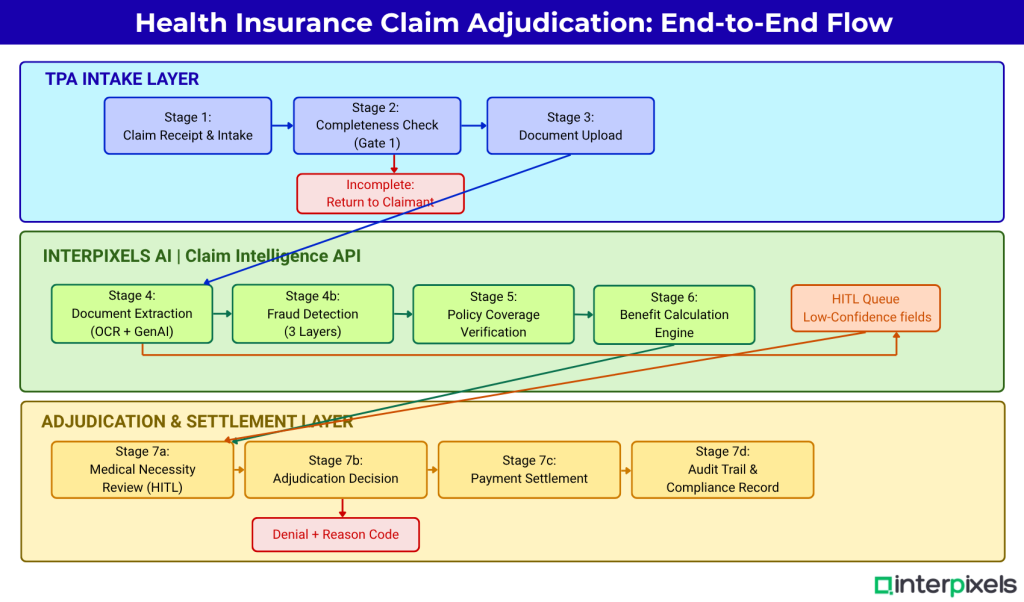
Figure 1: End-to-end health insurance claims adjudication flow for APAC TPAs. InterPixels AI handles Stages 3-6 (document extraction, fraud detection, coverage check, benefit calculation) as a REST API layer requiring no TPA platform changes. HITL queues route low-confidence fields and medical necessity edge cases to human reviewers. Green lane = InterPixels AI. Blue lane = TPA intake. Yellow lane = adjudication and settlement.
The TPA that deploys AI as a data pipeline and keeps humans at decision boundaries will out-process, out-comply, and out-scale every manual competitor by 2027.
Adjudication Approaches Compared
| Approach | Key Strength | TAT (Upstream Docs) | Fraud Detection | Best Used When |
|---|---|---|---|---|
| Manual Processing | Full human judgment on every claim | 30-45 min per claim | Spot-check only; 20-40% soft fraud detection | Claim volume is below 50 per day with highly complex cases |
| Rules-Based Automation | Consistent policy rule application; low cost | 10-20 min per claim | Arithmetic checks only; no pattern detection | Standardised, high-volume commodity claims with clean documents |
| AI-Augmented (InterPixels AI) | OCR and GenAI extraction; 3-layer fraud detection; HITL governance | Under 5 min per claim | Prescription matching + arithmetic + authenticity in real time | APAC TPAs processing IPD/OPD at scale across multiple languages |
Table 2: Comparison of manual, rules-based, and AI-augmented adjudication approaches for APAC TPAs.
Adjudication TAT Benchmarks for APAC TPAs
Manual APAC TPA adjudication averages 30-45 minutes per claim for upstream document work alone. AI-augmented workflows reduce this to under 5 minutes, achieving an 8x speed improvement in production deployments.
A leading InsurTech services provider in India, working with InterPixels AI, reduced processing time from 40 minutes to 5 minutes per claim across 15,000 plus claims processed in a single month. The reduction came from eliminating manual document sorting, data entry, and spot-check validation entirely.
McKinsey research estimates that by 2030 more than half of current claims activities could be replaced by automation as AI capabilities and structured data availability improve. APAC TPAs that build the data extraction layer now are compounding the advantage.
| Metric | Manual TPA | AI-Augmented TPA | IRDAI / Regulatory Mandate |
|---|---|---|---|
| Cashless pre-auth decision | 1-4 hours | Under 15 minutes | 1 hour (IRDAI 2024 circular) |
| Discharge authorisation | 2-6 hours | Under 1 hour | 3 hours (IRDAI 2024 circular) |
| Reimbursement document processing | 30-45 min per claim | Under 5 min per claim | 30 days from final doc submission |
| Soft fraud detection rate | 20-40% | Near-real-time on 100% of claims | No mandate; material for leakage control |
| Cost per claim (upstream docs) | USD 40-60 | Under USD 20 | No mandate; IRDAI profitability guidance |
Table 3: TAT benchmarks for APAC health insurance TPAs: manual vs AI-augmented, mapped to IRDAI regulatory mandates.
Frequently Asked Questions
What is health insurance claims adjudication?
Health insurance claims adjudication is the process by which a TPA receives a claim submission, validates its completeness, extracts data from supporting documents, checks policy coverage and medical necessity, calculates the benefit payable, and issues a payment decision. Every claim approval, partial payment, or denial is the output of this process.
How long does claims adjudication take for APAC TPAs?
Manual adjudication for upstream document work takes 30-45 minutes per claim in APAC TPA operations. AI-augmented workflows reduce this to under 5 minutes in production, with IRDAI mandating cashless pre-authorisation decisions within one hour and discharge authorisation within three hours under the 2024 master circular.
What is the role of HITL in medical necessity review?
Human-in-the-Loop (HITL) in medical necessity review means AI identifies and routes clinically borderline cases to a trained reviewer rather than auto-approving them. The reviewer sees the specific discrepancy flagged by the system, makes the call, and the claim proceeds. HITL ensures clinical accountability without adding review burden to routine, clean claims.
How does AI detect fraud during adjudication?
AI detects fraud during adjudication by running validation logic during the extraction stage itself. InterPixels AI applies prescription-pharmacy cross-validation, invoice arithmetic verification, and document authenticity analysis on every claim before it reaches an adjudicator. Deloitte research shows insurers using AI in claims operations achieve cost reductions of 20-50 percent, with fraud detection a primary driver.
What happens when a claim is flagged as incomplete at Gate 1?
At Gate 1, the completeness check classifies all submitted documents, identifies the claim type (IPD or OPD), and verifies that every required document class is present. If any document is missing, the claim is blocked before extraction resources are consumed. The submitter receives a structured return notice listing exactly which documents are absent and must be resubmitted.
Speed without accuracy creates settlements you later regret. Accuracy without speed creates regulation breaches you cannot afford. AI gives APAC TPAs both.
The Bottom Line
Three insights should stay with every TPA operations leader after reading this guide. First, adjudication is a data pipeline. Every delay or error in the process traces back to a data quality or routing failure upstream, not a problem with the downstream decision. Second, HITL is not a compromise. Keeping humans at medical necessity and exception boundaries is the correct architecture, not a limitation of the technology. Third, regulatory compliance and operational speed are not competing goals. AI removes the document bottleneck that forces the choice between speed and accuracy.
The TPA that automates the document layer today is the one processing twice the volume at half the cost by 2027. Where does your operation sit on that curve?
Table of Content