
Pre-authorization in health insurance is the process by which a Third-Party Administrator (TPA) formally validates that a planned treatment is covered under a policyholder’s policy before the hospital begins care. The TPA reviews the clinical justification, confirms policy eligibility, and issues a cashless approval letter. Without this gate, insurers face claim leakage; without speed, patients face discharge delays.
Why Pre-Auth Is the Highest-Stakes 60 Minutes in Cashless Claims
The decision a TPA makes on a pre-authorization request determines whether a patient receives cashless treatment or faces out-of-pocket costs. It also determines whether an insurer pays a legitimate claim, a fraudulent one, or nothing at all.
IRDAI’s 2024 Master Circular on Health Insurance Business mandates that insurers decide on cashless authorization for emergency admissions within one hour of receiving the request, and issue final discharge authorization within three hours of receiving a discharge request from the hospital. That mandate makes pre-auth speed a regulatory obligation, not just an operational preference, for every TPA operating in India.
Globally, Deloitte’s 2026 US Health Care Outlook Survey found that 70 percent of health plans are already prioritising agentic AI for utilisation management, prior authorization, and claims management in 2026. The APAC market is at the same inflection point: manual pre-auth is no longer defensible at scale.
Pre-authorization is not a formality. It is the control gate between a legitimate cashless claim and a payment that should never have been made.
When Is Pre-Authorization Required? The Four Trigger Categories
Not every hospital visit triggers a pre-auth request. TPAs in India and Malaysia apply pre-authorization to a defined set of clinical and financial scenarios.
Elective IPD Admissions
Any planned in-patient admission where the policyholder is not in an emergency requires advance pre-authorization. The hospital TPA desk should receive the request at least two days before the admission date to allow processing time.
Planned Surgeries and High-Cost Procedures
Orthopedic procedures, cardiac interventions, oncology treatments, and organ transplants all require pre-auth regardless of admission type. Insurers define the cost threshold that triggers mandatory review; this varies by insurer and policy type, but typically falls between INR 30,000 and INR 50,000 for corporate group policies in India.
Day-Care and OPD Procedures Above Threshold
High-cost day-care procedures such as chemotherapy sessions, dialysis, and cataract surgeries require pre-auth even though the patient does not stay overnight. Some insurers in Malaysia also require pre-auth for specialist consultations above a set threshold under their panel arrangements.
Critical Illness and Oncology Cases
Any treatment involving a critical illness diagnosis, including cancer, stroke, heart attack, or renal failure, automatically requires pre-authorization at admission and at each treatment cycle. These cases carry the highest fraud risk and the largest individual claim values, making the pre-auth check essential for both clinical and financial reasons.
The Pre-Auth Document Set: What Every TPA Must Receive
Incomplete document submission is the single largest cause of pre-auth delays. The following document set applies to planned IPD cashless pre-authorization in India. TPAs in Malaysia follow similar requirements under their respective insurer panel agreements.
Standard Pre-Authorization Document Checklist
- Pre-Authorization Request Form (RAL): Completed and signed by the treating doctor and the hospital TPA desk. Includes patient details, diagnosis, proposed procedure, and expected length of stay.
- Doctor’s Certificate or Referral Letter: Confirms the diagnosis, states the medical necessity for the proposed treatment, and is signed by the treating consultant.
- Treatment Plan: Outlines the procedures planned, medications required, and any anticipated complications that could affect cost.
- Cost Estimate / Hospital Break-Up Bill: A line-item estimate from the hospital, covering procedure costs, room charges, consumables, and surgeon fees.
- Prior Medical History and Past Claim Records: Discharge summaries from previous hospitalizations, prescriptions for chronic conditions, and any prior pre-auth letters for related treatments.
- Policy and KYC Documents: Active TPA card, photo ID, and policy number confirmation.
- Investigation Reports: Lab results, imaging (X-rays, MRI, CT scans), or diagnostic findings that support the proposed diagnosis.
For emergency admissions, the TPA desk accepts a partial document set at the time of admission and collects the remaining documents within 24 hours.
A deficiency letter costs a TPA rework time and costs the patient potentially hours of waiting at the hospital. Document completeness at intake eliminates both.
Comparison of Pre-Authorization Approaches
| Pre-Auth Approach | Key Strength | Best Used When | Typical TAT |
|---|---|---|---|
| Manual (Phone/Fax) | No technology setup required; familiar to legacy teams | Small TPA with low claim volume and single-insurer tie-up | 4 to 24 hours |
| Semi-Digital (Email + PDF portal) | Faster than fax; basic audit trail; moderate cost | Mid-size TPA moving off paper, with partial digitization | 2 to 6 hours |
| AI-Assisted (OCR + GenAI) | Document validation in seconds; multi-language OCR; fraud detection at intake | High-volume TPA processing 500+ cashless requests daily across multiple insurers | Under 30 minutes |
| Fully Automated with HITL | Human accountability retained at low-confidence fields; audit-ready; scales without headcount | Large TPA or hospital network under IRDAI real-time mandate, with multi-insurer and multi-market operations | 5 to 15 minutes |
The Pre-Auth Approval Workflow: Step by Step
The pre-auth process runs across four stakeholders: the hospital, the TPA, the AI processing engine, and the insurer’s clinical or medical team. Each stage has a clear owner and a defined output.
Pre-Authorization Process Flow Table
| Stage | Actor | Action | TAT Target | Output |
|---|---|---|---|---|
| 1. Submission | Hospital TPA Desk | Compile complete document set and submit pre-auth request form with CCN registration | D-2 (planned) / Immediate (emergency) | Pre-auth request + documents received |
| 2. Gate 1 Validation | TPA / AI Engine | Classify all submitted documents; check completeness; verify policy eligibility and network hospital status | Under 5 minutes (AI) / 30 minutes (manual) | Completeness confirmation or deficiency list |
| 3. Data Extraction | AI Engine (OCR + GenAI) | Extract structured data from 40+ document types; run fraud detection; assign confidence scores | Seconds to 2 minutes | Structured JSON with fraud flags |
| 4. HITL Review | TPA Operations Staff | Review only low-confidence fields flagged by AI; confirm or correct; escalate if needed | 5 to 15 minutes for flagged fields | Clean, validated data packet |
| 5. Clinical Assessment | Medical Officer / Insurer | Review treatment plan, diagnosis, and cost estimate against policy criteria and medical necessity standards | Under 1 hour (IRDAI mandate for emergency; operational best practice for planned) | Approval, query, or denial decision |
| 6. Authorization Issued | Insurer / TPA | Issue Authorization Letter (AL) with approved amount, room class, and any co-pay notes; notify hospital and patient by SMS/email | Within 1 hour of emergency cashless request (IRDAI 2024) | Authorization Letter (AL) or Denial Letter |
| 7. Discharge Pre-Auth | Hospital / TPA / Insurer | Hospital submits final bill and discharge summary; TPA validates; insurer issues final authorization | Within 3 hours of discharge request (IRDAI 2024) | Final Authorization; settlement instruction |
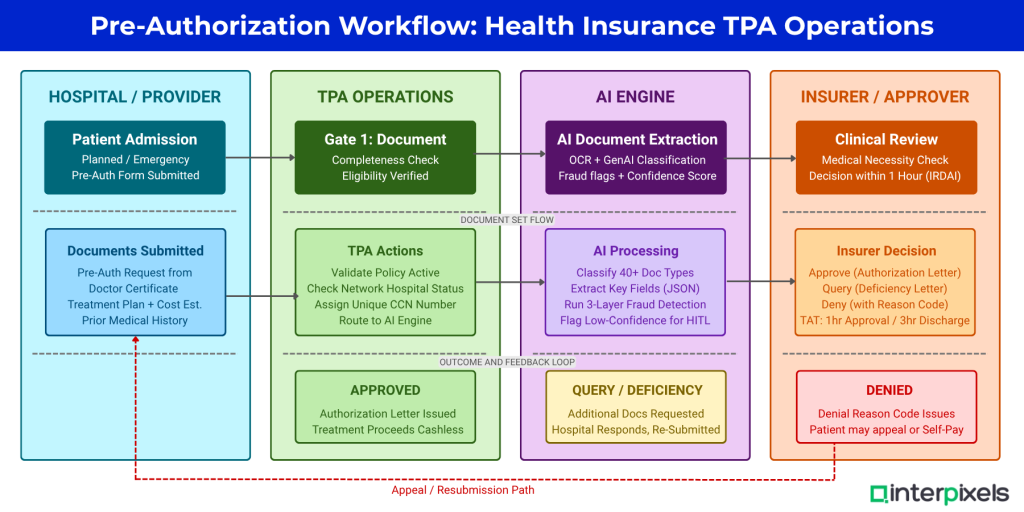
Caption: Figure 1. Pre-authorization workflow showing the four-lane process across Hospital, TPA Operations, AI Engine, and Insurer. Arrows show document flow direction. The feedback loop (red dashed) represents the denial and resubmission path. TAT benchmarks at the bottom reflect IRDAI 2024 mandatory standards for India.
In practice, teams managing this workflow typically find that the biggest delay is not the clinical review but the document triage step. A manual review of a complete IPD document bundle takes 20 to 40 minutes based on production data from TrueCover India’s deployment. AI-powered classification and extraction reduces that to under two minutes, which is where the IRDAI one-hour TAT for emergency cases becomes achievable for high-volume operations.
IRDAI Pre-Auth Norms and TAT Benchmarks for India
IRDAI’s Master Circular on Health Insurance Business (May 2024) sets binding timelines for every TPA and insurer operating in the Indian health insurance market. Non-compliance exposes the insurer to additional charges payable from the insurer’s own funds.
- Emergency cashless authorization decision: within one hour of receiving the pre-auth request.
- Final discharge authorization: within three hours of receiving the discharge request from the hospital. If the insurer misses this deadline, any additional hospital charges incurred are payable by the insurer from their shareholder’s fund.
- Pre-authorization channel: insurers must provide pre-authorization via digital mode, not only physical submission.
- Dedicated hospital help desks: insurers must set up physical TPA help desks at empanelled hospitals to assist with real-time cashless requests, with full infrastructure in place by July 31, 2024.
- Cashless everywhere mandate: IRDAI requires insurers to move toward 100 percent cashless settlement; reimbursement should be the exception, not the norm.
For planned elective admissions submitted two or more days in advance, the operational benchmark in India is a two to four hour turnaround from submission to authorization letter for a complete document set. This is an industry standard, not a separately mandated TAT under the 2024 circular.
Malaysia follows a different regulatory structure under Bank Negara Malaysia’s Medical and Health Insurance Takaful framework, which mandates co-payment provisions and panel hospital management. Pre-auth TAT in Malaysia depends on the insurer’s panel agreement; most BNM-supervised health insurers target a two to four hour authorization window for elective IPD admissions.
IRDAI’s one-hour cashless authorization mandate for emergency cases is the legal floor every Indian TPA must meet. For planned pre-auth, the operational benchmark is two to four hours. Neither is achievable at scale with manual document workflows.
How AI Compresses Pre-Auth from Hours to Minutes
The bottleneck in pre-authorization is always document work: sorting, classifying, extracting fields, checking for completeness, and flagging inconsistencies. Each of those tasks is rule-based, repetitive, and time-consuming when done manually. AI eliminates the bottleneck without removing the human.
McKinsey’s 2022 analysis of AI-enabled prior authorization found that AI can automate 50 to 75 percent of manual prior authorization tasks, freeing clinical teams to focus on cases that genuinely require judgment.
The InterPixels AI Claims Intelligence API demonstrates this at production scale. The platform is purpose-built for health insurance TPAs in APAC and handles the full upstream document workflow for IPD, OPD, and KYC claim submissions across 40+ document types in 6 APAC languages. For pre-authorization specifically, it delivers the following.
- Gate 1 completeness validation: the system classifies every submitted document, identifies the claim type (IPD, OPD, or day-care), and verifies that all required document classes are present before any extraction resources are consumed. Incomplete pre-auth requests are blocked and returned with a list of missing documents.
- Structured data extraction: OCR and Generative AI extract key fields from the pre-auth request form, doctor’s certificate, treatment plan, cost estimate, and prior history. Output is structured JSON ready for clinical review, with per-field confidence scores.
- Three-layer fraud detection: prescription-pharmacy cross-validation, invoice arithmetic verification, and document authenticity analysis run during extraction, before the clinical team sees the case.
- Human-in-the-Loop governance: fields extracted below a confidence threshold are automatically routed to the TPA’s operations team for review. Reviewers see only the flagged fields, not the entire document bundle.
In a production deployment with TrueCover India, InterPixels AI reduced claim processing time from 40 minutes to 5 minutes per claim, an 8x improvement across more than 15,000 claims. That speed gain directly enables TPAs to meet IRDAI’s TAT requirements without adding headcount.
AI does not replace the TPA medical officer who makes the final authorization call. It removes the document work that was stopping them from getting to that call in time.
When Pre-Auth Is Denied: The Appeal Process
A denied pre-authorization is not the end of the road. TPAs and hospitals have a structured path to challenge the decision and, in many cases, reverse it.
A 2024 academic review published in Clinical Gastroenterology and Hepatology by Amann, Shah, and Wilson found that the prior authorization process is time-intensive and inefficient for patients, physicians, and staff, and is designed primarily around reducing payer expenses. This structure drives a high volume of queries and appeals. Understanding the denial reason code is the first step toward a successful reversal.
Common Denial Reasons
- Policy exclusion: the proposed treatment is not covered under the policyholder’s plan.
- Pre-existing disease waiting period: the condition is linked to a pre-existing disease and the waiting period (now a maximum of three years under IRDAI’s Insurance Products Regulations 2024, effective April 1, 2024) has not been completed.
- Non-empanelled hospital: the hospital is not on the insurer’s approved network for cashless treatment.
- Incomplete or inconsistent documentation: the treatment plan does not align with the diagnosis, or required documents are missing.
- Medical necessity not established: the insurer’s clinical team does not find adequate justification for the proposed procedure.
The Appeal Workflow
- Step 1: Request the denial letter with the specific reason code from the TPA.
- Step 2: Obtain a detailed clinical justification letter from the treating specialist addressing the denial reason.
- Step 3: Resubmit the pre-auth request with the supplementary documentation within the insurer’s appeal window (typically 15 to 30 days).
- Step 4: If the appeal is declined, escalate to the insurer’s grievance redressal officer. IRDAI’s Integrated Grievance Management System (IGMS) is available for unresolved disputes in India.
- Step 5: If the denial is upheld and the patient requires immediate care, proceed with treatment and convert to a reimbursement claim, retaining all original documents.
Frequently Asked Questions About Pre-Authorization in Health Insurance
What is pre-authorization in health insurance?
Pre-authorization is the process where a TPA or insurer reviews and approves a treatment plan before the patient is admitted or a procedure begins. It confirms that the treatment is covered under the policy, that the hospital is empanelled, and that the clinical justification meets the insurer’s criteria. Without it, the patient pays out of pocket and claims reimbursement later.
How long does cashless pre-auth take in India?
Under IRDAI’s 2024 Master Circular, insurers must decide on a cashless authorization request for emergency admissions within one hour of receiving it. Discharge authorization must be issued within three hours of the hospital’s discharge request. For planned elective admissions submitted two or more days in advance with a complete document set, the operational benchmark is two to four hours.
What documents are needed for cashless pre-authorization?
The standard document set includes the pre-authorization request form, doctor’s certificate or referral letter, treatment plan, hospital cost estimate, prior medical history and discharge summaries, active TPA card and photo ID, and investigation reports supporting the diagnosis. Emergency admissions can submit a partial set at admission and complete it within 24 hours.
Can a denied pre-authorization be appealed?
Yes. The treating hospital submits a detailed clinical justification letter addressing the denial reason, along with any additional supporting documents, to the insurer within the appeal window (typically 15 to 30 days). If the appeal is rejected, the patient can escalate to the insurer’s grievance officer or file a complaint through IRDAI’s IGMS portal in India.
How does AI improve the pre-auth process for TPAs?
AI automates the document classification, completeness validation, and data extraction steps that manually take 20 to 40 minutes per case. It also runs real-time fraud detection during extraction. Low-confidence fields are routed to a human reviewer via a Human-in-the-Loop layer. The result is processing in under five minutes while retaining full human accountability for the authorization decision.
The Bottom Line on Pre-Auth for TPA Operations Teams
Three things define whether a TPA’s pre-auth operation is fit for purpose in 2026. First, the document gate: completeness validation at intake stops wasted processing on incomplete submissions and prevents avoidable deficiency cycles. Second, the TAT: IRDAI’s one-hour mandate for emergencies and the three-hour discharge window are the legal floor, not the ceiling. Operations teams that still rely on manual document review cannot reliably hit either. Third, the audit trail: every pre-auth decision, every field extracted, and every fraud flag must be logged. Regulators in both India and Malaysia expect it, and disputes require it.
TPAs that have moved to AI-assisted pre-auth, with human review retained at decision points, are processing cases in five minutes rather than 40. That gap is the difference between meeting IRDAI’s mandate and breaching it. For a deeper look at how InterPixels AI applies to the full claims lifecycle, see the InterPixels AI platform overview and the India market case study.
Table of Content