
Health Insurance Claims Automation · Singapore
Net claims up 27% in 2024. Your document workflow is where that cost starts.
InterPixels AI automates the full upstream document workflow for Singapore health insurance TPAs. Completeness validation, OCR extraction, and fraud detection across corporate group health and IP-linked claims. API-first. No changes to your existing platform. Headquartered in Singapore.

Regulatory and Operational Reality · Singapore
Six out of seven IP insurers in the red. Every unvalidated claim made it worse.
Six out of seven IP insurers saw net claims surge between 9% and 27% in 2024. The operational pressure extends to every TPA administering corporate health benefits in Singapore.
According to reporting by The Straits Times in November 2025, six out of seven Integrated Shield Plan insurers in Singapore saw net claims surge between 9% and 27% in 2024. The financial impact is documented in MAS insurer returns. Income Insurance moved from a SGD 16.1 million underwriting profit in 2023 to a SGD 49.5 million underwriting loss in 2024. Singlife’s underwriting losses more than doubled from SGD 26.2 million to SGD 59.7 million in the same period. All six affected insurers raised premiums in 2025 in response. According to MOH data, private hospital IP premiums rose at an average of 8.6% per year from December 2021 to December 2024. Rider premiums rose at an average of 17.2% per year over the same period.
For TPAs administering corporate group health insurance in Singapore, rising claims costs mean every submission processed without accurate completeness validation, extraction, and fraud checking contributes directly to insurer losses. Corporate group health insurance, administered by TPAs on behalf of employers, is where claims volume is concentrated. The operational discipline of the TPA at document intake and extraction is the most direct lever available.
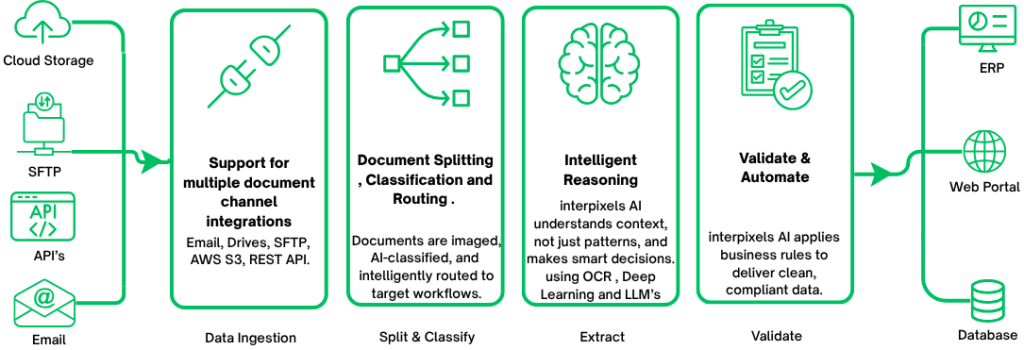
How InterPixels AI addresses it: Gate 1 completeness validation ensures every claim entering extraction is correctly documented before any processing resources are consumed. Gate 2 runs three concurrent fraud and validation checks on every claim during extraction. Prescription-pharmacy cross-validation, invoice arithmetic verification, and document authenticity analysis. Structured JSON output per claim reduces the leakage that drives claims cost growth at scale.

MOH’s IP rider changes from April 2026 have added a new layer of per-policy adjudication complexity that manual workflows cannot handle accurately at volume.
MOH announced on November 26, 2025 that from April 1, 2026, new IP riders are no longer permitted to cover the minimum IP deductibles set by MOH. These deductibles range from SGD 1,500 to SGD 3,500 per policy year depending on ward class. The minimum co-payment cap per policy year has been raised from SGD 3,000 to SGD 6,000, excluding the deductible. The minimum 5% co-payment requirement remains unchanged. New private hospital rider premiums are expected to be approximately 30% lower than existing maximum coverage riders as a result. Policyholders who purchased non-compliant riders on or after November 27, 2025 must transition to compliant riders no later than their next policy renewal after April 1, 2028.
For TPAs that administer corporate IP-linked benefits, these changes mean claims against IP policies now require precise per-policy validation: IP tier, ward class used, deductible applicable, whether the policyholder holds a compliant or transitional rider, and the correct co-payment cap. Claims submitted before and after the April 2026 transition date may carry different co-payment structures. Processing these through a manual workflow without field-level extraction and per-policy validation introduces material adjudication error at scale.
How InterPixels AI addresses it: Gate 2 extracts all fields required for co-payment and deductible validation per claim, outputting them in structured JSON formatted to your adjudication system’s schema. The data your system needs to apply the correct co-payment logic for each policy type is present, extracted, and confidence-scored in every claim output.

MAS and MOH require fair and timely claims processing. Singapore’s PDPA requires that health data is handled with documented governance throughout. Manual workflows satisfy neither at volume.
MAS and MOH require insurance companies to uphold contractual obligations and process claims in a fair manner, as confirmed in MOH’s Parliamentary response in September 2025. Under MAS insurance regulations, insurers must notify policyholders of any change in policy terms at least 30 days before it takes effect. Claims disputes may be escalated to the Financial Industry Disputes Resolution Centre (FIDReC). For TPAs, this creates a clear accountability requirement: every claim decision must be defensible and every field decision must be traceable.
Singapore’s Personal Data Protection Act (PDPA) applies to all health data processed by TPAs. Corporate group health insurance claims contain medical records, diagnosis codes, treatment details, and personally identifiable information of employees. PDPA requires that such data is collected, used, and disclosed only for stated purposes and that adequate technical and governance protections are in place throughout processing. Manual workflows that route health data through unstructured channels, shared inboxes, or spreadsheets create PDPA exposure that structured API-based processing eliminates.
How InterPixels AI addresses it: Every field extracted by InterPixels AI is logged with a confidence score. Where reviewed by a human, a full HITL audit record is created. Every claim output is structured and retrievable. Data flows through the API under token-based authentication. The audit trail produced supports both MAS fair dealing requirements and PDPA governance obligations.

69% of Singapore residents hold an IP on top of MediShield Life. Corporate health benefits for non-residents add a second uncovered population. Processing both accurately requires document-level consistency that manual teams cannot sustain.
According to the Commonwealth Fund’s 2024 data, 69% of Singapore residents hold an Integrated Shield Plan supplementing their MediShield Life coverage. As of June 2024, non-residents made up 30.7% of Singapore’s population. Non-residents are not eligible for government subsidies and rely on employer-provided insurance. Foreign workers are a significant proportion of Singapore’s workforce and their employer-sponsored health coverage is administered entirely by TPAs with no MediShield Life baseline to fall back on.
Corporate group health TPAs in Singapore therefore process claims from two distinct populations with different insurance structures: residents with IP-linked corporate coverage and non-residents with standalone group health cover. Each population presents different document sets, different co-payment structures, and different adjudication logic. Manual workflows that were designed for one population introduce errors when applied to the other.
How InterPixels AI addresses it: Gate 1 classifies the claim type on every submission regardless of the underlying insurance structure. Gate 2 extracts the relevant fields and applies the appropriate validation logic per claim. The same API, the same output schema, the same fraud detection checks apply to every claim regardless of the policyholder’s residency or insurance type.

The Product
Two gates. Every claim. No exceptions.
Gate 1: Completeness Validation
Every claim submission passes through Gate 1 first. InterPixels AI classifies all submitted documents, identifies the claim type (IPD, OPD, or KYC), and verifies that every required document class is present. Incomplete submissions are blocked immediately and returned with a specific list of missing documents. No processing resources are consumed on a claim that cannot be adjudicated.
Gate 2: Extraction and Fraud Detection
Claims that pass Gate 1 enter extraction. InterPixels AI reads every document using OCR and Generative AI, extracts all fields with per-field confidence scoring, and runs three concurrent fraud detection checks during extraction. Prescription-pharmacy cross-validation, invoice arithmetic verification, and document authenticity analysis. Structured JSON output is returned per claim, ready for your adjudication system.
HITL: Human-in-the-Loop
Fields extracted below confidence threshold are automatically flagged and routed to your operations team for review. Reviewers see only the fields requiring a decision, not the entire document. Every reviewed decision is logged for audit and compliance.
API-First
REST API. No UI changes to your existing TPA platform. No retraining of staff. Integration in 4 to 6 weeks.
Document Coverage · India
Built for the documents Indian health insurance TPAs actually process.
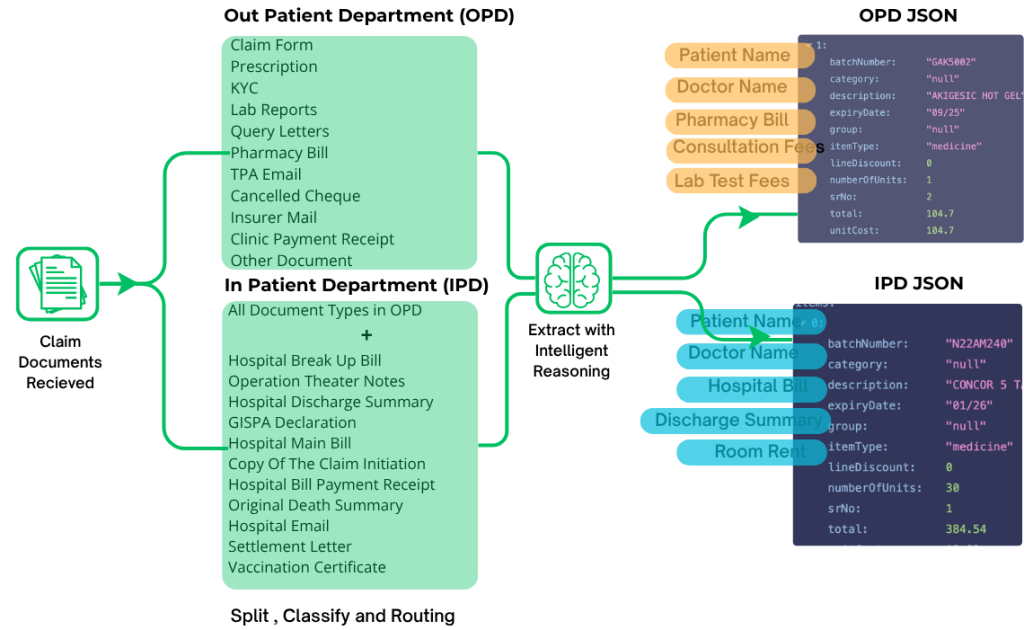
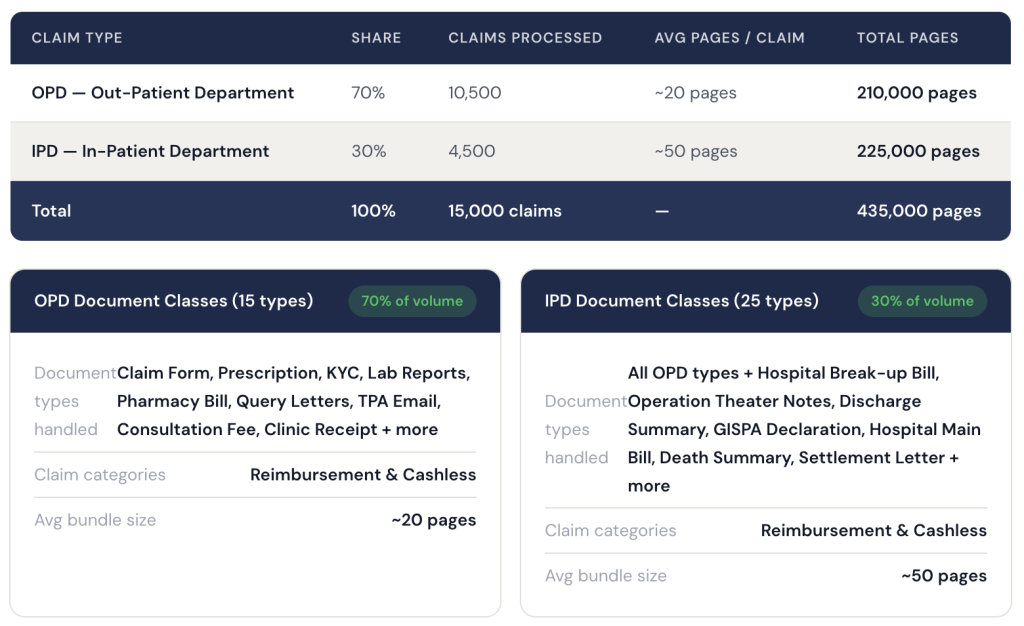
IPD: In-Patient Department 25 document classes
Cashless Claim Form, Hospital Main Bill, Hospital Break-Up Bill, Operation Theatre Notes, Hospital Discharge Summary, GISPA Declaration, Room Rent Receipt, Pharmacy Bill (inpatient), Laboratory Reports, Radiology and Imaging Reports, Doctor Consultation Notes, Anaesthesia Notes, Pre-authorisation Letter, TPA Authorisation Letter, Settlement Letter, Original Death Summary, Vaccination Certificate, Hospital Email Correspondence, Hospital Bill Payment Receipt, Copy of Claim Initiation, Cancelled Cheque, Insurer Mail, Query Letters, KYC Documents, Other Supporting Documents.
OPD: Out-Patient Department 15 document classes
Claim Form, Prescription, Pharmacy Bill, Laboratory Reports, Radiology Reports, Consultation Fee Receipt, Clinic Payment Receipt, TPA Email, Cancelled Cheque, Insurer Mail, Query Letters, KYC Documents, Referral Letter, Diagnostic Test Report, Other Supporting Documents.
KYC Documents
Aadhaar Card (front and back), PAN Card, Passport, Voter ID, Driving Licence.
Language OCR
Hindi, English, Tamil, Telugu, Bengali. Printed and handwritten. Handwritten prescriptions processed with per-field confidence scoring across all supported scripts.
Case Study · India
InsurTech : 40 minutes to 5 minutes per claim.
Stat 1: 15,000+ Claims processed in production
Stat 2: 8x Faster claim processing
Stat 3: 40 min to 5 min Per claim, data extraction
InsurTech India was processing health insurance claims manually. Sorting documents, entering data, validating fields before adjudication could begin. After integrating the InterPixels AI Claims Intelligence API, the full upstream document workflow was automated across IPD and OPD claim types. The operations team now reviews only flagged exceptions. Adjudication starts where the document work ends.
Integration Reality
Live in 4 to 6 weeks. No changes to your existing system.
REST API. Structured JSON output formatted to your schema.
Send claims via Email, SFTP, AWS S3, or direct API call.
PDF, JPG and PNG formats supported.
No changes to your TPA platform, UI, or staff workflows.
HITL review interface included. No separate tooling required.

INSIGHTS & INTELLIGENCE
Thinking on Claims, Documents & TPA Operations
Perspectives and analysis from the InterPixels AI team on health insurance claims automation, document intelligence, and operational efficiency across Asia-Pacific.