
A health insurance claims processing API is a REST interface that sits between a TPA’s document intake channel and its existing claims management system. It classifies incoming documents, extracts structured field data with confidence scores, applies real-time fraud validation, and routes low-confidence cases to human reviewers, returning a standardised JSON payload that feeds directly into adjudication. No changes to the TPA platform, UI, or workflows are required.
Why Automation Is Now a TPA Board Conversation, Not an IT Project
The health insurance claims processing API is reshaping how APAC third-party administrators think about automation. McKinsey analysis shows that more than 50% of claims activities have automation potential by 2030. The same research firm found in its July 2025 report on the future of AI in insurance that insurers who have already moved on AI are generating 6.1 times the total shareholder return of those that have not. That gap is widening every quarter.
For TPA CTOs, the calculation is blunt: manual document review consumes an average of 40 minutes per claim before adjudication even begins. InterPixels AI production data from a leading InsurTech services provider in India shows the same upstream work completed in under five minutes, an 8x improvement across more than 15,000 claims. The constraint is not ambition. It is the question of how to get there without dismantling a platform that processes thousands of claims per day.
The answer is not a new platform. It is an intelligence layer delivered via API on top of the platform that already exists.
“The fastest path to claims intelligence is not a new platform. It is an API layer that makes the platform you already have smarter.”
The Real Cost of Platform Replacement for APAC TPAs
Platform replacement is not the default path to claims automation. BCG has documented Central and Southern European insurance platform replacement programs that ran 500% over budget and produced write-offs exceeding $500 million in a single case. Those are not outliers; they reflect a structural problem.
BCG research has found that roughly 35% of all insurance applications globally still run on legacy technology stacks that are not cloud-ready. Gartner confirms that legacy modernisation programs typically take 12 to 18 months and routinely overrun their timelines. For APAC TPAs, the barriers go further:
- Regulatory certification of the existing TPA system was obtained over the years and is not trivially transferable to a new platform
- Customised adjudication logic and workflow rules embedded in the current system after years of iteration
- Staff trained on existing workflows, where retraining timelines stretch the disruption window further
- The dual-system trap: running old and new platforms concurrently while migration completes, doubling operational cost
A Deloitte 2024 survey of 200 insurance executives found that 76% have already implemented generative AI capabilities in at least one business function. In APAC specifically, Deloitte notes that technical talent availability and cultural acceptance are accelerating adoption. The executives moving fastest are not replacing their core systems first; they are layering intelligence on top of them.
“BCG documented platform replacement programs running 500% over budget. An API integration that goes live in 4 to 6 weeks is not a compromise; it is a strategic choice.”
What API-First Actually Means for a TPA
API-first for a TPA means adding a claims intelligence layer on top of the existing platform via a REST API, no UI changes, no data migration, no retraining, delivering structured JSON output ready for adjudication.
The InterPixels AI claims intelligence API sits between the TPA’s document intake channel and its claims management system. It does not see the adjudication system. It does not touch policy data. It receives documents, processes them, and returns a structured JSON payload that the TPA’s existing system can consume directly.
The API handles every upstream document task that currently consumes staff time:
- Document classification across 40+ health insurance document types (IPD, OPD, KYC)
- Field extraction using OCR and Generative AI across 200+ languages for printed documents, 50 languages for handwritten text
- Completeness validation at intake, blocking incomplete submissions before any extraction resources are consumed
- Real-time fraud detection across three concurrent validation layers
- HITL routing for low-confidence fields, with a full field-level audit trail retained
Teams building this integration typically find that the scope on their side is narrower than expected. The TPA’s tech team provides sample documents, confirms the output JSON schema, and configures the ingestion channel. InterPixels handles classification model configuration, extraction logic, HITL routing rules, and integration support through to go-live.
The Integration Flow, Step by Step
A claim arrives at the TPA’s intake channel, documents are sent to the InterPixels AI API endpoint, structured JSON is returned in under five minutes, and the TPA system processes the result no manual document handling required at any stage.
Step 1: Gate 1 Completeness Validation
Every submission is classified on arrival. The API identifies the claim type (IPD, OPD, or KYC) and checks that all required document classes are present. A missing discharge summary, absent prescription, or incomplete KYC document triggers an immediate block. The response specifies exactly which documents are missing. No extraction resources are consumed on a submission that cannot reach adjudication.
Step 2: OCR and GenAI Extraction
For complete submissions, OCR and Generative AI extract all required fields. A January 2026 arXiv paper (Ho et al., arXiv:2601.01897) validated this hybrid approach against real APAC claims data from Fullerton Health across nine markets including Singapore, the Philippines, Indonesia, and Malaysia, achieving 95%+ document classification accuracy and approximately 87% field-level extraction accuracy at under two seconds per document. Every extracted field carries a confidence score.
Step 3: Three-Layer Fraud Detection
Fraud detection runs concurrently with extraction, not as a downstream check. Prescription-pharmacy cross-validation compares medications prescribed against pharmacy dispensing records to catch quantity mismatches and phantom prescriptions. Invoice arithmetic validation verifies that all line-item totals are mathematically consistent. Document authenticity analysis detects editing artefacts, font inconsistencies, and tampering indicators in financial documents. All flags are embedded directly in the JSON payload returned to the TPA.
Step 4: HITL Routing for Low-Confidence Fields
Fields extracted below the confidence threshold are routed to the TPA’s operations team for review. Reviewers see only the fields requiring a decision, not the entire document. Once confirmed or corrected, the claim proceeds. The full field-level change log and audit trail are retained for regulatory compliance. Gartner’s Hype Cycle research on insurance technology identifies HITL governance as a core requirement for IDP deployments in regulated industries, keeping human accountability at every uncertain decision point.
“The API does not replace the TPA’s adjudication system. It eliminates the document work that sits upstream of it, so adjudication starts where the document work ends.”
Integration Architecture
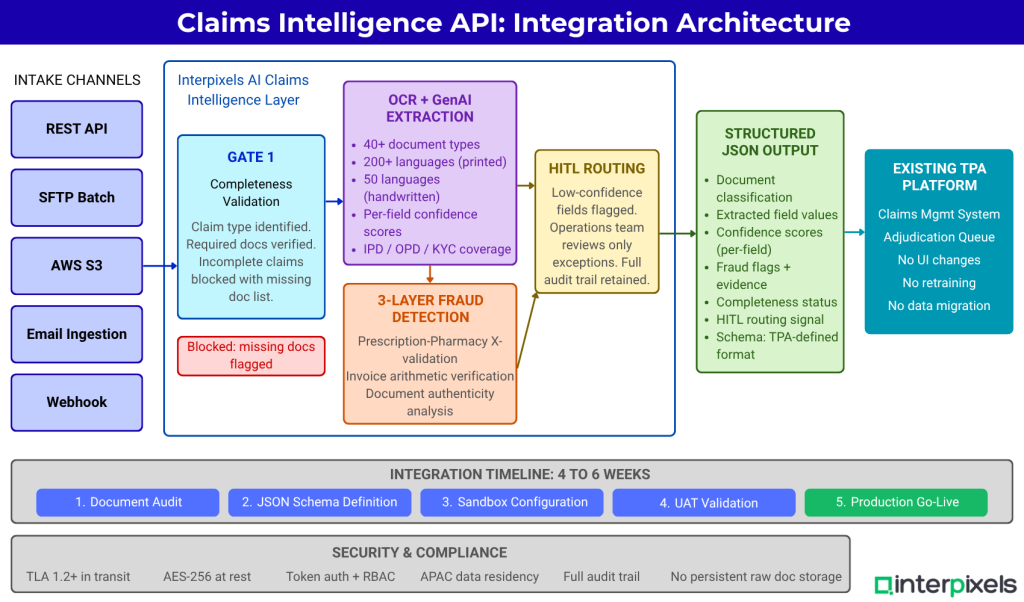
Figure: InterPixels AI Integration Architecture for APAC Health Insurance TPAs. Claim documents enter via REST API, SFTP, AWS S3, email ingestion, or webhook callback. Gate 1 completeness validation runs first. OCR and GenAI extract structured fields across 40+ document types in 200+ languages. Three fraud detection layers run concurrently. Low-confidence fields route to HITL review. Structured JSON returns to the TPA’s existing claims management system. No platform changes required. Integration live in 4 to 6 weeks.
What the API Returns – The JSON Payload Explained
The InterPixels AI API returns a structured JSON object containing document classification, extracted field values, per-field confidence scores, fraud flags with evidence, completeness status, and a HITL routing signal formatted to the TPA’s own schema requirements.
Every JSON response includes:
- Document classification: claim type (IPD / OPD / KYC) and all document classes identified within the submission
- Extracted field values: patient name, diagnosis codes, provider details, dates, amounts, medication names, and all schema-required fields
- Confidence scores: per-field numerical scores that trigger HITL routing for fields below the agreed threshold
- Fraud flags: specific anomaly type, evidence, and the field or document implicated
- Completeness status: confirmed-complete or blocked-with-missing-document-list
- HITL routing signal: boolean flag indicating whether any fields require human review before the claim proceeds
The output schema is defined jointly with each TPA client during integration. InterPixels AI formats the JSON to match the downstream system’s requirements, so the payload plugs into the adjudication queue without reformatting. SDKs are available for Python, Node.js, and Java to simplify the TPA-side connection.
Claims Processing Approach Comparison
| Approach | Key Strength | Best Used When |
|---|---|---|
| Full platform replacement | Clean slate architecture, modern data model, cloud-native from day one | TPA has 12-18 months runway, budget, and an aging system with no regulatory customisations to preserve |
| API-first integration (claims intelligence layer) | Live in 4-6 weeks, zero platform disruption, immediate ROI on document automation | TPA has a certified, customised system it cannot afford to re-implement; needs intelligence without disruption |
| Manual processing (status quo) | No IT project risk, no integration complexity, no vendor dependency | Claim volumes are very low and accuracy requirements are minimal — rarely valid at TPA scale |
“APAC TPAs are not resistant to automation. They are resistant to disruption. The API-first model removes the disruption, and the resistance disappears.”
Security, Data Residency, and Compliance
InterPixels AI uses TLS 1.2+ encryption in transit, AES-256 at rest, token-based API authentication, and APAC-region hosting so that claim data does not leave the required jurisdiction with a full audit trail on every document processed.
Health insurance claim documents contain patient health information, financial records, and KYC identity data. InterPixels AI treats data security as a baseline design requirement:
- Data encrypted in transit (TLS 1.2+) and at rest (AES-256)
- APAC-region hosting available data does not leave the required jurisdiction for markets including India, Malaysia, Indonesia, Singapore, Thailand, and the Philippines.
- Token-based API authentication with role-level access controls
- Timestamped, traceable audit trail on every document processed, including field-level change log for HITL decisions
- No persistent raw document storage post-processing
- Data Processing Agreements available for enterprise and regulated clients
Accenture (February 2026) notes that GenAI and agentic AI can extract and validate data from legacy tech stacks without a radical change of tech stack or architectural transformation; the same principle applies to the security posture.
“Data residency is not a checkbox for APAC TPAs; it is a regulatory baseline. The API must keep claim data within the jurisdiction it came from.”
How Long Does Integration Actually Take?
Most TPA API integrations with InterPixels AI go live in 4 to 6 weeks compared to 12 to 18 months or longer for platform replacement. The integration follows five consistent stages:
- Document audit: InterPixels reviews the TPA’s document types, formats, language variations, and volume profile
- JSON schema definition: The TPA confirms the output fields its downstream system requires
- Sandbox configuration: Classification and extraction models are aligned to the TPA’s document set using a minimum of 50 sample documents per document class
- UAT and accuracy validation: Outputs are tested against real claim samples before production
- Production go-live: Live processing begins at agreed volume thresholds, with accuracy monitoring ongoing post-deployment
In practice, the TPA’s tech team is responsible for four things: providing sample documents, confirming the JSON schema, configuring the ingestion channel (API credentials, SFTP keys, or S3 bucket access), and UAT sign-off. InterPixels provides a dedicated integration engineer from kickoff through to production.
The benchmark from production: a leading InsurTech services provider in India reduced claims processing time from 40 minutes to 5 minutes per claim across more than 15,000 claims after going live with InterPixels AI. That improvement began on day one of production, not 18 months later.
Frequently Asked Questions
What is a health insurance claims processing API?
A health insurance claims processing API is a REST interface that connects to a TPA’s document intake channel and returns structured JSON data for each claim submission. It classifies documents, extracts key fields, validates completeness, detects fraud in real time, and routes low-confidence extractions to human reviewers. The TPA’s existing claims management system receives the JSON payload and proceeds to adjudication without manual document handling. No changes to the TPA platform are required.
How does a claims automation API integrate with an existing TPA system?
The API sits between the TPA’s document intake and its claims management system. Documents arrive via REST API, SFTP, AWS S3, email ingestion, or webhook. The API processes them and returns structured JSON to the TPA’s system. The TPA’s tech team configures the ingestion channel and confirms the output schema. InterPixels AI handles all model configuration and integration support. Most integrations go live in 4 to 6 weeks with no disruption to existing workflows.
What is the difference between API integration and platform replacement for a TPA?
Platform replacement removes and rebuilds the TPA’s core claims management system, a process that typically takes 12 to 18 months or longer, carries significant over-budget risk, and requires staff retraining and regulatory re-certification. API integration adds an intelligence layer on top of the existing platform without touching it. The TPA’s system, workflows, and adjudication logic remain unchanged. Claims data is enriched and structured by the API before reaching the platform, not after.
What does the API return? What data does the JSON payload include?
The JSON payload includes document classification (claim type and document classes identified), extracted field values for all schema-required fields, per-field confidence scores, fraud flags with specific evidence for each anomaly detected, completeness status, and a HITL routing signal. The schema is defined to match each TPA’s downstream system requirements. Every field returned is formatted for direct ingestion into the TPA’s adjudication queue without reformatting.
How long does it take to go live with a claims intelligence API?
InterPixels AI integrations go live in 4 to 6 weeks in most deployments. The timeline covers five stages: document audit, JSON schema definition, sandbox configuration, UAT validation, and production go-live. The TPA’s tech team provides sample documents and confirms the output schema. InterPixels provides a dedicated integration engineer throughout. Timeline varies based on existing infrastructure, document volumes, and internal IT capacity, but the absence of any platform changes eliminates the largest sources of delay.
The Strategic Case, Summarized
Three things are true for APAC TPAs considering claims automation right now.
First, the cost of the status quo is compounding. Manual document review at 40 minutes per claim is a ceiling on how fast a TPA can grow without adding proportional headcount. McKinsey analysis shows that more than 50% of claims activities can be automated by 2030. The TPAs capturing that upside are not waiting for a platform replacement cycle.
Second, platform replacement is the hardest way to get there. BCG’s documented cases of programs running 500% over budget are not exceptions; they are the pattern. The regulatory certification, workflow customization, and dual-system transition costs are real, and they fall on the TPA’s IT team and operations simultaneously.
Third, the API-first model removes the tradeoff. A REST API integration that goes live in 4 to 6 weeks, returns structured JSON to the existing system, and requires no platform changes means a TPA can have production-grade claims intelligence without the risk of a multi-year transformation program.
The question worth sitting with: if your team can have 8x faster claims processing in six weeks without touching the platform, what is the cost of waiting another quarter to begin?
Explore the InterPixels AI API at interpixels.ai/api or review integration channel options at interpixels.ai/integrations. Book a demo to see a live JSON output for your claim types.
Table of Content
- Why Automation Is Now a TPA Board Conversation, Not an IT Project
- The Real Cost of Platform Replacement for APAC TPAs
- What API-First Actually Means for a TPA
- The Integration Flow, Step by Step
- What the API Returns – The JSON Payload Explained
- Security, Data Residency, and Compliance
- How Long Does Integration Actually Take?
- Frequently Asked Questions
- What is a health insurance claims processing API?
- How does a claims automation API integrate with an existing TPA system?
- What is the difference between API integration and platform replacement for a TPA?
- What does the API return? What data does the JSON payload include?
- How long does it take to go live with a claims intelligence API?
- The Strategic Case, Summarized