
It is the measurable financial return a Third-Party Administrator achieves by replacing manual claims handling with AI-driven workflows. This return comes from three sources: lower cost per claim (from approximately $40–$60 manual to under $20 automated), reduced claims leakage through consistent rule application, and faster turnaround that avoids regulatory penalties. For APAC TPAs, ROI also includes the compliance value of meeting IRDAI and regional TAT mandates.
The Cost of Standing Still Is Higher Than You Think
Manual health insurance claims processing costs APAC TPAs between $40 and $60 per claim; automation brings that figure below $20 while cutting processing time from 40 minutes to under 5 minutes per claim.
The global Insurance TPA market was valued at USD 307 billion in 2022 and is projected to reach USD 511 billion by 2030, growing at a CAGR of 5.5% (Next Move Strategy Consulting, 2023). Every point of that growth increases claim volume. Yet most APAC TPAs still process the majority of claims manually. That gap is where ROI lives. The health insurance claims automation ROI conversation in India and Southeast Asia is no longer theoretical: regulatory pressure, staffing costs, and competitive margin compression have turned it into a budget-year decision.
India’s IRDAI data for FY2024 shows health claim rejections rose 19.10 percent year-on-year to Rs 26,000 crore. A significant portion of those rejections trace directly to documentation errors and manual processing failures. Each rejected claim costs your TPA time, rework cost, and relationship capital with the insured. Automation prevents the rejection before it happens.
This post builds three specific ROI scenarios for small, mid, and large APAC TPAs. The numbers use published benchmarks from Deloitte, McKinsey, and IRDAI, anchored to real TPA operating economics. A link to our ROI calculator appears at the end for you to model your own numbers.
Why APAC TPA Economics Make the Automation Case Stronger Than in the West
APAC TPAs face a unique cost-pressure combination: lower per-employee labour costs mask higher per-claim processing times caused by fragmented hospital data, mixed document formats, and multi-language submissions. Automation resolves exactly those friction points.
A US or UK TPA running automation ROI models starts from a high labour-cost baseline. Saving $40 per claim per FTE has a fast payback because the avoided cost is large. APAC TPAs sometimes assume their lower labour costs reduce the automation case. This is the wrong calculation. The actual cost driver in APAC is volume and error rate, not hourly wage. When you process 20,000 claims a month with a 15–20 percent initial rejection rate, the rework cost, TAT penalty exposure, and leakage dwarf the original processing cost.
Malaysia’s digital health infrastructure, India’s NHCX interoperability initiative, and Singapore’s MediShield Life all push more structured data into claim workflows. TPAs that automate now capture the efficiency dividend from that data quality improvement. TPAs that wait will find their manual teams still struggling with the same exceptions as data quality improves around them.
The biggest ROI mistake APAC TPAs make is comparing their labour cost to a US benchmark. The real opportunity is in the 15–20 percent rejection rate that automation eliminates before claims ever reach a human desk.
The Three ROI Scenarios: Small, Mid, and Large TPA
A small TPA processing 5,000 claims per month can expect payback in 10–14 months; a mid-sized TPA at 20,000 claims per month typically breaks even within 8–12 months; a large TPA at 100,000 claims per month can recover automation investment in 6–9 months.
The model below uses the Deloitte “Future of Claims” (2022) benchmark of $40–$60 manual cost per claim and under $20 automated cost per claim as its spine. These are US-market benchmarks used as industry-standard proxies; APAC absolute costs will vary by country and labour market, but the proportional reduction holds across markets. India-specific figures are converted at approximately INR 83 to the USD. All figures are processing cost only, excluding the benefit payout itself.
Table 1: TPA Claims Automation ROI Scenarios
| TPA size | Claims / month | Manual cost / month | Automated cost / month | Est. payback period |
|---|---|---|---|---|
| Small TPA | 5,000 | INR 20L (~$24K) | INR 6L (~$7.2K) | 10–14 months |
| Mid TPA | 20,000 | INR 80L (~$96K) | INR 24L (~$29K) | 8–12 months |
| Large TPA | 100,000 | INR 400L (~$480K) | INR 120L (~$144K) | 6–9 months |
Assumptions: Manual cost at approx. Rs 1,660 per claim (midpoint of Deloitte US benchmark converted to INR); automation platform cost at approx. Rs 500 per claim at scale. Indicative implementation cost: INR 40L for small TPA, INR 1.2 Cr for mid, INR 4.5 Cr for large. These are directional estimates; run your own numbers using the ROI calculator.
In practice, the payback models above are conservative. They exclude three additional ROI streams: leakage prevention (Section 3), compliance penalty avoidance (Section 4), and staff redeployment value. Include all three and payback timelines often shrink by 20–30 percent.
A mid-sized TPA at 20,000 claims per month that reduces its cost per claim from Rs 1,660 to Rs 500 saves over INR 2.8 crore annually from processing cost alone, before a single rupee of fraud prevention is counted.
Where the Money Actually Goes: Four Automation ROI Drivers
The four main ROI drivers are cost-per-claim reduction, claims leakage prevention, TAT compliance avoidance of penalties, and staff redeployment from data entry to exception handling.
Table 2: ROI Driver Breakdown (20,000 Claims/Month TPA)
| ROI driver | Manual baseline | Automated outcome | Annual saving (20K claims/month TPA) |
|---|---|---|---|
| Cost per claim | $40–$60 (Deloitte 2022) | Under $20 | ~INR 3.2 Cr ($384K) |
| Processing time | 35–45 min per claim | 3–7 min (STP); 15–20 min (complex) | FTE redeployment: 18–22 staff hours freed/day |
| Claims leakage | 5–8% of claim value lost to errors/fraud | AI detection improvement of 20–40% over manual (Deloitte 2025) | ~INR 1.5–2.4 Cr on INR 30 Cr monthly payout |
| Rejection rate | 15–20% initial rejection (IRDAI FY24 data) | Under 5% with pre-submission validation | Reduced rework: 12–15 fewer FTE-hours/day |
The leakage line is the most underestimated in most TPA ROI models. Soft fraud, which inflates a legitimate claim, accounts for 60 percent of all fraud incidents. Deloitte’s 2025 research finds manual detection rates for soft fraud run at only 20–40 percent. Deploying AI-driven multimodal fraud analytics could deliver savings improvements of 20–40 percent over manual operations, depending on implementation and product mix. On a mid-sized TPA paying out INR 30 crore per month in claims, even a 2 percent leakage reduction saves INR 60 lakh per month.
According to McKinsey’s “Insurance 2030” analysis (2021), insurance companies that embrace digital transformation can reduce claims expenses by up to 30 percent. UK insurer Aviva, as reported in McKinsey’s July 2025 AI in Insurance update, saved more than GBP 60 million in 2024 by deploying over 80 AI models across its motor claims domain. While the Aviva numbers are UK motor, the unit-economics logic transfers directly to health TPA operations in India and Malaysia.
Staff redeployment is the ROI driver CFOs most often undercount at approval stage and most appreciate post-implementation. Teams building this find the clearest near-term win is redeploying data-entry staff to provider relationship management and pre-authorisation query resolution. Both activities have direct impact on TAT compliance and net promoter scores with corporate clients.
Automation does not eliminate your claims team. It removes the 40-minute-per-claim data transcription burden so your people can spend their time on exceptions, provider disputes, and corporate client service.
The Compliance ROI Nobody Puts in a Spreadsheet
India’s 2024 IRDAI Health Insurance Master Circular mandates 1-hour cashless pre-authorisation and 3-hour discharge approvals. Non-compliant TPAs face daily interest penalties at bank rate plus 2 percent, making automation a risk mitigation investment, not just an efficiency play.
The IRDAI Master Circular on Health Insurance Products (May 29, 2024) is the regulatory forcing function that changes the automation calculus for every Indian TPA. The regulation requires cashless authorisation within 1 hour of receiving hospital documents. Final discharge authorisation must arrive within 3 hours. Insurers must also bear any additional hospital charges caused by a delay beyond those limits. The IRDAI PPHI Circular (September 2024) further tightened policyholder interest provisions, including the bank rate plus 2 percent daily penalty for delayed settlements.
Manual workflows at most mid-sized TPAs run a 35–45 minute processing time per claim on a good day. That leaves almost no buffer to meet the 1-hour cashless TAT, and zero capacity for concurrent peak-hour submissions. A hospital that submits 15 pre-auth requests between 8 AM and 10 AM will breach your TAT on at least 3 to 5 of them under a fully manual operation.
Automated pre-authorisation systems trigger the eligibility and rules check the moment the hospital submits via the NHCX or a direct API. Response time drops to 4–8 minutes for straight-through cases. That gives you a 50-minute compliance buffer on every standard submission. For APAC TPAs operating in Malaysia and Singapore, similar TAT obligations are embedded in BNM and MAS service standards for group health administrators.
The compliance ROI also includes audit trail value. Regulatory examinations increasingly scrutinise AI model governance. The IRDAI has signalled that TPAs must maintain documentation of how automated decisions are made. Purpose-built claims automation platforms generate immutable, timestamped audit logs by design. Building equivalent documentation into a patched manual-plus-spreadsheet operation costs 3 to 5 times more.
Every manual pre-authorisation your team processes in over 60 minutes is a potential IRDAI penalty event. At bank rate plus 2 percent per day, 30 such events per month on a Rs 50,000 average claim produces a six-figure annual liability that never appears in your claims budget.
Architecture: How an Automated Claims Stack Actually Works
A modern TPA claims automation stack has five layers: document ingestion (OCR + NLP), eligibility and policy rules engine, AI fraud scoring, straight-through processing adjudication, and audit trail and reporting, connected via APIs to hospital HMS systems and the insurer core platform.
The architecture below shows the end-to-end flow. The stack is modular by design. Most APAC TPAs start with Layers 1 and 2, which deliver the fastest TAT improvement with the lowest integration complexity. Layer 3 (AI fraud scoring) adds the leakage prevention ROI but requires a minimum of 6–12 months of structured claim history to train effectively.
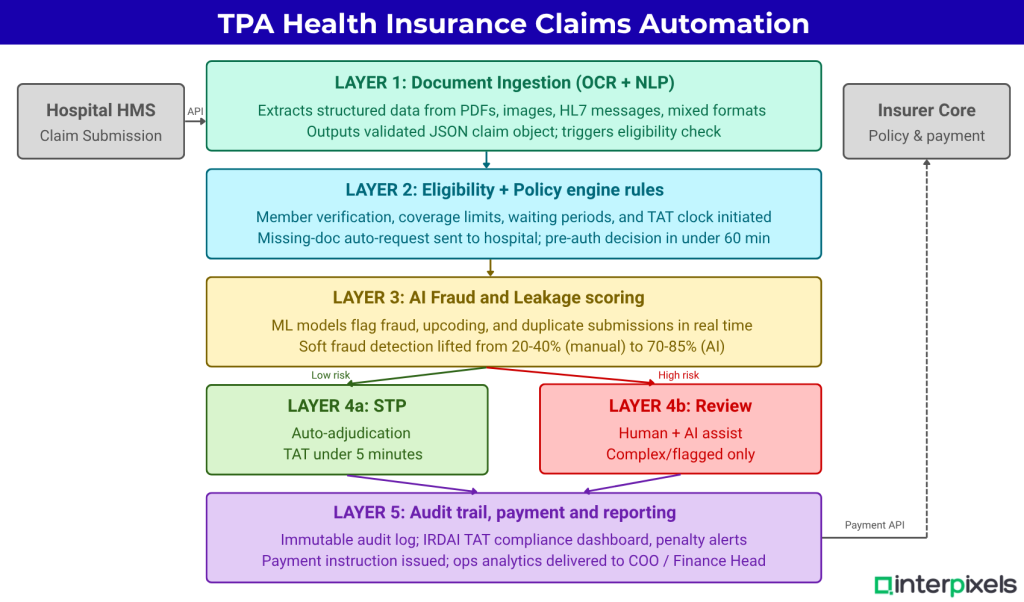
Architecture diagram caption: The five-layer TPA claims automation stack processes a submitted claim from hospital document ingestion through AI fraud scoring to payment instruction in under 7 minutes for straight-through cases. Layer 4a (STP) handles 60–75 percent of claims in mature deployments. Layer 4b routes complex and flagged claims to human reviewers with an AI-generated case summary, reducing human review time by 40–50 percent compared to fully manual assessment. All layers write to the Layer 5 audit trail, which is the compliance spine for IRDAI examinations. Source: Adapted from the TrueCover platform architecture for APAC TPA context.
The API integration layer is the implementation component that most surprises first-time deployers. Connecting to hospital HMS systems in India ranges from straightforward (large chain hospitals using HL7 FHIR or NHCX-compliant formats) to complex (smaller nursing homes submitting paper-scanned PDFs). Purpose-built APAC claims automation vendors, including TrueCover, handle this heterogeneity through adaptive OCR engines and ML-based document classification trained on Indian and Southeast Asian billing formats.
Implementation: What Teams Building This Typically Find
The biggest implementation surprise for APAC TPAs is that data readiness, specifically clean policy master data and standardised hospital billing codes, determines 70 percent of automation ROI, not the AI technology itself.
Table 3: Automation Approach Comparison
| Option | Key strength | Best used when | Typical APAC TPA fit |
|---|---|---|---|
| Rule-based only | Fast to deploy, fully auditable, no training data needed | Highly standardised products with stable benefit schedules | Government scheme TPAs with fixed tariffs |
| Rule-based + ML | Handles exceptions; fraud scoring improves with volume; proven ROI within 12 months | Mixed product portfolios; moderate fraud exposure; 10K+ claims/month | Most mid-sized and large Indian and Malaysian TPAs |
| Full agentic AI | Handles unstructured inputs, multi-language docs, complex multi-line billing | Large TPAs with diverse hospital networks and high document variance | Large group health TPAs in India, Singapore, Malaysia |
In practice, teams building a rules-plus-ML stack typically find three things that no vendor pre-sales conversation mentions. First, your policy master data almost certainly has gaps. Benefit schedules that were manually maintained across Excel files will need 4–6 weeks of cleanup before the rules engine can fire correctly. Budget for this. Second, hospital onboarding is slower than expected. Getting 80 percent of your hospital network to submit structured digital claims usually takes 9–12 months, not 3. Third, your fraud model improves significantly between month 6 and month 18 as it sees more claim patterns. The ROI in year 2 typically exceeds year 1 by 30–40 percent as the model matures.
Academic research from Alam and Prybutok (2024) confirms that machine learning models including XGBoost and Random Forest outperform traditional actuarial approaches for predicting health insurance claim costs and outcomes. A 2025 study published in MDPI Data found Random Forest achieving 88.67 percent classification accuracy and AUC of 0.9437 for high-cost claim identification (based on motor bodily-injury data from 2018–2024); the underlying methodology applies directly to health claim triage. Both findings validate the ML tier in a rules-plus-ML stack for APAC TPAs operating at 10,000+ claims per month.
A PRISMA-guided systematic review (PMC 2024) of AI adoption across the insurance industry identifies data governance as the single most critical success factor for sustained ROI. This mirrors what implementation teams find on the ground: the technology is available and proven; the constraint is always data quality and organisational readiness, not the AI itself.
Deploy automation in 30–60 day sprints, starting with document ingestion and rules only. Ship the fraud scoring layer once your claims history is clean enough to train on. Trying to go full-stack on day one is how implementation timelines slip from 6 months to 18.
Frequently Asked Questions About Health Insurance Claims Automation ROI
How much does it cost to process a health insurance claim manually at an Indian TPA?
Based on Deloitte’s “Future of Claims” (2022) benchmark, manual health insurance claims processing costs between $40 and $60 per claim in developed markets. These are US-benchmarked figures used as an industry proxy; equivalent INR figures for mid-sized Indian TPAs fall in the range of Rs 1,400 to Rs 2,200 per claim, reflecting lower but still significant Indian labour and overhead costs. Automation consistently reduces this to under Rs 600 per claim at volume across APAC markets.
What is realistic automation ROI for a TPA processing 20,000 health claims per month?
A mid-sized APAC TPA at 20,000 claims per month can typically expect INR 2.5 to 3.5 crore in annual processing cost savings, plus INR 1.5 to 2.5 crore in leakage prevention through improved fraud detection. Combined ROI reaches INR 4 to 6 crore per year against indicative implementation costs of INR 1 to 1.5 crore, giving a payback period of 8–12 months and a 3-year ROI of 300–400 percent.
Does health insurance claims automation help meet IRDAI TAT requirements?
Yes, directly. The IRDAI May 2024 Health Insurance Master Circular mandates cashless pre-authorisation within 1 hour and discharge approval within 3 hours. Automated straight-through processing delivers pre-authorisation decisions in 4–8 minutes for standard claims, giving TPAs a 50-minute compliance buffer. Without automation, manual operations averaging 35–45 minutes per claim have almost no margin to meet peak-hour TAT obligations.
How long does it take to implement claims automation at an APAC TPA?
A phased implementation of document ingestion plus a policy rules engine typically goes live in 90–120 days. Adding the AI fraud scoring layer requires 6–12 months of clean structured claims data before the model is production-ready. Full-stack deployment from contract to steady-state operations takes 12–18 months for most mid-sized and large APAC TPAs. Hospital network onboarding is consistently the longest lead-time item.
What percentage of health insurance claims can be auto-adjudicated at a mature APAC TPA?
In mature APAC TPA deployments, 60–75 percent of claims qualify for straight-through processing with no human intervention. The remaining 25–40 percent involve complex cases, fraud flags, or missing documentation and route to human reviewers with AI-generated case summaries. McKinsey’s “Insurance 2030” analysis indicates that more than 50 percent of claims activities industry-wide could be automated by 2030 as structured data availability improves.
Three Numbers That Should Change How You Budget for 2026
The ROI case for health insurance claims automation at APAC TPAs reduces to three numbers that belong in every budget presentation: Rs 1,160, 19.10 percent, and 3 hours.
Rs 1,160 is the approximate per-claim saving when you move from manual to automated processing at scale (based on Deloitte benchmark midpoints converted to INR). Multiply that by your monthly volume and you have your annual cost-reduction headline. 19.10 percent is the year-on-year rise in IRDAI claim rejections for FY2024, most of it driven by preventable documentation errors that automated pre-submission validation eliminates. 3 hours is your regulatory deadline for every discharge authorisation under the IRDAI May 2024 Master Circular. That is not a target your manual team can consistently meet at volume.
The question for APAC TPA leaders is no longer whether to automate. It is which layer to start with and how fast to move. Use the ROI calculator to model your own numbers, then work backwards to build the business case your board needs to see.
Table of Content
- The Cost of Standing Still Is Higher Than You Think
- Why APAC TPA Economics Make the Automation Case Stronger Than in the West
- The Three ROI Scenarios: Small, Mid, and Large TPA
- Where the Money Actually Goes: Four Automation ROI Drivers
- The Compliance ROI Nobody Puts in a Spreadsheet
- Architecture: How an Automated Claims Stack Actually Works
- Implementation: What Teams Building This Typically Find
- Frequently Asked Questions About Health Insurance Claims Automation ROI
- Three Numbers That Should Change How You Budget for 2026