Health Insurance Claims Automation · Malaysia
Malaysia’s MHIT claims ratio hit 111%. Your document workflow is part of that problem.
InterPixels AI automates the full upstream document workflow for Malaysian health insurance and Takaful TPAs. Completeness validation, OCR extraction, and fraud detection across Bahasa Malaysia and English, IPD and OPD, MyKad to hospital bill. API-first. No changes to your existing platform.

Regulatory and Operational Reality · Malaysia
BNM mandates fair and prompt settlement. Manual workflows do not deliver either.
Medical claims cost inflation in Malaysia has structurally outpaced premiums for years. The numbers come from BNM directly.
According to data from Bank Negara Malaysia and the Ministry of Finance, presented to Parliament in December 2024, the MHIT (Medical and Health Insurance and Takaful) claims ratio hit 101% to 111% for the period 2018 to 2023, excluding pandemic years. This means insurers paid out more in claims than they collected in premiums across that period. Cumulative MHIT claims cost inflation reached 56% from 2021 to 2023 alone, against only 20% growth in premiums over the same period. Medical cost inflation in Malaysia reached 12.6% in 2023, more than double the global average of 5.6% that year, according to BNM. In 2024, medical inflation rose further to 15%, exceeding both the global average of 10% and the Asia Pacific average of 11%.
Claims frequency rose from 6.8 per 100 policyholders in 2020 to 8.6 in 2023. The cost per private hospital visit increased 22% from RM8,800 in 2020 to RM10,700 in 2023. More claims, at higher values, processed against a premium base that has not kept pace. For TPAs managing claims in this environment, every claim processed without accurate completeness checking and validation contributes directly to insurer losses.
How InterPixels AI addresses it: Gate 1 completeness validation ensures every claim entering extraction is correctly documented and classifiable before any processing resources are consumed. Gate 2 runs three concurrent checks on every claim during extraction. Prescription-pharmacy cross-validation, invoice arithmetic verification, and document authenticity analysis. Structured, auditable output per claim reduces the downstream leakage that drives loss ratios beyond 100%.

BNM mandates fair and prompt settlement. The absence of fixed timelines does not reduce TPA accountability.
BNM’s position, confirmed in writing to CodeBlue in December 2025, is that insurers and takaful operators cannot unreasonably delay or deny medical claims without valid justification. Specifically: “ITOs must observe fair and prompt settlement of claims and cannot unreasonably delay or deny claims without valid justification.” BNM has not introduced fixed settlement deadlines. However, what constitutes unreasonable delay is assessed on a case-by-case basis. Guarantee letter delays, deferred decisions, and repeated documentation requests are under active Parliamentary and regulatory scrutiny.
The Grievance Mechanism Committee (GMC), reactivated in 2025 and comprising BNM, insurers, takaful operators, TPAs, hospitals, and medical associations, is actively working to establish standardised claims protocols to address common TPA pain points, including guarantee letter delays and inconsistent practices across payers and providers. BNM has stated these protocols will apply to all MHIT claims. TPAs that cannot demonstrate timely, consistent, and documented claims handling face direct exposure under this framework.
How InterPixels AI addresses it: Gate 1 returns incomplete claims immediately with a specific list of missing documents, eliminating the repeated documentation request cycle that BNM has identified as a source of unreasonable delay. Gate 2 extraction with HITL logging ensures every field decision is recorded and auditable. Every claim decision is traceable and every human-reviewed field is logged.

BNM’s 2024 MHIT Policy Document mandates structured claims data submission to a central platform from January 2025.
BNM’s MHIT Policy Document, issued February 29, 2024, requires all licensed insurers and takaful operators to submit MHIT claims data, including retrospective data for 2023 and 2024, to a central medical claims data platform from January 1, 2025. The mandate covers all claims data. Annual records for co-payment product experience must also be submitted to BNM by January 31 each subsequent year. The platform is designed to enable industry-wide claims analysis, pricing discipline, and fraud and overutilisation identification.
This is a structured data mandate. Claims data must be submitted in a consistent, retrievable format. TPAs whose workflows produce unstructured or inconsistent claim outputs face a structural compliance gap that cannot be patched manually at scale.
How InterPixels AI addresses it: InterPixels AI returns structured JSON output per claim, formatted to your schema requirements. The API produces the consistent, structured claims data that downstream reporting to BNM’s central MHIT platform requires. No separate data formatting layer is required from your operations team.

BNM’s co-payment offer requirement from September 2024 and the incoming base MHIT plan from 2027 are adding adjudication complexity, not reducing it.
From September 1, 2024, BNM requires all licensed insurers and takaful operators to offer co-payment options, including deductibles and co-insurance features, at point of sale and at renewal of existing MHIT products. Products with co-payment features typically carry lower premiums. Co-payment applies when claims are made. For TPAs, every claim against a co-payment product now requires validation of the specific co-payment structure applicable to that individual policy before adjudication can be completed.
Looking further ahead, BNM confirmed in March 2026 that a standardised base MHIT plan is in pilot for H2 2026, with full rollout targeted for early 2027. This plan will standardise product design, pricing, and benefit structures across insurers. Only about 22% of Malaysians are currently insured, and 39% of total health spending in 2024 came from out-of-pocket payments. The base MHIT plan is designed to expand coverage, which will directly increase private health insurance claim volumes. TPAs processing those claims need a document workflow that scales without adding headcount.
How InterPixels AI addresses it: Structured JSON output per claim includes all extracted fields required for co-payment calculation and policy-level validation. The data your adjudication system needs to apply the correct co-payment structure is present, extracted, and confidence-scored in every claim output. When claim volumes increase as the base MHIT plan reaches market, the processing capacity scales through the API without operational restructuring.

The Product
Two gates. Every claim. No exceptions.
Gate 1: Completeness Validation
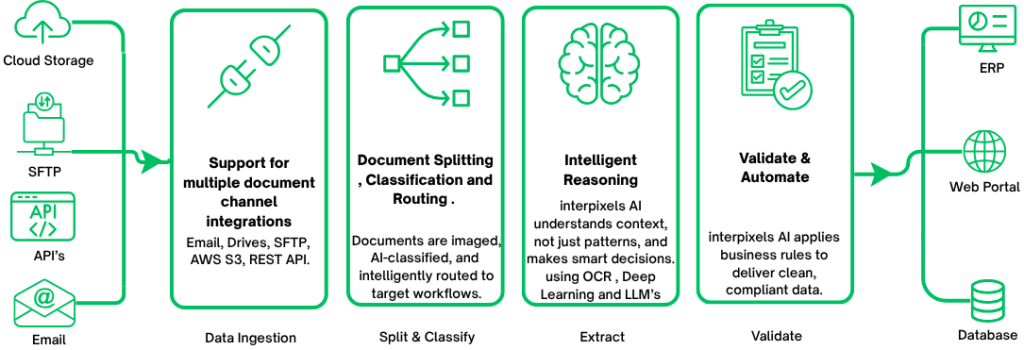
Every claim submission passes through Gate 1 first. InterPixels AI classifies all submitted documents, identifies the claim type (IPD, OPD, or KYC), and verifies that every required document class is present. Incomplete submissions are blocked immediately and returned with a specific list of missing documents. No processing resources are consumed on a claim that cannot be adjudicated.
Gate 2: Extraction and Fraud Detection
Claims that pass Gate 1 enter extraction. InterPixels AI reads every document using OCR and Generative AI, extracts all fields with per-field confidence scoring, and runs three concurrent fraud detection checks during extraction. Prescription-pharmacy cross-validation, invoice arithmetic verification, and document authenticity analysis. Structured JSON output is returned per claim, ready for your adjudication system.
HITL: Human-in-the-Loop
Fields extracted below confidence threshold are automatically flagged and routed to your operations team for review. Reviewers see only the fields requiring a decision, not the entire document. Every reviewed decision is logged for audit and compliance.
API-First
REST API. No UI changes to your existing TPA platform. No retraining of staff. Integration in 4 to 6 weeks.
Document Coverage · India
Built for the documents Indian health insurance TPAs actually process.
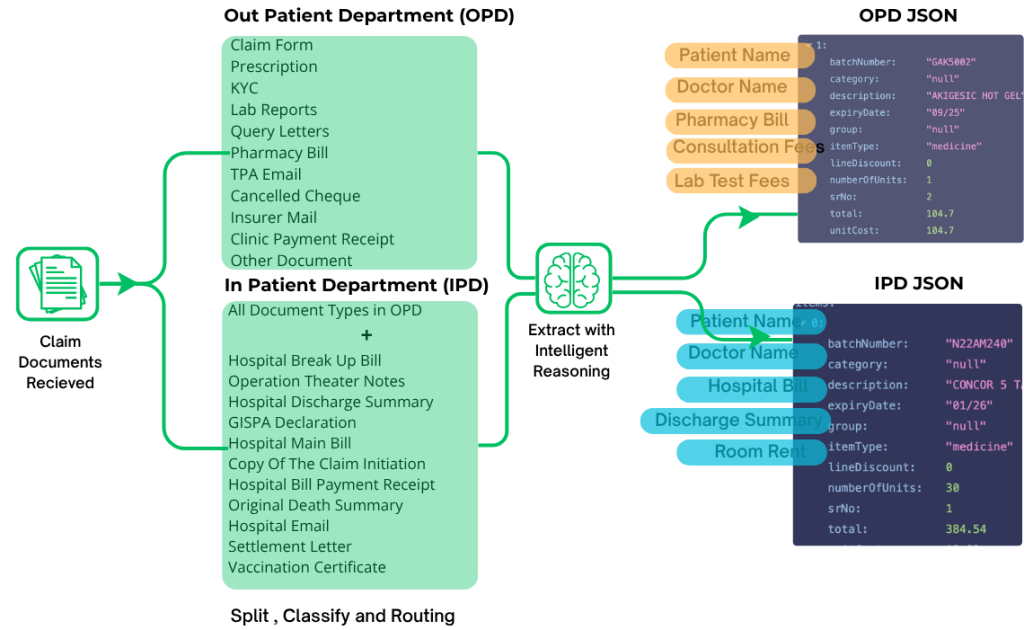
IPD: In-Patient Department 25 document classes
Cashless Claim Form, Hospital Main Bill, Hospital Break-Up Bill, Operation Theatre Notes, Hospital Discharge Summary, GISPA Declaration, Room Rent Receipt, Pharmacy Bill (inpatient), Laboratory Reports, Radiology and Imaging Reports, Doctor Consultation Notes, Anaesthesia Notes, Pre-authorisation Letter, TPA Authorisation Letter, Settlement Letter, Original Death Summary, Vaccination Certificate, Hospital Email Correspondence, Hospital Bill Payment Receipt, Copy of Claim Initiation, Cancelled Cheque, Insurer Mail, Query Letters, KYC Documents, Other Supporting Documents.
OPD: Out-Patient Department 15 document classes
Claim Form, Prescription, Pharmacy Bill, Laboratory Reports, Radiology Reports, Consultation Fee Receipt, Clinic Payment Receipt, TPA Email, Cancelled Cheque, Insurer Mail, Query Letters, KYC Documents, Referral Letter, Diagnostic Test Report, Other Supporting Documents.
KYC Documents
Aadhaar Card (front and back), PAN Card, Passport, Voter ID, Driving Licence.
Language OCR
Hindi, English, Tamil, Telugu, Bengali. Printed and handwritten. Handwritten prescriptions processed with per-field confidence scoring across all supported scripts.
Case Study · India
InsurTech : 40 minutes to 5 minutes per claim.
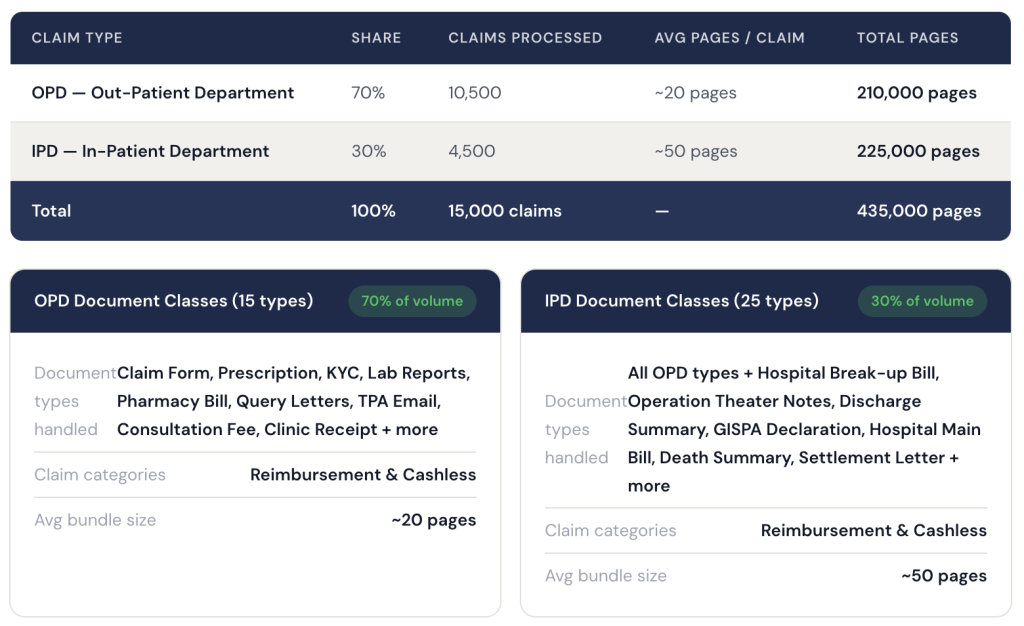
Stat 1: 15,000+ Claims processed in production
Stat 2: 8x Faster claim processing
Stat 3: 40 min to 5 min Per claim, data extraction
InsurTech India was processing health insurance claims manually. Sorting documents, entering data, validating fields before adjudication could begin. After integrating the InterPixels AI Claims Intelligence API, the full upstream document workflow was automated across IPD and OPD claim types. The operations team now reviews only flagged exceptions. Adjudication starts where the document work ends.
Integration Reality
Live in 4 to 6 weeks. No changes to your existing system.
REST API. Structured JSON output formatted to your schema.
Send claims via Email, SFTP, AWS S3, or direct API call.
PDF, JPG and PNG formats supported.
No changes to your TPA platform, UI, or staff workflows.
HITL review interface included. No separate tooling required.

INSIGHTS & INTELLIGENCE
Thinking on Claims, Documents & TPA Operations
Perspectives and analysis from the InterPixels AI team on health insurance claims automation, document intelligence, and operational efficiency across Asia-Pacific.