Health Insurance Claims Automation · India
IRDAI is counting the days. Your document workflow should not be the bottleneck.
InterPixels AI automates the full upstream document workflow for Indian health insurance TPAs , completeness validation, OCR extraction, and fraud detection , across Hindi and English, IPD and OPD, Aadhaar to hospital bill. API-first. No changes to your existing platform.

Regulatory and Operational Reality · India
Four regulatory pressures. One operational gap.
IRDAI’s 30-day mandate and the document bottleneck that makes it unachievable manually.
Under IRDAI regulations, every health insurance claim must be settled or rejected within 30 days of receiving the last required document. The 2024 IRDAI Master Circular tightens this further for cashless claims: pre-authorisation decisions must be issued within 1 hour of hospital submission, and final discharge approvals within 3 hours. Breach either deadline and the insurer is liable to pay interest at 2% above the prevailing bank rate on the delayed claim amount. That liability extends to the TPA managing the claim.
The 30-day clock starts from the last document received. In a manual workflow, your team is still sorting, identifying, and entering data from that document bundle before the adjudicator can begin. The regulatory deadline is not a buffer. It is a countdown that manual processing consumes before adjudication even starts.
How InterPixels AI addresses it: Gate 1 completeness validation identifies the claim type and verifies that every required document is present before any extraction begins. Gate 2 delivers structured JSON per claim in under 5 minutes. Document processing time before adjudication drops from 40 minutes to 5 minutes, as measured in production across 15,000+ claims.

Rs. 26,000 crore in disallowed and repudiated claims in FY24. 72% of them processed through TPAs.
According to IRDAI’s Annual Report for FY2023-24, out of 3.26 crore health insurance claims filed, insurers disallowed claims worth Rs. 15,100 crore (12.9% of total claim value) and repudiated a further Rs. 10,937 crore. Combined Rs. 26,000 crore, up 19.10% from Rs. 21,861 crore the previous year. 72% of all settled claims were processed through TPAs.
The leading driver of disallowance is not adjudication disagreement. It is documentation errors, incomplete submissions, and data discrepancies that should have been caught at intake. Every disallowed claim that reached the insurer already consumed your team’s processing time. Every one is wasted effort, a potential grievance, and a mark against TPA performance in IRDAI’s monitoring framework.
How InterPixels AI addresses it: Gate 1 classifies every submitted document, identifies the claim type, and verifies that every required document class is present before a single extraction resource is consumed. Incomplete submissions are returned immediately with a specific list of what is missing. Only complete, correctly classified submissions proceed to Gate 2.

IRDAI’s 2025 Fraud Monitoring Framework makes pre-settlement detection a compliance obligation, not a best practice.
IRDAI’s Insurance Fraud Monitoring Framework Guidelines 2025, effective April 1, 2026, mandate that insurers and their TPAs shift from reactive fraud detection to active pre-settlement fraud prevention. The framework requires board-level oversight of fraud risk, mandatory participation in the Insurance Information Bureau’s Fraud Monitoring Technology Framework, and systematic cross-industry reporting of fraud patterns.
For TPAs, this is an operational compliance obligation. Prescription mismatches, duplicate submissions, invoice arithmetic errors, and KYC document tampering must be identified and flagged before claims are paid, not discovered post-settlement during audit. The liability for missed fraud sits with the entity processing the document at intake.
How InterPixels AI addresses it: Three concurrent fraud detection checks run during Gate 2 extraction on every claim. Prescription-pharmacy cross-validation, invoice arithmetic verification, and document authenticity analysis. Fraud flags are embedded in the structured JSON output with the specific fields and evidence cited per alert. Every claim reaching your adjudicator has already passed all three checks.

NHCX is live. Structured, machine-readable claim data is now the direction of Indian health insurance infrastructure.
The National Health Claims Exchange (NHCX), jointly developed by IRDAI and the National Health Authority, is a single digital gateway for health insurance claims built on open FHIR standards. As of April 2026, 50 entities are live on NHCX, including 28 insurers and 11 TPAs, with more in the integration pipeline. The platform is designed to replace fragmented, manual, paper-driven claim submissions with standardised, interoperable, machine-readable data exchange between hospitals, TPAs, and insurers.
NHCX requires structured, coded claim data at the point of submission. TPAs that continue producing claim records through manual workflows will face a structural incompatibility with where India’s health insurance infrastructure is moving.
How InterPixels AI addresses it: InterPixels AI returns structured JSON output per claim, formatted to your schema requirements, ready for downstream systems. The API produces the structured data layer that NHCX-compliant adjudication workflows require, without changing how your operations team receives or handles incoming documents.

The Product
Two gates. Every claim. No exceptions.
Gate 1: Completeness Validation
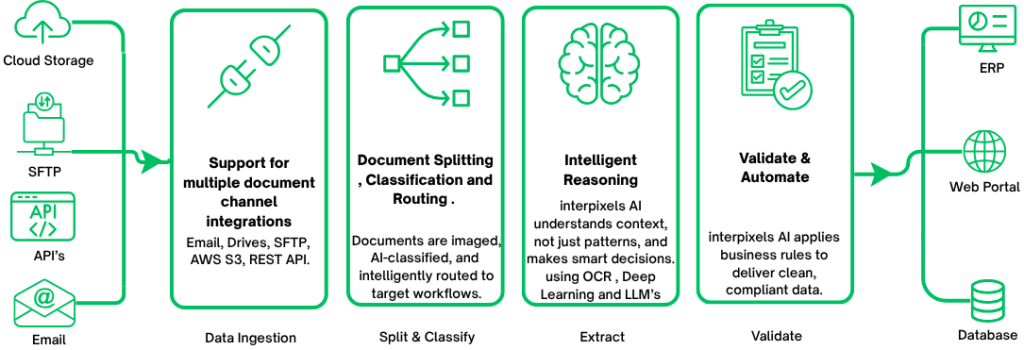
Every claim submission passes through Gate 1 first. InterPixels AI classifies all submitted documents, identifies the claim type (IPD, OPD, or KYC), and verifies that every required document class is present. Incomplete submissions are blocked immediately and returned with a specific list of missing documents. No processing resources are consumed on a claim that cannot be adjudicated.
Gate 2: Extraction and Fraud Detection
Claims that pass Gate 1 enter extraction. InterPixels AI reads every document using OCR and Generative AI, extracts all fields with per-field confidence scoring, and runs three concurrent fraud detection checks during extraction. Prescription-pharmacy cross-validation, invoice arithmetic verification, and document authenticity analysis. Structured JSON output is returned per claim, ready for your adjudication system.
HITL: Human-in-the-Loop
Fields extracted below confidence threshold are automatically flagged and routed to your operations team for review. Reviewers see only the fields requiring a decision, not the entire document. Every reviewed decision is logged for audit and compliance.
API-First
REST API. No UI changes to your existing TPA platform. No retraining of staff. Integration in 4 to 6 weeks.
Document Coverage · India
Built for the documents Indian health insurance TPAs actually process.
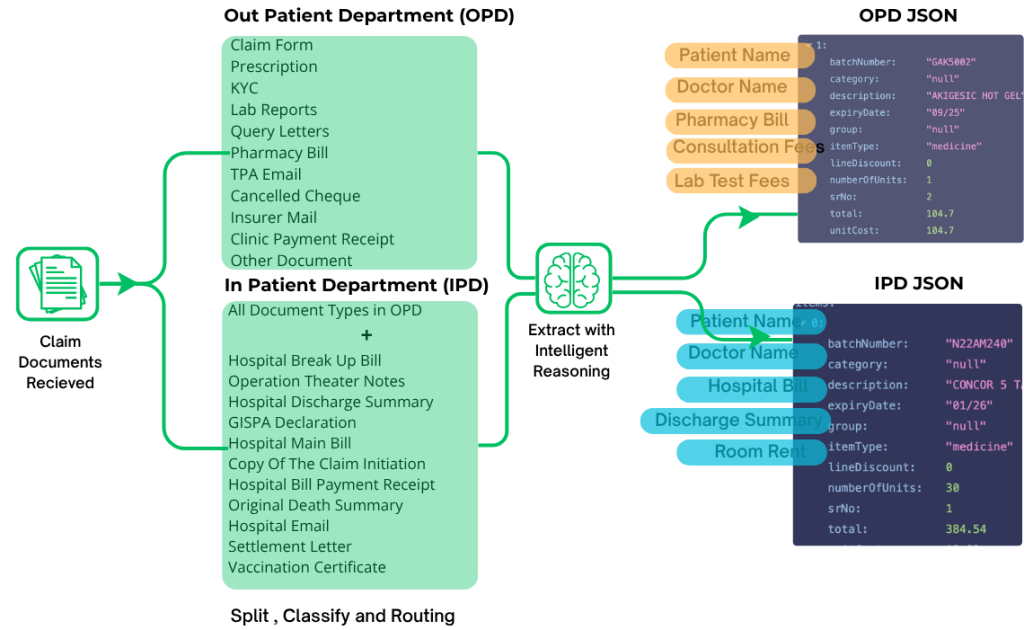
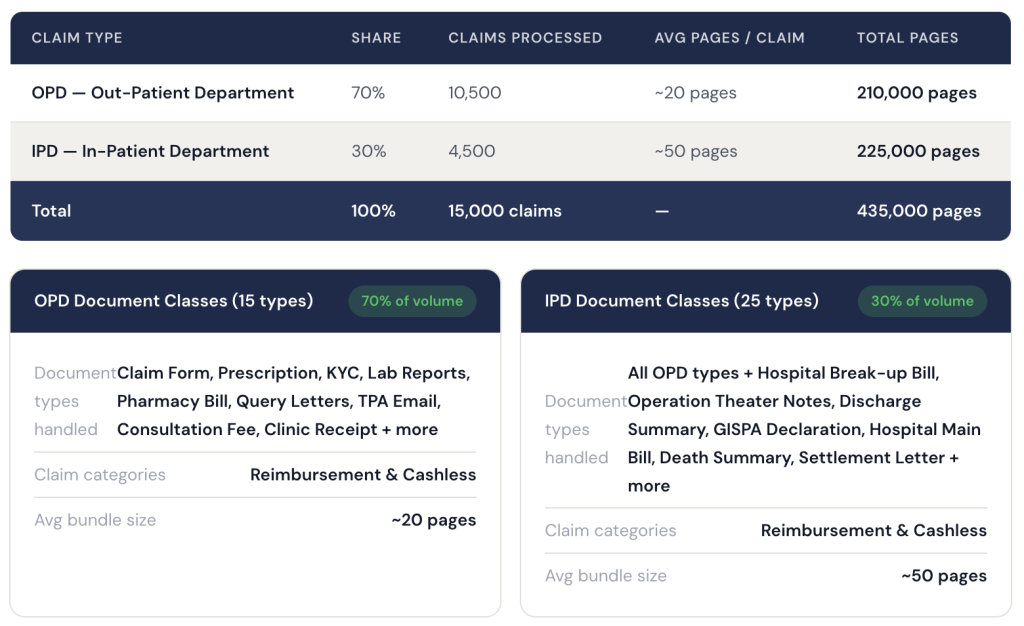
IPD: In-Patient Department 25 document classes
Cashless Claim Form, Hospital Main Bill, Hospital Break-Up Bill, Operation Theatre Notes, Hospital Discharge Summary, GISPA Declaration, Room Rent Receipt, Pharmacy Bill (inpatient), Laboratory Reports, Radiology and Imaging Reports, Doctor Consultation Notes, Anaesthesia Notes, Pre-authorisation Letter, TPA Authorisation Letter, Settlement Letter, Original Death Summary, Vaccination Certificate, Hospital Email Correspondence, Hospital Bill Payment Receipt, Copy of Claim Initiation, Cancelled Cheque, Insurer Mail, Query Letters, KYC Documents, Other Supporting Documents.
OPD: Out-Patient Department 15 document classes
Claim Form, Prescription, Pharmacy Bill, Laboratory Reports, Radiology Reports, Consultation Fee Receipt, Clinic Payment Receipt, TPA Email, Cancelled Cheque, Insurer Mail, Query Letters, KYC Documents, Referral Letter, Diagnostic Test Report, Other Supporting Documents.
KYC Documents
Aadhaar Card (front and back), PAN Card, Passport, Voter ID, Driving Licence.
Language OCR
Hindi, English, Tamil, Telugu, Bengali. Printed and handwritten. Handwritten prescriptions processed with per-field confidence scoring across all supported scripts.
Case Study · India
InsurTech : 40 minutes to 5 minutes per claim.
Stat 1: 15,000+ Claims processed in production
Stat 2: 8x Faster claim processing
Stat 3: 40 min to 5 min Per claim, data extraction
InsurTech India was processing health insurance claims manually. Sorting documents, entering data, validating fields before adjudication could begin. After integrating the InterPixels AI Claims Intelligence API, the full upstream document workflow was automated across IPD and OPD claim types. The operations team now reviews only flagged exceptions. Adjudication starts where the document work ends.
Integration Reality
Live in 4 to 6 weeks. No changes to your existing system.
REST API. Structured JSON output formatted to your schema.
Send claims via Email, SFTP, AWS S3, or direct API call.
PDF, JPG and PNG formats supported.
No changes to your TPA platform, UI, or staff workflows.
HITL review interface included. No separate tooling required.

INSIGHTS & INTELLIGENCE
Thinking on Claims, Documents & TPA Operations
Perspectives and analysis from the InterPixels AI team on health insurance claims automation, document intelligence, and operational efficiency across Asia-Pacific.