
The claims loss ratio in health insurance is the percentage of earned premiums paid out as claims. It equals net incurred claims divided by net earned premium, multiplied by 100. For TPAs, the operationally relevant version is the adjudication ratio: claims paid as a percentage of claims received and adjudicated. Both metrics measure financial leakage. Either can be reduced with tighter pre-authorisation, fraud controls, and AI-driven document validation.
Why APAC TPAs Are Watching This Number More Closely Than Ever
The claims loss ratio in health insurance is the single most watched financial metric in health insurance operations. Every percentage point of movement translates directly into millions of dollars of insurer or TPA liability. Get it wrong and the entire portfolio becomes unprofitable. Get it right and the business scales.
Two APAC data points frame the challenge. India’s health segment incurred claims ratio reached 85.34% in FY2024-25 per the IRDAI Annual Report, with public sector insurers at 97.30% and the overall non-life ICR at 82.88%. In Malaysia, medical insurance claims cost inflation ran at a cumulative 56% from 2021 to 2023 per LIAM, pushing the medical and health insurance claims ratio to 65.9% by 2023 per Insurance Services Malaysia. Both markets are tightening fast.
For TPAs specifically, a high ratio signals one or more operational failures: fraud slipping through, adjudication errors inflating payouts, or slow processing windows giving leakage time to compound. None of these are revenue problems. They are process problems, and process problems respond to technology.
“A single percentage point reduction in the claims loss ratio on a portfolio paying $100M in annual claims is worth $1 million. For a mid-size APAC TPA, a 5-point AI-driven improvement is not a rounding error; it is a business transformation.”
Three Metrics Every TPA Finance Team Must Separate
The loss ratio, combined ratio, and adjudication ratio each measure something different. Conflating them leads to wrong benchmarks and misdiagnosed problems.
Claims Loss Ratio (CLR) – the insurer metric
CLR = (Net Incurred Claims / Net Earned Premium) x 100. This is the insurer’s primary measure of how much of collected premium flows out the door as claims. An 85% CLR means 85 cents of every premium dollar pays claims. IRDAI reports this figure annually for every licensed insurer. A TPA does not collect premium directly, so this ratio is relevant to TPAs as a benchmark against which their administration fee and expense structure is evaluated.
Combined Claims Ratio – profitability at a glance
Combined Ratio = CLR + Expense Ratio. A combined ratio above 100% means the underwriting operation loses money before investment income. Deloitte’s 2025 Global Insurance Outlook projected the US non-life combined ratio falling to 98.5% in both 2024 and 2025, down from an estimated 103% in 2023, a directional recovery that APAC markets are also pursuing, though medical inflation pressures make the path slower in health lines.
Adjudication Ratio – the TPA operating metric
Adjudication Ratio = (Claims Approved and Paid / Total Claims Received for Adjudication) x 100. This is the metric a TPA finance team actually controls. A high adjudication ratio is not inherently bad; it may reflect strong policyholder coverage, but an unexpectedly rising ratio signals fraud, overbilling, or process failure. This is where AI intervention has the most direct financial impact.
“Malaysia’s LIAM data shows cumulative medical claims cost inflation of 56% over just three years, and BNM has confirmed that MHIT claims-to-premium ratios ran at 101% to 111% from 2018 to 2023, excluding pandemic years. That structural pressure is why ratio reduction is not optional for APAC TPAs.”
APAC Benchmarks: India and Malaysia
India’s standalone health insurers reported a 68.06% incurred claims ratio in FY2024-25; the health segment overall stood at 85.34%, driven by public sector insurers at 97.30%. Malaysia’s medical and health insurance sector reached 65.9% in 2023, up from 61.29% in 2022. Both markets are trending upward.
The IRDAI FY2024-25 Annual Report confirms that standalone health insurers that largely operate as TPAs have a significantly lower claims ratio than their public-sector counterparts. Private sector insurers averaged 77.50%. The gap between 68% and 97% is almost entirely operational, not actuarial. India processed 3.26 crore health insurance claims in FY2024-25, up year-on-year, with an 8% repudiation rate.
In Malaysia, Insurance Services Malaysia data cited by Statista shows the medical and health insurance claims ratio rose from 61.29% in 2022 to 65.9% in 2023, a 4.6-percentage-point increase in a single year. BNM and MOF confirmed that cumulative medical claims cost inflation reached 56% from 2021 to 2023, while premium growth over the same period was only 20%, creating a structural premium-to-claims gap that makes automation an operational imperative.
Five Drivers That Inflate the Claims Loss Ratio
The five primary drivers of an inflated claims loss ratio are overbilling by providers, phantom claims, adjudication errors, slow processing that delays detection, and weak pre-authorisation controls. Each driver has a distinct signature in the data and a distinct AI intervention point.
Overbilling and Upcoding
Overbilling occurs when providers charge for a higher level of complexity or quantity of services than was delivered. Research published in the International Journal of Science and Research Archives (2024) identifies upcoding billing as a more expensive procedure code than performed as one of the most frequent and financially significant forms of healthcare billing fraud. In practice, teams running manual adjudication catch overbilling through spot checks, which means most of it passes undetected at the point of adjudication.
Phantom Claims and Duplicate Submissions
Phantom claims charges for services never rendered represent a persistent and growing cost to health insurance systems globally. A 2023 NBER Working Paper by Shekhar, Leder-Luis, and Akoglu (Carnegie Mellon / Boston University) demonstrated that unsupervised ML can detect provider-level billing anomalies consistent with fraud without requiring any labelled training data, using only patient-level and billing-pattern signals. The paper was subsequently published in the Journal of Policy Analysis and Management (2026). Duplicate submissions of the same claim filed multiple times are particularly common in high-volume TPA environments where document intake is manual.
Adjudication Errors from Manual Data Entry
Manual data entry error rates in document-heavy workflows typically run at 5 to 10 percent. In health insurance claims processing, where OPD claim bundles average 20 pages and IPD bundles average 50 pages, each page read and keyed manually introduces compounding error risk. A wrong diagnosis code, transposed amount, or missed exclusion can mean a claim is approved that should have been rejected or rejected that should have been approved.
Slow Processing Windows
The longer a fraudulent or erroneous claim stays in the pipeline, the more likely it is to be approved. Manual workflows averaging 30 to 40 minutes per claim upstream of adjudication create a window in which fraud patterns cannot be detected in real time. By the time a batch audit catches an anomaly, settlement may already have occurred.
Inadequate Pre-Authorisation Controls
Pre-authorisation is the first line of financial control. A claim that enters the pipeline with missing documents, invalid policy references, or unmatched patient records will eventually be rejected, but only after consuming adjudicator time and processing resources. The IRDAI Master Circular of May 2024 mandates cashless pre-authorisation within one hour and discharge approval within three hours for Indian health insurers. Without automated completeness gating at intake, TPAs spend operational capacity on claims that can never be approved, while failing to meet regulatory speed requirements.
InterPixels AI Claims Intelligence Pipeline Architecture
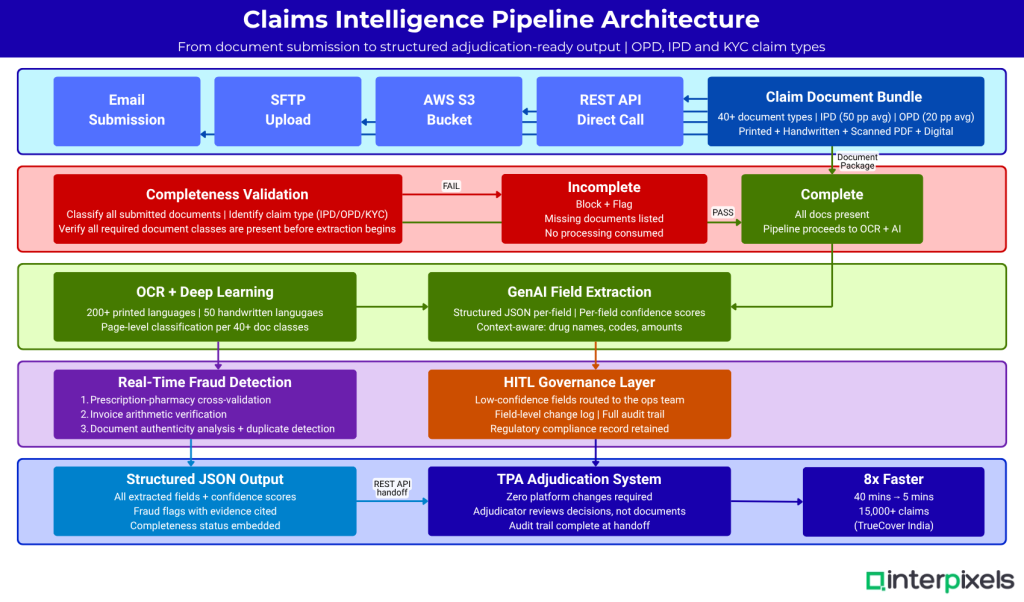
Figure: InterPixels AI Claims Intelligence Pipeline. Claim document packages enter via email, SFTP, AWS S3, or REST API (Layer 1). Gate 1 validates completeness before any extraction begins, blocking incomplete submissions at zero processing cost (Layer 2). OCR and GenAI extract structured fields per document class across 200+ printed and 50 handwritten languages (Layer 3). Three concurrent fraud detection layers run during extraction: prescription-pharmacy cross-validation, invoice arithmetic verification, and document authenticity analysis (Layer 4). Low-confidence fields route to HITL review. Structured JSON output with confidence scores and fraud flags is returned to the TPA adjudication system, ready for decision (Layer 5). In production deployment with a leading InsurTech services provider in India, this pipeline reduced claim adjudication time from 40 minutes to 5 minutes per claim across 15,000+ claims and 435,000 document pages in a single month.
Claims Ratio Driver vs. AI Intervention vs. Manual Baseline
The table below maps each of the five ratio drivers against its manual baseline and the specific AI mechanism that addresses it.
| Driver | Manual Baseline | AI Intervention | Primary Mechanism |
|---|---|---|---|
| Overbilling / Upcoding | Spot-check review; misses volume | Invoice arithmetic validation on every claim | Real-time line-item cross-check during extraction |
| Phantom Claims | Adjudicator cross-reference; slow and retrospective | Prescription-pharmacy matching at extraction stage | Concurrent fraud layer runs during OCR before adjudication |
| Duplicate Submissions | Periodic batch deduplication; catches duplicates late | Real-time duplicate detection by patient, date, and hospital | Claim-level ID match on intake before processing begins |
| Adjudication Errors | Manual data entry; 5-10% error rate on complex bundles | Structured fields auto-validated; HITL for exceptions only | Structured JSON replaces data entry; adjudicator reviews decisions |
| Pre-Auth Weakness | Email / phone queues; 24-48 hour lag before rejection | Gate 1 completeness gate blocks incomplete submissions at intake | Incomplete claims blocked before any processing resource is consumed |
What a 5% Reduction in Claims Ratio Means in Dollar Terms
For a mid-size APAC TPA managing $100M USD in annual claims volume, a 5-percentage-point reduction in the claims loss ratio prevents $5 million in annual leakage. The calculation is direct and verifiable.
Consider a TPA handling INR 500 crore (approximately $60M USD) in annual claims at an 85% loss ratio. That TPA currently pays out INR 425 crore in claims. A 5-point reduction to an 80% ratio reduces the payout to INR 400 crore, saving INR 25 crore (~$3M USD) annually without changing premium volume. Scaled to a $100M claims portfolio, the annual saving reaches $5M. Scaled to a $200M portfolio, it reaches $10M.
Those numbers assume no premium growth. In a market where IRDAI data shows India processed 3.26 crore health insurance claims in FY2024-25 up year-on-year the underlying portfolio is growing. Every percentage point of ratio improvement compounds in value as volume increases.
In practice, the ratio improvement comes from two compounding sources: fraud prevented at the document layer before settlement, and adjudication errors reduced by structured JSON extraction replacing manual data entry. Both reduce the numerator claims paid without touching the denominator.
“Across 15,000 claims and 435,000 document pages processed in a single month, a leading InsurTech services provider in India saw claim adjudication time fall from 40 minutes to 5 minutes, an 8x improvement that directly compresses the window in which leakage occurs.”
How AI Closes Each Driver and What the Evidence Shows
AI closes the five main claims ratio drivers by applying real-time validation, fraud detection, and structured data extraction at the document layer before any claim reaches an adjudicator.
Fraud Detection at the Document Layer
A systematic review published in Artificial Intelligence in Medicine, Vol. 160 (Elsevier, 2024) confirms that machine learning is the leading validated approach for healthcare fraud detection, with unsupervised methods particularly effective where labeled fraud data is scarce. The InterPixels AI platform applies three concurrent fraud detection layers during extraction. Prescription-pharmacy cross-validation catches quantity mismatches between prescribed and dispensed medications. Invoice arithmetic verification confirms that all line-item totals are mathematically consistent. Document authenticity analysis detects editing artifacts, font inconsistencies, and tampering indicators in KYC and financial documents.
All three layers run concurrently during the extraction process itself, not as a separate post-processing audit. Fraud flags are embedded in the structured JSON output returned to the TPA system, with specific fields and evidence cited for each alert. The adjudicator sees the fraud signal at the moment of decision, not weeks later in a batch report.
HITL Governance for Adjudication Accuracy
Human-in-the-Loop governance ensures that automation does not introduce new error risks. When a field is extracted below a confidence threshold, an ambiguous handwritten amount, or an unclear diagnosis code, that specific field is flagged and routed to a TPA operations team member for review. The reviewer sees only the fields requiring a decision, not the entire document bundle. Once confirmed or corrected, the claim proceeds with a complete audit trail. This structure is what makes AI-extracted data acceptable to regulators: human accountability is retained at every uncertain decision point.
Completeness Gating and Pre-Auth Controls
Gate 1 validation at intake prevents wasted processing on claims that cannot be adjudicated. Every claim submission is classified on arrival, the claim type identified (IPD with 25 document classes, or OPD with 15 document classes), and every required document class is verified before extraction begins. A missing discharge summary, absent prescription, or incomplete KYC document triggers a block and a list of missing items. The claim does not enter the processing pipeline until it is complete. This single control eliminates the operational waste of incomplete-claim processing, which in high-volume manual environments can represent 10 to 20 percent of total processing effort.
The Production Evidence from India
The most concrete production evidence comes from the InterPixels AI case study with a leading InsurTech services provider in India. Across 15,000 health insurance claims and 435,000 document pages processed in a single production month, adjudication time fell from 40 minutes to 5 minutes per claim, an 8x improvement. The client processes both Reimbursement and Cashless claim types across OPD (averaging 20 pages per claim) and IPD (averaging 50 pages per claim) bundles, integrated via AWS S3 and REST API with no changes to the existing TPA platform.
This speed reduction matters for the loss ratio in a specific way. When adjudication time drops 8x, the detection window for fraud and overbilling compresses proportionally. McKinsey’s documentation of Aviva’s AI claims transformation shows the same pattern at scale: 80+ AI models cut complex motor liability assessment time by 23 days, improved claims routing accuracy by 30%, reduced customer complaints by 65%, and saved Aviva more than GBP 60 million in 2024. The underlying mechanism is identical: faster, more accurate processing reduces the window in which leakage occurs.
“The adjudicator’s job is a decision, not a data entry exercise. AI should eliminate the document work so human judgment is spent where it is irreplaceable.”
Frequently Asked Questions
What is the claims loss ratio in health insurance?
The claims loss ratio in health insurance is the percentage of earned premium paid out as claims. Calculated as (Net Incurred Claims / Net Earned Premium) x 100, it is the primary measure of claims cost relative to revenue. A ratio of 85% means 85 cents of every premium dollar pays claims. IRDAI in India and BNM in Malaysia publish this figure annually as the primary industry benchmark.
What is a good claims ratio for an APAC health insurer or TPA?
For APAC health insurance, industry experts typically view a range of 70% to 90% as comfortable. India’s standalone health insurers averaged 68.06% in FY2024-25 per IRDAI, while Malaysia’s medical claims ratio reached 65.9% in 2023. Public sector insurers in India reached 97.30%, signalling operational strain. Ratios consistently above 90% on a health-only portfolio indicate pricing pressure and structural claims leakage.
How does AI reduce the health insurance claims ratio?
AI reduces the health insurance claims ratio by catching fraud, overbilling, and errors at the document layer before adjudication. Prescription-pharmacy matching catches phantom claims. Invoice arithmetic validation catches overbilling. Document authenticity analysis catches tampering. Gate 1 completeness checking blocks incomplete claims at intake. Each intervention reduces the numerator claims paid without changing premium volume.
What is the difference between the loss ratio and the combined ratio?
The loss ratio measures claims cost as a percentage of earned premium. The combined ratio adds the expense ratio (operating costs as a percentage of premium) to the loss ratio. A combined ratio above 100% means the underwriting operation is unprofitable before investment income. For TPAs, the most operationally useful metric is the adjudication ratio, claims approved as a percentage of claims received for processing.
How much can a TPA realistically reduce its claims ratio with AI?
A 3 to 7 percentage point reduction is achievable within the first year for TPAs implementing AI document validation and fraud detection. On a $100M claims portfolio, a 5-point reduction prevents $5M in annual leakage. The production deployment with a leading InsurTech services provider in India demonstrated 8x faster processing across 15,000+ claims, compressing the fraud detection window and enabling real-time anomaly flagging before adjudication decisions are made.
Three Numbers Every APAC TPA Should Put on a Dashboard
Three insights from this post are worth converting into standing KPIs. First, the claims loss ratio is tracked by claim type, not just in aggregate. A ratio that looks acceptable at the portfolio level often masks a deteriorating sub-segment. Second, the adjudication cycle time is the variable that most directly correlates with leakage. Third, the fraud detection rate is the percentage of claims flagged for review versus the percentage where fraud was confirmed. A high flag rate with low confirmation is a false-positive problem. A low flag rate with frequent post-settlement discoveries is a detection failure.
For APAC TPAs, the IRDAI and LIAM data make the market direction clear: claims costs are rising, medical inflation is persistent, and the gap between high-performing and low-performing operations is operational, not actuarial. The TPAs closing that gap are not hiring faster; they are processing smarter.
If you are benchmarking your TPA’s claims ratio against APAC peers and want to quantify what a 5-point improvement is worth at your actual claim volume, the InterPixels AI team works through that calculation in the initial discovery call.
Book a demo at interpixels.ai to see the pipeline running on your document types.
Table of Content