
Human-in-the-Loop (HITL) in insurance claims processing is a system design where an AI model handles document extraction and initial decision-making, then routes specific claims to a human reviewer when its confidence score falls below a defined threshold. The human reviews, corrects, or confirms the AI output before a final decision is committed to record. The result is a timestamped, auditable workflow that satisfies both speed requirements and regulatory compliance obligations.
Why HITL Is Now a Non-Negotiable in Claims AI
HITL is the mechanism that keeps claims AI legally defensible. Without it, every auto-approved claim is an undocumented decision with no reviewer, no timestamp, and no appeal trail.
The pressure to automate claims is real. McKinsey (2025) reports that UK insurer Aviva deployed more than 80 AI models across its claims domain, cutting liability assessment time by 23 days and improving routing accuracy by 30 percent while saving more than GBP 60 million in 2024 alone. That kind of performance is only possible when AI handles volume at scale. But volume at scale without oversight creates a different category of risk.
The APAC region makes this risk concrete. Accenture (2025) found that 24 percent of consumers globally are unsatisfied with their health insurance claim experience, with dissatisfaction rates reaching 39 percent in China and 41 percent in Japan. Much of that frustration comes from opaque, automated decisions with no clear human accountability.
Regulators across Singapore, Australia, and Japan have all issued AI governance guidance requiring human oversight of high-risk automated decisions. The Monetary Authority of Singapore’s AI Model Risk Management guidance (2025) explicitly recommends human oversight for generative AI decisions in financial services. Deloitte’s Centre for Financial Services (2024) found that 76 percent of insurance organisations have now deployed Gen AI in one or more business functions, with claims handling among the highest-adoption areas. Yet governance investment remains uneven, making HITL the practical mechanism that keeps compliance evidence audit-ready without rebuilding the manual pipeline.
A claims AI system without HITL is not faster. It is just faster at making undocumented mistakes.
How Confidence Thresholds Decide Who Reviews a Claim
The confidence threshold is the single most important number in a HITL system. It is the score below which the AI refuses to make a final call and hands the claim to a human reviewer instead.
When an AI model extracts data from a claim document, it produces a confidence score for each field, typically expressed as a probability between 0 and 1. A score of 0.95 on a patient name field means the model is 95 percent confident the extracted value is correct. A score of 0.62 on a procedure code field means the model is uncertain, likely because the document is blurry, handwritten, or uses a non-standard format.
Teams configuring a HITL system set a threshold, commonly between 0.80 and 0.92 depending on the claim type and the regulatory environment. Any claim where one or more field scores fall below that threshold routes to the human queue. Claims where all fields score above the threshold auto-approve and proceed directly to the JSON output and downstream payment pipeline.
Wu et al. (2021, arXiv) classify confidence-based sampling as the primary routing mechanism in production HITL systems, noting that it allows teams to achieve near-zero tolerance for critical extraction errors without making human review the default for all claims. Jakubik et al. (2023, arXiv) demonstrate that over time, HITL systems can train secondary AI models on claim types previously reviewed by human experts, progressively reducing human effort while preserving accuracy on those patterns.
In practice, teams typically find that a well-tuned threshold routes fewer than 10 percent of claims to human review. MindStudio (2026) reports that organisations using smart escalation rules keep the human intervention rate below 10 percent while achieving document extraction accuracy rates of up to 99.9 percent, compared to 92 percent for AI-only systems.
Set the confidence threshold too low and you automate errors at scale. Set it too high and you have rebuilt the manual queue. The calibration is the product.
The Six Types of HITL Triggers in Health Insurance Claims
Not every HITL escalation is triggered by a low confidence score. A robust system flags six distinct conditions for human review.
- Low confidence score: One or more extracted fields fall below the configured threshold.
- Missing mandatory field: A required field such as policy number, diagnosis code, or treatment date is absent from the extracted output.
- Amount anomaly: The claim value exceeds a defined monetary ceiling or deviates from historical norms for that provider or procedure code.
- Policy mismatch: The extracted treatment date, procedure, or patient details do not match the active policy record in the core system.
- Regulatory flag: The claim involves a protected category such as mental health, substance abuse, or a procedure with prior-authorisation requirements under local regulations.
- Fraud signal: The AI fraud detection layer returns a risk score above a secondary threshold, triggering joint review by a claims assessor and the fraud team.
The Full HITL Workflow in InterPixels: Step by Step
The InterPixels HITL workflow routes every claim through an identical extraction pipeline. The confidence score determines whether a claim exits to auto-approval or enters the human review queue.
Step 1. Claim received The claim document arrives via API, email parser, or direct upload. InterPixels logs a receipt timestamp and assigns a unique claim ID.
Step 2. AI data extraction The extraction model reads the document, identifies all mandatory fields, and assigns a confidence score per field. Supported document types include EOBs, hospital discharge summaries, pharmacy receipts, and pre-authorisation forms across APAC languages.
Step 3. Confidence score aggregation The system computes a composite confidence score using a weighted average across all mandatory fields. High-risk fields such as procedure codes and billed amounts carry higher weights.
Step 4. Threshold decision The composite score is compared against the configured threshold. Claims scoring above the threshold proceed to auto-approval. Claims scoring below route to the HITL queue.
Steps 5a and 5b. Routing Auto-approved claims write directly to a structured JSON output and trigger the downstream payment or benefits system. HITL-queued claims notify the assigned reviewer with the claim document, extracted fields, and per-field confidence scores displayed side by side.
Steps 6 to 8. Human review, audit log, and JSON output The reviewer confirms correct fields, edits incorrect ones, and submits the reviewed record. InterPixels writes an immutable audit log entry capturing the reviewer ID, timestamp, original extracted value, corrected value, and review duration. The corrected record then writes to the same JSON output schema as an auto-approved claim. Downstream systems receive a consistent payload regardless of which path the claim took.
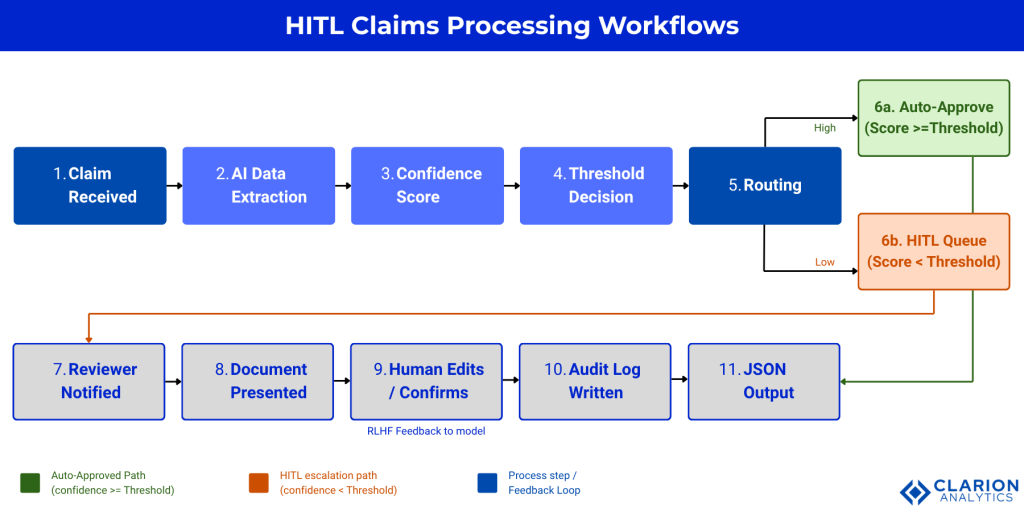
Figure 1: InterPixels HITL Claims Processing Workflow. Claims enter at Step 1 and follow a linear extraction and scoring path. At the threshold decision point, high-confidence claims auto-approve and route directly to JSON output (green path). Low-confidence claims enter the human review queue (amber path), where a reviewer confirms or corrects extracted fields. Both paths produce an identical structured JSON payload. The amber path additionally writes a timestamped audit log entry at Step 10. Reviewer corrections feed back into model retraining via RLHF signals.
Both the auto-approved claim and the HITL-reviewed claim produce the same JSON output. The audit trail is the only structural difference, and it is the most important one.
HITL vs. Full Automation vs. Full Manual: A Practical Comparison
The table below compares the three approaches across four dimensions relevant to APAC TPA and health insurance operations teams.
| Approach | Key Strength | Best Used When | APAC Compliance Risk |
|---|---|---|---|
| Full Automation (no HITL) | Maximum speed; lowest per-claim cost | Highly standardised, low-value claims with structured data only | High. No audit trail; AI governance guidance from MAS, APRA, and FSA all expect human oversight for high-risk automated decisions |
| HITL with Confidence Threshold (InterPixels model) | Balances throughput with accuracy; builds a timestamped audit log on every escalated decision | Mixed claim volumes with variable document quality; regulated APAC markets | Low. Every escalated decision is logged with reviewer ID, timestamp, and rationale |
| Full Manual Review | Maximum human oversight; highest accuracy on edge cases | Catastrophic or contested claims above defined monetary thresholds | Lowest automation risk; highest cost and slowest SLA |
Table 1: HITL approach comparison for APAC insurance claims processing.
How HITL Eliminates Both Over-Automation Risk and Queue Bottlenecks
The most common objection to HITL is that it simply recreates the manual queue in digital form. The data does not support this concern.
Over-automation risk is the danger that AI approves incorrect claims at scale before anyone notices the pattern. Sele and Chugunova (2024, PLOS ONE / ETH Zurich) ran a controlled experiment with 292 participants and found that while people prefer to delegate decisions to algorithms, they are paradoxically less likely to intervene on the least accurate algorithmic recommendations. This automation bias means HITL done poorly, where reviewers simply rubber-stamp AI outputs, can reduce net accuracy rather than improve it. The design fix InterPixels uses is to withhold the AI confidence score from the reviewer during the review step and present only the extracted values, so the reviewer forms an independent judgment before seeing how confident the model was.
Bottleneck risk is the concern that routing claims to human review slows the pipeline below acceptable SLAs. This is a threshold calibration problem, not a structural HITL problem. MindStudio (2026) reports that organisations using smart escalation rules keep the human intervention rate below 10 percent while achieving extraction accuracy of up to 99.9 percent. The remaining 90-plus percent of claims process end-to-end without human involvement, typically in minutes rather than days.
Accenture (2024) found that 87 percent of global insurance carriers reported material financial benefits from Gen AI usage, with demand now shifting from individual use cases to impact at scale. HITL is the architecture that makes scale safe, because it concentrates human judgment exactly where the AI is least reliable and keeps humans out of the pipeline everywhere else.
HITL does not slow down claims processing. It concentrates human time precisely where automation is least reliable and removes humans from the rest.
Frequently Asked Questions About HITL in Insurance Claims
What does human in the loop mean in health insurance claims processing?
Human-in-the-loop (HITL) in health insurance means the AI model processes and extracts claim data automatically, but routes specific claims to a human reviewer when its confidence score falls below a set threshold. The reviewer confirms or corrects the AI output before the claim is finalised. Every human decision is logged with a timestamp and reviewer ID, creating a full audit trail.
How does a confidence threshold work in claims AI?
The AI assigns a probability score between 0 and 1 to each extracted field. A score of 0.92 means the model is 92 percent confident the extracted value is correct. If any mandatory field scores below the configured threshold (commonly 0.80 to 0.92), the claim routes to the human queue. If all fields score above the threshold, the claim auto-approves and proceeds to payment.
Is HITL required by insurance regulators in APAC?
Regulatory expectations vary by market, but MAS in Singapore, APRA in Australia, and the FSA in Japan have all issued AI governance guidance requiring human oversight of high-risk automated decisions in financial services. HITL satisfies these expectations by generating a timestamped, immutable audit log for every claim that receives human review, making compliance evidence straightforward to produce on request.
What percentage of claims typically go to a HITL queue?
In a well-calibrated system, fewer than 10 percent of claims require human review. The exact figure depends on document quality, claim complexity, and threshold settings. Teams processing structured digital claims from major hospital networks often achieve human review rates of 3 to 5 percent. Teams processing handwritten or scanned documents typically see rates of 15 to 25 percent until document quality improves.
How does HITL improve the AI model over time?
Every correction a human reviewer makes is a labelled training signal. InterPixels captures the original extracted value and the corrected value, then feeds these pairs back into the model through a reinforcement learning from human feedback (RLHF) process. Over time, the model learns which document types and field combinations generate the most errors and becomes more confident on those patterns, gradually lowering the human review rate.
What HITL-Ready Claims Processing Looks Like in Practice
Three insights define effective HITL implementation in APAC insurance operations.
First, the confidence threshold is an operational decision, not a technical one. Set it based on your regulatory environment and the financial risk of an incorrect auto-approval, not on what looks impressive in a demo.
Second, the audit log is not a compliance afterthought. It is the product. Every stakeholder, from the claims assessor to the compliance officer to the external auditor, needs a clear, timestamped record of who reviewed what and when. HITL generates that record automatically.
Third, HITL is a feedback loop, not a static checkpoint. Every correction a reviewer makes is training data. The goal is not to keep 10 percent of claims in the human queue forever. The goal is to use that 10 percent to drive the model toward a 5 percent review rate and beyond.
Teams building HITL workflows for the first time typically find that the threshold calibration takes two to three weeks of live data before it stabilises. Start conservative, review the queue volumes weekly, and adjust upward only when reviewer correction rates drop below 2 percent for a sustained period.
If your team is evaluating HITL architecture for a health insurance or TPA deployment in APAC, the InterPixels platform includes configurable confidence thresholds, a built-in reviewer interface, immutable audit logging, and RLHF feedback pipelines out of the box. The question to ask your current vendor is straightforward: can you show me the audit log from the last 100 claims your system auto-approved?
Table of Content
- Why HITL Is Now a Non-Negotiable in Claims AI
- How Confidence Thresholds Decide Who Reviews a Claim
- The Six Types of HITL Triggers in Health Insurance Claims
- The Full HITL Workflow in InterPixels: Step by Step
- HITL vs. Full Automation vs. Full Manual: A Practical Comparison
- How HITL Eliminates Both Over-Automation Risk and Queue Bottlenecks
- Frequently Asked Questions About HITL in Insurance Claims
- What HITL-Ready Claims Processing Looks Like in Practice