
Manual claims processing cost is the total operating expense a TPA absorbs to move a single claim from intake to settlement by hand. It is not just the staff hour spent on data entry. It includes error correction, leakage from missed fraud signals, rework from incomplete submissions, and compliance penalties triggered by missed turnaround times. Most TPAs track only the first of these four.
Why “Cost Per Claim” Undersells the Real Number
Ask a TPA operations head what a claim costs to process manually, and the answer usually comes from payroll math: hours worked divided by claims handled. That number is real, but it is also incomplete.
Industry commentary widely cites manual health insurance claims processing at $40 to $60 per claim in developed markets, a figure that circulates broadly across insurtech blogs and vendor research. That specific figure could not be traced to a live, checkable primary report at the time of writing, so treat it as a commonly repeated estimate rather than a confirmed benchmark. A peer-reviewed activity-based costing study of insurance claims processing found total per-claim cost as low as $158 in a comparable market, a reminder that published figures vary widely by methodology, claim type, and geography. Whatever the precise number, the point holds: it covers document handling and data entry. It does not cover what happens when the data entry is wrong, when a fraud signal gets missed, or when a hospital’s pre-authorization request breaches a regulatory clock.
Aviva’s overhaul of its claims domain, using more than 80 AI models, cut liability assessment time on complex cases by 23 days and improved claim routing accuracy by 30 percent, savings McKinsey reports totaled more than £60 million ($82 million) in 2024. Those are not efficiency numbers. They are cost numbers wearing a different label.
Every hour a claim spends in manual review is an hour of staff cost, leakage exposure, and compliance risk compounding simultaneously.
The Five Cost Layers Nobody Adds Up
Manual claims processing cost breaks into five distinct line items, and TPAs typically budget for only the first one. Each layer compounds the one before it.
- Staff cost per claim: base labor cost of document review, data entry, and validation.
- Error rate cost: the dollar cost of fields entered incorrectly the first time.
- Rework cost: the cost of catching and correcting those errors before settlement, or of the claim bouncing back from adjudication.
- Leakage cost: money paid out that should not have been, through overbilling, duplicate claims, or fraud that manual review missed.
- Compliance risk cost: regulatory penalties and liabilities triggered when manual processing breaches mandated turnaround times.
In practice, teams building cost models for TPA leadership typically find that leadership already has visibility into layer one and almost none into layers two through five, which is exactly where the largest and most defensible savings argument lives.
A Worked Cost Model for a Mid-Sized APAC TPA
Note on methodology: because no single, independently verifiable dollar figure exists for manual claims processing cost at the level of precision this exercise needs, the model below is a transparent, clearly labeled illustrative exercise, not a sourced industry benchmark. Every figure is marked as an assumption. Run your own numbers against your actual claim mix before using this for budget planning.
Assume a mid-sized APAC TPA processing 20,000 health claims per month, fully manual workflow, based in India.
| Cost Layer | Basis | Monthly Cost (Modeled) | Annual Cost (Modeled) |
|---|---|---|---|
| Staff cost per claim | Assumption, informed by commonly cited (but unverified) industry figures of $40-60/claim, scaled to Rs 1,400-2,200/claim for Indian labor costs | Rs 2.8-4.4 crore | Rs 33.6-52.8 crore |
| Error rate cost | Assumption: 8% first-pass field error rate at Rs 150/error correction | Rs 2.4 lakh | Rs 28.8 lakh |
| Rework cost | Assumption: 5% of claims reprocessed after bounce-back, at Rs 400/claim | Rs 4 lakh | Rs 48 lakh |
| Leakage cost | Assumption: 1.5% of claim value lost to overbilling/duplicates, avg claim Rs 45,000 | Rs 1.35 crore | Rs 16.2 crore |
| Compliance risk cost | IRDAI 1-hour TAT; assumption: 3% of pre-auth requests breach TAT | Rs 8-12 lakh | Rs 96 lakh-1.44 crore |
The staff cost line is usually the smallest lever, not the largest one, once leakage and compliance risk are counted.
Under IRDAI’s Master Circular, insurers must decide on cashless authorization requests within one hour of receipt, with final bill authorization due within three hours. A manual desk running at 35 to 45 minutes per claim on a good day has almost no buffer against that clock, especially during morning admission peaks when multiple pre-authorization requests land at once.
Where the Money Actually Leaks
Claim leakage rarely shows up as a single large fraud event. It accumulates from small, repeated gaps: a pharmacy bill that does not match the prescription, an invoice where the line items do not sum correctly, a duplicate submission that slips through because no one cross-checked patient, date, and hospital together.
BCG estimates that end-to-end AI deployment could reduce administrative costs by 40 percent for healthcare payers. In a separate analysis of P&C insurers specifically, BCG found operating costs per dollar of premium could fall 15 to 25 percent with AI-first redesign of core workflows; the figure comes from a different insurance segment but is directionally relevant to how much leakage AI-driven validation can prevent. Leakage prevention is a meaningful share of that reduction, because automated cross-validation catches the arithmetic and matching errors a reviewer processing dozens of claims an hour will eventually miss.
The Compliance Clock Is a Cost Center Too
Most TPA cost models leave out compliance risk entirely, treating it as a legal or reputational issue rather than a financial one. That is a mistake, though the mechanism is more specific than it first appears. Under India’s 2024 Master Circular, a missed one-hour pre-authorization window or three-hour discharge window makes the insurer liable for any additional hospital costs the delay causes, such as an extra day’s room charges. Separately, if the final claim settlement itself is delayed beyond its mandated window, IRDAI requires the insurer to pay interest at the bank rate plus 2 percent per day, credited automatically without the policyholder needing to file a separate claim. A TPA processing thousands of pre-authorizations a month during peak admission hours is not managing an edge case in either scenario. It is managing a recurring, quantifiable liability.
Compliance risk cost is the only line item on this list that grows automatically with claim volume, without a single fraud attempt required.
Architecture: How the Five Cost Layers Stack
The diagram below shows how each layer compounds on top of the last as a claim moves through a fully manual workflow.
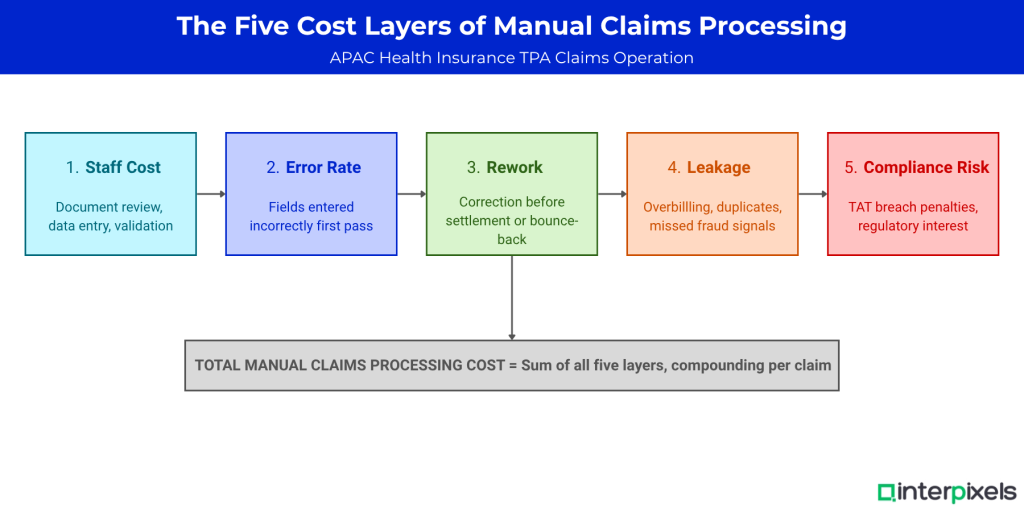
Figure: Each claim moving through a manual workflow accumulates cost across five layers. Staff cost is the only layer most TPAs measure directly. Error, rework, and leakage costs compound silently, while compliance risk cost grows automatically with volume once IRDAI, BNM, or MAS turnaround-time mandates are breached.
Manual vs. Partial vs. Full Automation
| Option | Key Strength | Best Used When |
|---|---|---|
| Fully manual processing | Full human judgment on every field, no integration required | Claim volume is very low or claim types are highly non-standard |
| OCR-only automation | Fast text extraction, lower cost than manual entry | Document formats are consistent and fraud risk is low |
| Full claims intelligence (OCR + GenAI + fraud detection + HITL) | Combines extraction, fraud scoring, and structured routing in one pass | Volume is high, document types vary, and leakage or TAT compliance is a measured risk |
What Changes When You Automate the Document Layer
Platforms purpose-built for this problem, such as InterPixels AI, apply completeness validation before any extraction resources are spent, classify and extract data across 40-plus health insurance document types using OCR and generative AI, and run fraud detection during extraction rather than after settlement, according to the vendor’s published product documentation. A human-in-the-loop layer routes only low-confidence fields to a reviewer, not entire documents, which is what shifts the staff cost curve without removing human oversight from the process.
The effect on the five-layer model above is directional and consistent across TPAs that make this shift: staff cost per claim drops because reviewers work exceptions instead of full documents, error and rework costs fall because validation happens before adjudication instead of after, leakage narrows because fraud checks run on every claim instead of a sampled few, and compliance risk shrinks because the document bottleneck, not the adjudication decision, is what was consuming the TAT clock.
Frequently Asked Questions
How much does manual health insurance claims processing cost per claim? No single authoritative, independently verifiable figure exists. Industry commentary commonly cites $40 to $60 per claim in developed markets, which for Indian TPAs is often converted to roughly Rs 1,400 to Rs 2,200 per claim, but treat this as a directional estimate rather than a confirmed benchmark, and add error, leakage, and compliance costs on top.
What is claims leakage and how much does it cost? Claims leakage is money paid out incorrectly due to overbilling, fraud, or processing errors that should have been caught before settlement. It is typically the largest hidden cost layer in a manual claims operation, often exceeding staff cost once measured properly.
Why does IRDAI’s one-hour TAT rule matter for cost, not just compliance? A missed pre-authorization or discharge window under the 2024 Master Circular makes the insurer liable for the hospital costs the delay causes. Separately, delayed final claim settlement triggers interest at the bank rate plus 2 percent per day. At volume, both become recurring, quantifiable operating costs.
Does automating claims processing eliminate staff jobs? No. Human-in-the-loop automation routes low-confidence fields and exceptions to reviewers, shifting staff time from full-document data entry toward judgment-based exception handling rather than eliminating the review function.
What is the fastest way for a TPA to estimate its own manual processing cost? Start with the five layers in this post, staff cost, error rate, rework, leakage, and compliance risk, and pull actual numbers for each from your claims system rather than relying on industry averages alone.
Conclusion
Manual claims processing cost is almost never one number. It is five, and the four layers TPAs rarely measure, error correction, rework, leakage, and compliance risk, routinely outweigh the staff cost line that gets all the attention in budget conversations. APAC TPAs operating under IRDAI, BNM, or MAS turnaround mandates carry an additional cost layer their US or UK counterparts do not: a regulatory clock that turns document delay directly into financial liability.
Where does your own claims operation sit against these five cost layers, and which one would move the needle first if you measured it properly?
Table of Content
- Why “Cost Per Claim” Undersells the Real Number
- The Five Cost Layers Nobody Adds Up
- A Worked Cost Model for a Mid-Sized APAC TPA
- Where the Money Actually Leaks
- The Compliance Clock Is a Cost Center Too
- Architecture: How the Five Cost Layers Stack
- Manual vs. Partial vs. Full Automation
- What Changes When You Automate the Document Layer
- Frequently Asked Questions
- Conclusion