
A claims automation platform for health insurance TPAs extracts structured data from inbound claim documents, validates completeness, detects fraud signals, and routes exceptions. Hence, adjudicators start work where document processing ends. InterPixels and Sprout.ai both serve this function, but with fundamentally different product models, market focus, and regional training: InterPixels is an API-first tool purpose-built for APAC health TPAs, while Sprout.ai is a SaaS platform developed for multi-line insurers primarily in the UK, Europe, and the Americas.
Why This Comparison Matters Right Now
The InterPixels vs Sprout.ai question is one that more APAC health TPA leaders are asking in 2025 and 2026. According to McKinsey (2025), a full end-to-end claims domain transformation can deliver up to 14 times the impact of isolated automation pilots. That number raises the stakes considerably for vendor selection.
APAC accounts for more than 29% of global insurance IT spending, per HG Insights market intelligence data. Four of the top ten insurance IT markets globally sit in Asia Pacific. Yet most AI claims platforms reaching the region were designed for Western, single-language regulatory environments.
The gap between what a European-trained platform assumes and what an APAC health TPA actually processes is wider than most vendor presentations admit.
Why APAC Health TPAs Need a Different Standard
APAC health TPAs process claims across six or more distinct languages and 40-plus document formats, often from handwritten prescriptions and regional hospital bills. A generic western claims platform cannot handle this without significant re-engineering.
Research confirms the technical challenge. A 2026 arXiv paper from the Fullerton Health AI team, which processes tens of millions of claims annually across nine APAC markets, found that multilingual claim documents exhibit significant content heterogeneity ranging from typed invoices to handwritten medical reports and linguistic diversity. Their production pipeline achieves a 300x efficiency gain over manual processing. Getting there required a purpose-built multilingual OCR stack, not a repurposed UK claims tool.
A companion 2026 benchmark from arXiv (SEA-Vision) found that leading multimodal models show pronounced performance degradation on low-resource Southeast Asian languages, including Thai, Bahasa, and Filipino. Training data geography matters.
The gap between what a European-trained AI platform assumes and what an APAC health TPA actually processes is wider than most vendor demos admit.
Company Overview: What Each Vendor Actually Is
InterPixels AI is a health insurance claims intelligence API developed by Clarion Analytics Pte Ltd, based in Singapore. Founded with a single focus on health insurance TPAs across Asia Pacific, it covers India, Malaysia, Indonesia, Singapore, Thailand, and the Philippines. The product is API-first: it slots into your existing TPA platform via REST API, returning structured JSON per claim. No portal changes, no workflow disruption.
Sprout.ai’s company page states the platform has been deployed for insurers including AXA, AdvanceCare, Lloyd’s Banking Group, MetLife, and Scottish Widows, operating in the UK, Europe, the Americas and Japan. It is a multi-line insurance SaaS platform covering health, motor, property, and commercial lines. Its business model is a full platform deployment, not an API add-on.
Both companies use AI-powered document extraction, OCR, NLP, and fraud detection. The difference lies in what they were trained on, who they were built for, and how they integrate.
Product Model: API Drop-In vs Full SaaS Platform
InterPixels deploys as a REST API that slots into your existing TPA system in 4 to 6 weeks with no platform changes. Sprout.ai deploys as a full SaaS platform replacing or overlaying your existing claims workflow, with a stated 3-month minimum implementation timeline.
In practice, this distinction shapes everything downstream. Teams building claims automation in APAC typically find that the fastest path to value is adding intelligence to an existing TPA workflow, not replacing it. The InterPixels model delivers structured JSON per claim via REST API. Your adjudication logic, your team’s screens, and your existing audit trail remain unchanged.
TechRadar’s Sprout.ai review (2025) confirms that Sprout.ai offers rapid implementation with seamless integrations, modular design, and SaaS deployment with the ability to deploy in as little as 3 months. For a multi-line insurer rebuilding their entire claims stack, this is a feature. For an APAC health TPA that already has a working platform and needs to add document intelligence, it can mean three months of disruption before value appears.
The fastest path to value in APAC TPA operations is adding intelligence to an existing workflow, not replacing it.
APAC Language and Document Coverage
InterPixels processes printed documents across 200-plus languages and is explicitly trained on health insurance document types from India, Malaysia, Indonesia, Singapore, Thailand, and the Philippines. Sprout.ai does not publicly state dedicated APAC health insurance language model training, though it does serve Japan.
InterPixels covers 40-plus health insurance document types including OPD claim forms, prescriptions, lab reports, pharmacy bills, IPD hospital bills, discharge summaries, settlement letters, and KYC documents. This specificity matters operationally. A general document AI that handles invoices is not the same as one trained on the specific layout of an Indonesian hospital break-up bill or a Malaysian pharmacy receipt.
A 2025 academic paper published in the International Journal of Science and Research Archive found that AI-driven IDP reduces claims processing time from 4-6 weeks to 24-48 hours (80% improvement) and improves document accuracy from 75% to 99.8% when systems are trained on the correct document corpus. The key phrase is correct document corpus. Sprout.ai’s models are trained on a seven-year corpus of UK and European insurance documents. Whether that training transfers cleanly to Thai hospital billing formats is not addressed in public documentation.
InterPixels AI: Claims Processing Architecture
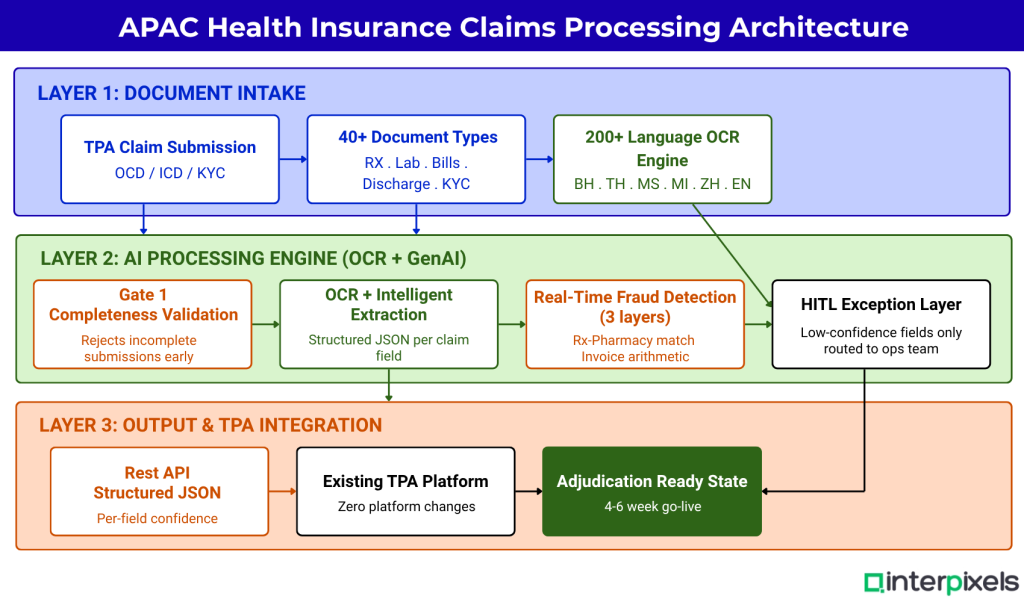
Documents flow from TPA intake through Gate 1 completeness validation, multilingual OCR and GenAI extraction (200+ languages), and three-layer real-time fraud detection. Low-confidence fields route to a Human-in-the-Loop (HITL) layer for ops team review. Structured JSON output is returned via REST API directly to the existing TPA platform, with no system changes required. Average go-live: 4 to 6 weeks.
Full Feature Comparison
InterPixels leads on APAC document specificity, integration speed, and health-only depth. Sprout.ai leads on multi-line breadth, established European regulatory compliance, and full-platform claims lifecycle management.
| Feature | InterPixels AI | Sprout.ai | What It Means for APAC TPAs |
|---|---|---|---|
| Product Model | API drop-in (REST) | Full SaaS platform | API means no platform changes for your team |
| Target Market | APAC health insurance TPAs | UK / EU / Americas multi-line insurers | InterPixels trained on APAC document formats |
| APAC Languages (printed) | 200+ languages | Not publicly stated for APAC | Critical for BH, TH, MS, HI, ZH document processing |
| Health Doc Types | 40+ health-specific types | Generic document AI (multi-line) | 40+ types covers the full APAC TPA document lifecycle |
| OPD / IPD Coverage | Yes – dedicated models | Yes – general health claims | InterPixels trains OPD/IPD separately for accuracy |
| Fraud Detection | 3 real-time layers at extraction | Yes – pattern and anomaly-based | Prescription-pharmacy matching is APAC-specific |
| HITL Layer | Yes – exception routing | Yes – handler empowerment tools | Both include human-in-loop; different implementation |
| Integration Speed | 4 to 6 weeks via REST API | 3 months minimum (SaaS) | Critical for TPAs needing fast go-live |
| Platform Changes Required | No – zero disruption | Yes – platform deployment | Minimal change management cost with InterPixels |
| Multi-line Insurance | Health only | Yes – motor, property, commercial | Sprout.ai fits multi-line carriers; InterPixels fits health-only TPAs |
| Established Enterprise Clients | APAC TPA case studies | AXA, MetLife, Scottish Widows | Sprout.ai has broader enterprise proof points globally |
| Pricing Model | API-based (consumption) | SaaS subscription | API pricing scales with claim volume |
A platform built for Lloyd’s of London is not the same as a platform built for a Jakarta health TPA, even if both call themselves AI claims automation.
When Each Platform Makes Sense
Choose InterPixels if your operation is an APAC health TPA that needs fast, non-disruptive API integration. Choose Sprout.ai if you are a multi-line carrier operating primarily in the UK, Europe, or Americas, or if you are building a full claims lifecycle platform from scratch.
Choose InterPixels AI when:
- Your claims arrive in Bahasa Indonesia, Thai, Malay, Hindi, Mandarin, or another APAC language
- You process OPD and IPD health claims and need document-type-specific extraction logic
- Your existing TPA platform works, and you need to add document intelligence without rebuilding it
- You need to be live in 4 to 6 weeks, not 3 to 6 months
- Your team has API integration capability (standard REST / JSON)
Choose Sprout.ai when:
- You operate across multiple insurance lines (motor, property, health, commercial)
- Your primary markets are the UK, EU, or Americas with standard Western document formats
- You want a full SaaS platform managing the entire claims lifecycle, not just document extraction
- You can commit to a 3-month or longer implementation and transformation program
- Your vendor relationship includes European regulatory compliance frameworks (FCA, EIOPA)
FAQ: InterPixels vs Sprout.ai for APAC Health Insurance
Is InterPixels better than Sprout.ai for APAC TPAs?
For APAC health insurance TPAs, InterPixels is purpose-built for the job. It is trained on the document types, languages, and claim formats that APAC TPAs process daily, including Bahasa, Thai, Malay, Hindi, and Chinese. Sprout.ai is a proven platform but is primarily designed for European and Americas multi-line insurers. Regional fit matters significantly for document AI accuracy.
How long does InterPixels take to integrate?
InterPixels integrates via REST API in 4 to 6 weeks. No changes are required to your existing TPA platform. The API returns structured JSON per claim, which feeds directly into your existing adjudication workflow. This compares to a minimum 3-month deployment timeline for a full SaaS platform like Sprout.ai.
Does Sprout.ai support APAC languages?
Sprout.ai does not publicly state dedicated APAC language model training on its product pages. It does operate in Japan. Its AI models are described as insurance-trained over seven years, primarily on UK and European insurance document corpora. For TPAs processing documents in Thai, Bahasa Indonesia, Malay, or Hindi, this is a significant gap to evaluate before selection.
What document types does InterPixels cover?
InterPixels covers 40-plus health insurance document types across both outpatient (OPD) and inpatient (IPD) claims. This includes claim forms, prescriptions, lab reports, pharmacy bills, hospital break-up bills, discharge summaries, settlement letters, and KYC documents. The platform is trained specifically on APAC regional document layouts, not generic invoice formats.
What is the main risk of choosing the wrong vendor?
The primary risk is accuracy degradation on regional document types. SEA-Vision benchmark research (arXiv 2026) found that leading AI models show pronounced performance degradation on low-resource Southeast Asian languages. A platform trained on European documents may extract data correctly in demos on English forms but fail on production-volume Thai pharmacy receipts, triggering downstream adjudication errors and claim leakage.
The Right Claims API for Where Your Claims Actually Come From
Three things are clear from this comparison. First, regional document training is not a marketing claim, it is an engineering constraint. A platform cannot accurately extract data from document formats it was never trained on. Second, integration speed is a competitive advantage. An APAC TPA that can go live in 6 weeks rather than 4 months gains a meaningful operational head start. Third, health-only specialisation produces better accuracy than multi-line generalism for a TPA that processes nothing but health claims.
InterPixels is built for the APAC health TPA use case. Sprout.ai is built for multi-line carriers in Western markets. If your claims come from Jakarta, Kuala Lumpur, Mumbai, or Manila, your claims platform should be trained on those markets too.
The question worth asking your vendor: what percentage of your training data comes from APAC health insurance documents, and can you show the accuracy benchmarks to prove it?
Explore the full platform comparison at /compare/interpixels-vs-sprout-ai/ or book a live demo.
Table of Content