
IRDAI health insurance claims processing compliance refers to the set of regulatory obligations that licensed Indian TPAs and insurers must meet under the IRDAI (Third Party Administrators Health Services) Regulations 2016, the IRDAI 2024 Master Circular on Health Insurance Products, and related directives. Obligations cover turnaround times (TATs) for cashless and reimbursement claims, document standards, structured rejection reasons, claims register maintenance, policyholder grievance escalation via Bima Bharosa, and annual settlement ratio reporting to IRDAI.
Why 2026 Is a Defining Year for IRDAI-Regulated TPAs
Indian health insurers processed a record 3.26 crore health insurance claims in FY 2024-25, according to the IRDAI Annual Report FY 2024-25. That volume, equivalent to roughly 89,000 claims per day, is running through a regulatory framework that was fundamentally rewritten when IRDAI repealed 55 standalone circulars and issued the 2024 Master Circular on Health Insurance Products on May 29, 2024. For IRDAI health insurance claims processing in India, compliance is no longer a background obligation. It is a daily operational discipline with quantified financial consequences.
For TPA compliance officers and COOs, the central pressure in 2026 comes from three directions. TAT mandates are tight, measurable, and now carry automatic interest penalties. Settlement ratio data feeds directly into regulator oversight. And grievance data flows in real time to Bima Bharosa, making every breach visible to IRDAI. The IRDAI Annual Report FY 2024-25 shows that claims-related issues account for 69% of all general and health insurance grievances registered in FY25, the single largest category of policyholder complaints. That is not an industry-wide problem. It is a processing infrastructure problem that individual TPAs can solve.
In 2026, every TAT breach in Indian health insurance carries a price tag: interest at Bank Rate plus 2% per day, compounding from the moment the deadline passes.
Understanding the IRDAI 2024 Master Circular: What It Consolidated and What Changed
The 2024 Master Circular is the single most important regulatory document for India health insurance TPA compliance today. It absorbed and superseded 55 previously standalone circulars into one authoritative reference, issued under Section 14(2)(e) of the IRDAI Act 1999 and Section 34 of the Insurance Act 1938.
The 55 Circulars That Were Repealed
Before May 2024, TPAs and insurers had to cross-reference dozens of standalone circulars to determine their obligations on any given claim. The Master Circular ended that fragmentation. Every compliance officer should now maintain a single working reference to this document rather than the legacy circular archive.
The circular also introduced policyholder-facing language that has direct operational implications for TPAs. Insurers and TPAs are now required to collect all claim documents directly from hospitals. Policyholders, per the Master Circular, should not need to submit documents for claim settlement. That requirement alone changes the intake workflow for every TPA still relying on policyholder document submission.
New TAT Mandates at a Glance
The turnaround times introduced by the 2024 Master Circular are specific, measurable, and non-negotiable. Three deadlines govern the cashless and reimbursement flows that every Indian TPA must operationalise:
- Cashless pre-authorisation: decision within 1 hour of request receipt.
- Final discharge authorisation: decision within 3 hours.
- Reimbursement claim settlement: settled or formally rejected within 30 days of receiving the last required document.
The penalty for missing the reimbursement deadline is interest at 2% above the prevailing bank rate, applied for every day of delay. The 2024 Master Circular also specifies that ombudsman awards not implemented within 30 days attract a penalty of Rs 5,000 per day to the policyholder. These are not theoretical risks for busy TPAs. They are automatic financial liabilities.
The 1-hour cashless pre-auth window is not achievable with manual document review. It requires a system that validates completeness and extracts structured data before a human adjudicator reads the first field.
TAT Mandates Every TPA Must Operationalise in 2026
Meeting IRDAI TAT mandates at scale is the defining operational challenge for India health insurance TPA compliance in 2026. The gap between the mandated timeline and the average manual processing time is large: industry benchmarks show manual document review running at 30 to 40 minutes per claim before adjudication even starts.
Cashless Pre-Authorisation: The 1-Hour and 3-Hour Rules
The 1-hour pre-auth clock starts the moment the TPA receives the hospital’s request. In practice, teams building cashless workflows typically find that document completeness checking alone consumed 15 to 20 minutes before any clinical assessment could begin. A pre-auth request arriving with missing documents or a poor-quality prescription scan creates an immediate TAT risk.
The 3-hour discharge authorisation timeline is equally demanding. A patient awaiting discharge while the TPA processes a final hospital bill and discharge summary is a visible, high-stakes scenario. Delays here generate policyholder complaints directly into Bima Bharosa and create reputational exposure for both the TPA and the insurer.
Reimbursement Settlement: The 30-Day Clock
The 30-day clock for reimbursement starts from receipt of the last required document, not from the date of hospitalisation. This creates a critical compliance dependency: if the TPA cannot clearly identify which document was received last, and at what time, it cannot defend against an interest claim or ombudsman complaint.
According to IRDAI data published in February 2026, standalone health insurers achieved a 99.93% settlement ratio in FY 2024-25. The operational practices behind that number share one common feature: automated document intake with timestamp precision.
TPA Licensing, Document Standards, and Claims Register Obligations
Operating as a TPA in India requires a licence under the IRDAI (Third Party Administrators Health Services) Regulations 2016, registered with IRDAI under regulation reference IRDAI/Reg/5/117/2016. A TPA must be incorporated as a company under the Companies Act 2013 with health services as its sole object. LLPs and partnerships are not eligible. Post-registration, TPA performance is monitored by the insurer, which is now authorised under the Master Circular to claw back TPA remuneration based on customer feedback.
Document standards are prescribed at the claim type level. IPD claims require a larger document bundle, typically including discharge summary, hospital main bill, OT notes, and break-up bills. OPD claims require prescriptions, pharmacy bills, lab reports, and consultation receipts. A claim that fails document completeness checks cannot legally start the TAT clock, but it also cannot sit indefinitely in an incomplete state. TPAs need a defined rejection or query workflow with documented timestamps for each step.
The National Health Claims Exchange (NHCX), developed by India’s National Health Authority, is IRDAI’s digital infrastructure push for standardised, paperless claims. As of July 2024, 34 insurers and TPAs and over 300 hospitals were live on NHCX per Ministry of Health and Family Welfare data. TPAs not yet integrated face a growing digital gap as NHCX adoption accelerates. Fully coded NHCX claims, per the NatHealth report, can be settled within 48 hours, well within the 30-day mandate.
The claims register obligation requires each TPA to maintain a structured record per claim that supports adjudication audit, settlement ratio calculation, and insurer performance monitoring. The register must capture document inventory, processing timestamps, decision rationale, and settlement or rejection outcome. This is the record that IRDAI, the ombudsman, or the insurer can request at any point.
A claims register that cannot show which document arrived at what time is not IRDAI-compliant. Timestamp integrity is the foundation of every TAT defence.
Claim Rejection Norms, Grievance Escalation, and the Bima Bharosa Framework
The 2024 Master Circular tightened rejection standards in a way that directly affects TPA operations. A rejection must cite specific policy clauses, not generic language like “policy conditions not met.” That obligation puts the burden on the TPA’s data infrastructure: the rejection reason must be traceable to a specific document field, a specific clause, and a specific extraction event.
Vague rejections are one of the primary drivers of Bima Bharosa escalations. The IRDAI Annual Report FY 2024-25 shows that claims-related issues account for 69% of general and health insurance grievances, the single largest complaint category. A policyholder or hospital that receives a rejection without a clause-wise explanation has immediate grounds for a complaint. That complaint flows from the insurer’s grievance channel directly into the Bima Bharosa platform, and the regulator monitors resolution in real time.
The Bima Bharosa portal replaced the earlier IGMS system and provides IRDAI with a live view of insurer complaint volumes and resolution patterns. Policyholders escalate to Bima Bharosa after 15 days of unresolved insurer response. The token number generated on registration is tracked across both the insurer’s system and IRDAI’s repository simultaneously. For TPAs, every complaint that reaches Bima Bharosa is a record against the insurer’s conduct score.
The escalation pathway runs from the insurer grievance officer (first contact), to Bima Bharosa escalation (if unresolved within 15 days), to the insurance ombudsman (for disputes above a threshold). Ombudsman decisions not implemented within 30 days attract the Rs 5,000 per day penalty. TPAs whose claim decisions are regularly challenged at ombudsman stage face both direct costs and regulatory scrutiny.
How Technology Enables IRDAI Compliance: The Regulatory-Technology Alignment
Technology does not replace compliance judgement. It creates the infrastructure within which compliant decisions can be made at the speed and scale the 2024 Master Circular demands. The table below maps each IRDAI requirement to the operational layer that addresses it.
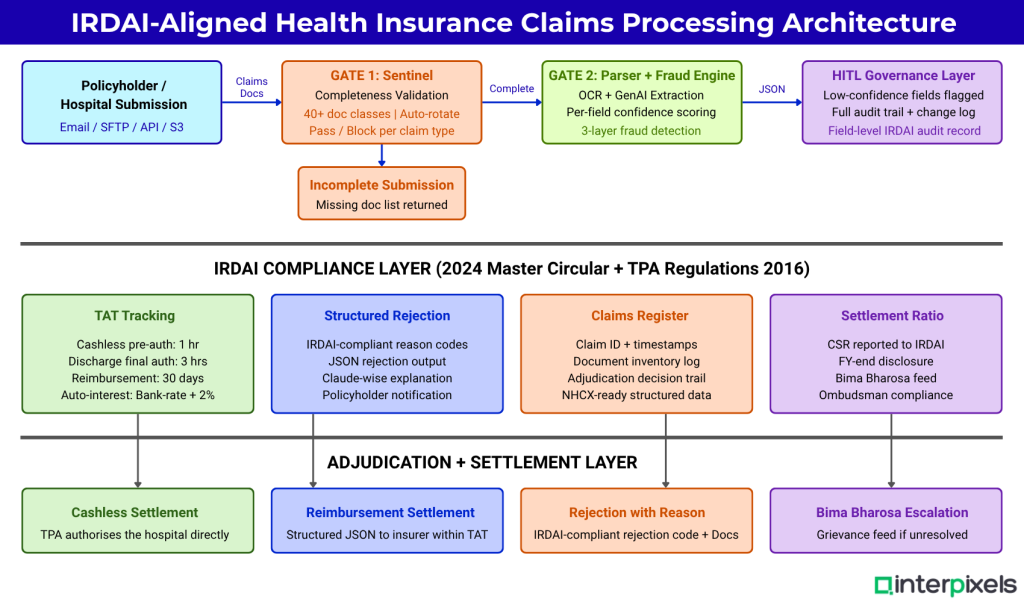
Figure 1: IRDAI-Aligned Health Insurance Claims Processing Architecture (InterPixels AI, 2026). Claims pass Gate 1 completeness validation, then Gate 2 OCR + GenAI extraction with 3-layer fraud detection. Low-confidence fields route to HITL with full audit trail. The compliance layer tracks TAT, structures rejection codes, maintains the claims register, and feeds settlement ratio data to IRDAI via Bima Bharosa, satisfying the 2024 Master Circular and TPA Regulations 2016.
IRDAI Compliance Requirements vs Technology Support
| IRDAI Requirement | Regulatory Standard | InterPixels AI Support |
|---|---|---|
| Cashless Pre-Auth TAT | 1 hour from request (2024 Master Circular) | Gate 1 + Gate 2 processing in under 5 min per claim; automated pre-auth data package output |
| Discharge Final Auth | 3 hours from discharge summary receipt | Real-time document ingestion via webhook; structured JSON delivered in seconds |
| Reimbursement Settlement | 30 days from last document receipt | Automated TAT clock start on document ingestion; missing-doc alerts prevent clock restarts |
| Delay Interest | Bank Rate + 2% per day of delay | TAT dashboard surfaces breach risk before deadlines; alerts routed to ops team |
| Structured Rejection Reasons | Clause-wise explanation mandatory | JSON output embeds specific field-level rejection codes; IRDAI-compliant reason mapping |
| Claims Register Maintenance | Full audit trail per claim; NHCX-ready data | Per-field confidence scores, HITL change log, and timestamp records retained per claim |
| Settlement Ratio Reporting | Annual CSR disclosure to IRDAI; Bima Bharosa integration | Structured JSON output feeds directly into insurer reporting pipeline and NHCX |
| TPA Performance Monitoring | Insurer must monitor and may claw back TPA remuneration | HITL audit records provide insurer-facing performance evidence per claim processed |
Solutions such as InterPixels AI are purpose-built for this compliance infrastructure. Delivered via REST API with no changes to the TPA’s existing platform, the system processes 40+ health insurance document types, returns structured JSON output per claim in seconds, and maintains field-level confidence scores and HITL change logs that satisfy IRDAI audit requirements. In production deployment with TrueCover India, processing time dropped from 40 minutes to 5 minutes per claim across 15,000+ claims, a direct enabler of the 1-hour cashless TAT mandate.
The McKinsey July 2025 report on AI in insurance documents how AI-led claims transformation at UK insurer Aviva cut complaints by 65% and saved over GBP 60 million in 2024. The operational principle is the same for Indian TPAs: automation at the document intake layer removes the bottleneck that generates TAT breaches and the complaints that follow.
Automation at the document intake layer is not a technology upgrade. It is a compliance upgrade. The two are now inseparable under IRDAI’s 2024 framework.
Claims Processing Approach Comparison
| Approach | Key Strength | Compliance Risk | Best Used When |
|---|---|---|---|
| Manual Document Review | Zero technology dependency | HIGH: TAT breaches likely at scale; poor audit trail | Claim volume under 200 per day with dedicated staff |
| Semi-Automated (RPA / Basic OCR) | Reduces data-entry errors on printed forms | MEDIUM: 1-hour cashless TAT still difficult; no fraud detection | Transitional stage; stable printed-document workflows |
| AI-Native Claims Intelligence API (e.g. InterPixels AI) | 8x faster processing; 94% auto-validation; real-time fraud detection | LOW: automated TAT tracking, structured JSON rejection codes, full audit trail | Any TPA processing 1,000+ claims per day targeting IRDAI compliance |
| Insurer In-House System (no TPA) | Direct control over data and workflows | VARIABLE: depends on system maturity and update cadence | Large standalone health insurers with significant IT investment |
Frequently Asked Questions on IRDAI Claims Compliance
What is the IRDAI 30-day rule for health insurance claim settlement?
IRDAI requires every insurer and TPA to settle or formally reject a reimbursement claim within 30 days of receiving the last required document. Missing this deadline triggers mandatory interest at 2% above the prevailing bank rate, applied for every day of delay from the deadline. The clock starts from documented receipt of the final document, making intake timestamping a compliance-critical process.
What does the IRDAI 1-hour cashless pre-auth rule mean for TPAs?
The 2024 IRDAI Master Circular requires a TPA or insurer to make a cashless pre-authorisation decision within 1 hour of receiving the hospital’s request. A final discharge authorisation must follow within 3 hours of receiving the discharge summary and final bill. These timelines apply to every IRDAI-licensed insurer and their appointed TPAs, with no volume exceptions.
How should a TPA structure claim rejections to comply with IRDAI norms?
IRDAI requires every rejection to carry a clause-wise explanation citing the specific policy clause that applies. Generic reasons such as “policy conditions” or “documents insufficient” are non-compliant. The rejection must identify the specific document or field that triggered it, the policy clause invoked, and the policyholder’s right of escalation to Bima Bharosa if unresolved within 15 days.
What is Bima Bharosa and how does it affect TPA operations?
Bima Bharosa is IRDAI’s integrated grievance management portal at bimabharosa.irdai.gov.in, which replaced the earlier IGMS system. Policyholders can escalate unresolved complaints directly to IRDAI after 15 days. Every complaint registered flows simultaneously to the insurer’s system and IRDAI’s repository in real time. IRDAI monitors resolution patterns as a market conduct indicator, making Bima Bharosa complaint volume a de facto performance metric for TPAs.
What TPA licensing requirements must companies meet under IRDAI regulations?
Under IRDAI (TPA Health Services) Regulations 2016, a TPA must be registered as a company under the Companies Act 2013 with health services as its sole stated object. LLPs and partnerships are ineligible. The entity must obtain a TPA licence from IRDAI before commencing operations. Post-registration, the TPA is subject to performance monitoring by the appointing insurer, which can claw back remuneration for poor service, per the 2024 Master Circular.
Three Compliance Priorities Every Indian TPA Must Act On in 2026
The IRDAI 2024 Master Circular removed ambiguity from Indian health insurance claims compliance. TAT obligations are specific, interest penalties are automatic, rejection reasons must be clause-wise, and grievance data is monitored in real time. For TPA compliance officers, three priorities determine whether operations stay ahead of the regulation or spend 2026 managing penalties and ombudsman cases.
First, implement timestamped document intake. The 30-day reimbursement clock and the 1-hour cashless clock both depend on defensible evidence of when a document was received. Manual intake processes cannot produce that evidence reliably at scale. Second, structure rejection reasons at the field level. Every rejection that does not cite a specific clause is a Bima Bharosa complaint in waiting. Third, prepare for NHCX integration. The platform is live, adoption is growing, and fully coded claims settle faster than the 30-day mandate requires. TPAs who integrate early build a structural compliance advantage.
What does your current claims intake system produce when IRDAI asks for the timestamp on the last required document for your 50 most recent reimbursement claims? That answer defines your 2026 compliance posture.
Table of Content
- Why 2026 Is a Defining Year for IRDAI-Regulated TPAs
- Understanding the IRDAI 2024 Master Circular: What It Consolidated and What Changed
- TAT Mandates Every TPA Must Operationalise in 2026
- TPA Licensing, Document Standards, and Claims Register Obligations
- Claim Rejection Norms, Grievance Escalation, and the Bima Bharosa Framework
- How Technology Enables IRDAI Compliance: The Regulatory-Technology Alignment
- Frequently Asked Questions on IRDAI Claims Compliance
- Three Compliance Priorities Every Indian TPA Must Act On in 2026