
A cashless health insurance claim is settled directly between the TPA and a network hospital, requiring pre-authorisation before treatment begins. A reimbursement claim is filed after the patient pays out-of-pocket and submits documents post-discharge. Both paths serve the same policy, but each carries distinct workflows, turnaround times, fraud risk profiles, and automation requirements for the TPA processing them.
Why the Claim Type You Choose Shapes Everything the TPA Does
The claim type determines whether a TPA validates documents before treatment (cashless) or after payment (reimbursement). That single difference drives every downstream decision: system routing, fraud checks, and payment timelines.
The scale of this decision is significant. According to the IRDAI Annual Report 2023-24, Indian general and health insurers settled 2.69 crore health insurance claims totalling Rs. 83,493 crore in 2023-24, with an average claim payout of Rs. 31,086. Of those settled claims, 66.16% moved through cashless mode and approximately 39% through reimbursement mode. Seventy-two percent of all claims flowed through TPAs. The India TPA market was valued at USD 5.91 billion in 2023 and is forecast to reach USD 9.29 billion by 2030 as IRDAI drives its cashless-everywhere mandate and claim volumes compound.
For TPA ops teams, both paths land in the same document queue. Processing them accurately requires understanding where each path diverges and where the same upstream document intelligence applies to both.
“In APAC health insurance, the claim type is not a preference. It is an operational architecture decision that determines every document, system, and timeline downstream.”
How the Cashless Claim Process Works in Practice
In a cashless claim, the hospital sends a pre-authorisation request to the TPA before treatment begins. The TPA validates eligibility and approves a treatment limit; the insurer then pays the hospital directly at discharge.
Step 1: Hospital Initiates Pre-Authorisation
When a policyholder is admitted to a network hospital, the billing team submits a pre-authorisation request to the TPA. This includes the insured’s health card or policy number, the treating doctor’s diagnosis, the planned procedure, and an estimated cost. For planned admissions, IRDAI requires at least 48 hours’ advance notice. For emergencies, the hospital must intimate the TPA within 48 hours of admission.
Since January 2024, IRDAI’s “Cashless Everywhere” initiative extends this facility beyond network hospitals under specific conditions, pushing TPAs to handle a broader volume of cashless requests from any registered hospital in the country.
Step 2: TPA Validates and Approves
The TPA checks the policy against four dimensions: active status, benefit eligibility, available sum insured, and any waiting periods or exclusions. Under IRDAI’s July 2024 mandate, approval must be issued within one hour of receiving a complete request. If documentation is incomplete, the TPA sends a query back to the hospital rather than rejecting outright.
This is the exact point where document intelligence becomes the bottleneck. Research published in the International Journal of Science and Research Archive (2025) confirms that integrating ML and NLP into document workflows reduces processing time by 80% and error rates by 90%, which directly enables TPAs to meet the one-hour TAT requirement at scale.
Step 3: Direct Settlement at Discharge
Once treatment is complete, the hospital submits the final bill to the TPA. The TPA reconciles actual charges against the approved limit, flags any excess, and confirms the payable amount. The insurer settles directly with the hospital. The patient signs the discharge paperwork but pays nothing for covered items.
“Cashless claims shift the financial risk from the patient to the TPA-insurer relationship. That is why pre-authorisation is not optional. It is the contract.”
How the Reimbursement Claim Process Works in Practice
In a reimbursement claim, the patient pays the hospital at discharge and submits original bills and discharge documentation to the TPA. The TPA validates the document bundle, checks policy limits, and triggers insurer payment, typically within 15 to 30 days.
Step 1: Patient Pays and Collects Documents
The patient pays the full hospital bill at discharge from any hospital, including non-network facilities. They must collect the original discharge summary, itemised hospital bills, pharmacy receipts, diagnostic reports, the attending physician’s prescription, and a duly completed claim form. Missing any original document restarts the processing clock.
Step 2: Post-Discharge Submission to TPA
The patient or employer submits the complete document bundle to the TPA within the policy’s filing window, typically 30 days from discharge. The TPA runs completeness checks, validates each document against policy terms, screens for duplicate submissions, and applies fraud detection logic across the full bundle.
A 2024 study in Exploration of Digital Health Technologies found that XGBoost outperformed five other ML algorithms in predicting health insurance claim costs and fraud risk, underscoring why AI-powered document validation on the reimbursement path is now a TPA operations standard rather than an optional enhancement.
Step 3: Insurer Reimburses Patient
Once the TPA approves the claim, it triggers a payment instruction to the insurer. The insurer credits the patient’s registered bank account. Per standard IRDAI-aligned industry practice, reimbursement settlement typically completes within 15 days of receiving a complete document set, rising to 30 days for cases requiring investigation.
“Reimbursement claims are not a fallback. For Indonesia’s private market and Malaysia’s non-panel hospitalisations, they are the primary path. TPAs must treat them with first-class process rigour.”
TAT, Fraud Risk, and Document Requirements: A Direct Comparison
Cashless claims settle in 1 to 2 hours on average; reimbursement claims take 15 to 30 days. Reimbursement claims carry higher fraud exposure because document manipulation is easier post-discharge and harder to intercept in real time.
| Dimension | Cashless Claim | Reimbursement Claim |
|---|---|---|
| Payment flow | TPA approves; insurer pays hospital directly | Patient pays upfront; insurer reimburses patient |
| Pre-authorisation | Mandatory before treatment | Not required |
| Turnaround time (TAT) | 1 to 2 hours (IRDAI-mandated) | 15 to 30 days post-submission |
| Hospital eligibility | Network hospitals; Cashless Everywhere extends to others under 2024 IRDAI rules | Any hospital, including non-network |
| Fraud risk profile | Lower; document checks run before payment is authorised | Higher; document manipulation possible after discharge |
| Document burden on patient | Minimal; hospital submits on patient’s behalf | High; patient collects and submits all originals |
| Patient cash outlay | Zero for covered treatment | Full cost upfront; recovered after TPA approval |
| AI document automation fit | Completeness check and data extraction at pre-auth stage | OCR, classification, duplicate detection, and fraud scoring on full post-discharge bundle |
Fraud risk deserves particular attention. Deloitte’s 2025 analysis of AI in insurance fraud detection reports that soft fraud, which involves inflating a legitimate claim, accounts for 60% of all insurance fraud incidents and currently has a detection rate of only 20% to 40% without AI. Reimbursement claims are the primary vehicle for this type of fraud because the claim is submitted after the fact. The fraud detection technology market is projected to grow from USD 4 billion in 2023 to USD 32 billion by 2032, reflecting the scale of investment underway.
APAC Context: India, Malaysia, and Indonesia Do It Differently
India mandates cashless settlement for network hospitals under IRDAI regulations, while Malaysia operates a mixed model where cashless is a non-contractual privilege at panel hospitals. Indonesia’s private market remains predominantly reimbursement-based, giving TPA ops teams three distinct regulatory contexts to navigate within a single region.
India: IRDAI-Mandated Cashless and the NHCX
India has the most developed regulatory cashless framework in APAC. IRDAI requires insurers to achieve 100% cashless settlement for network hospitals, with one-hour pre-auth decision TATs mandatory since July 2024. The National Health Claims Exchange (NHCX), which processed its first claim in June 2024, creates a standardised interoperability layer so claim data flows between hospitals, TPAs, and insurers without re-keying. By July 2024, 34 insurers and TPAs were live on NHCX.
TPAs operating in India must integrate with NHCX and maintain dedicated help desks at hospitals under IRDAI’s operating guidelines. Reimbursement remains the fallback when cashless is denied or when a patient chooses a non-panel provider.
Separately, IRDAI’s Annual Report 2023-24 shows that India’s health insurers rejected or disallowed Rs. 26,000 crore in claims during FY24, a 19.10% year-on-year rise driven primarily by documentation errors and manual processing failures. This figure illustrates the direct operational cost of inadequate upstream document handling for both claim types.
Malaysia: Mixed Panel Model
Malaysia’s cashless model is contractually different from India’s. As a 2025 ScienceDirect study on private health insurance in Malaysia explains, cashless admission is a non-contractual privilege available only at panel hospitals, with insurers controlling panel participation. Outside panel hospitals, all claims revert to reimbursement.
From September 1, 2024, Bank Negara Malaysia mandated that all insurers and takaful operators must offer at least one medical product with a minimum co-payment feature, either 5% co-insurance per policy year or an RM500 deductible. This structural change directly affects claim volumes and out-of-pocket calculations for both claim paths. Malaysia’s medical insurance incurred claims ratio reached 65.9% in 2023, up 4.6 percentage points year-on-year, adding urgency to TPA cost control measures.
Indonesia: Private Market Reimbursement
Indonesia’s private health insurance market operates predominantly on reimbursement. Government workers and eligible residents use the national BPJS Kesehatan scheme, but private insurers and employer-sponsored plans route most hospitalisation claims through reimbursement. TPAs handling Indonesian employer groups must build document validation workflows that accommodate variable hospital billing formats and longer submission windows than those found in India.
“A claims document pipeline built only for India’s cashless mandate will struggle with Malaysia’s panel rules and Indonesia’s reimbursement-heavy volumes unless the underlying document intelligence layer handles all format and language combinations equally.”
How InterPixels AI Handles Document Intelligence Across Both Claim Paths
Before a TPA can adjudicate any claim, someone or something must receive the documents, check they are all present, classify each one, extract the relevant fields, and flag anomalies. That upstream work is what InterPixels AI automates. The TPA’s own adjudication system, payment engine, and compliance workflows are separate and sit downstream of the InterPixels output.
InterPixels AI is a claims intelligence API developed by Clarion Analytics Pte Ltd, Singapore, and purpose-built for health insurance TPAs across India, Malaysia, Indonesia, Singapore, Thailand, and the Philippines. It plugs into any existing TPA platform via REST API with no system changes required and goes live in four to six weeks.
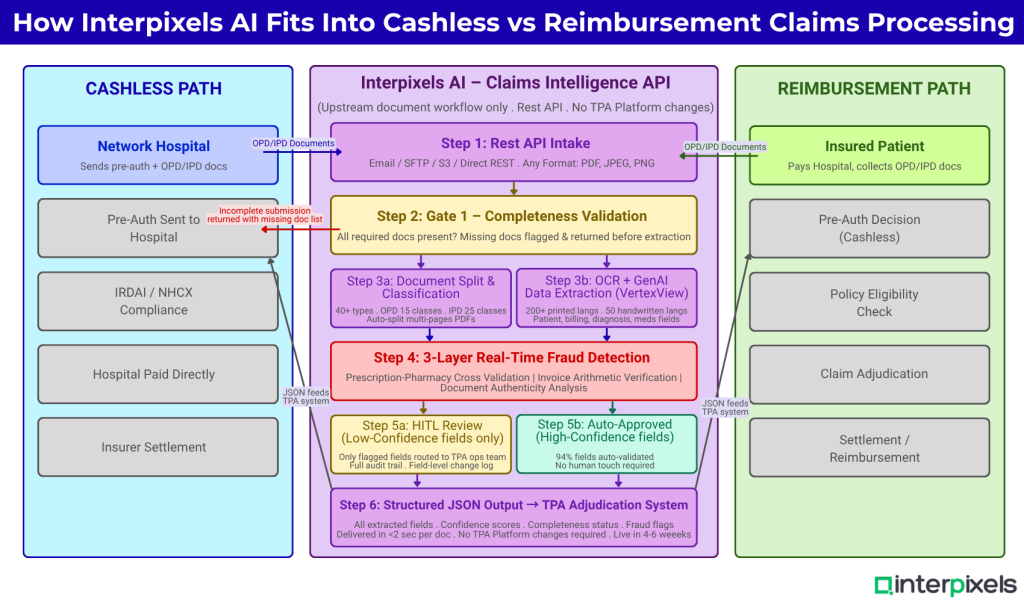
Figure 1: InterPixels AI sits between document receipt and TPA adjudication on both the cashless and reimbursement paths. It automates completeness validation, document classification across 40+ types, OCR and GenAI data extraction, three-layer fraud detection, and HITL routing. Structured JSON output is returned to the TPA’s existing system. Adjudication, pre-auth decisions, payment, and regulatory compliance sit outside InterPixels scope and remain with the TPA and insurer.
Step 1: Gate 1 Completeness Validation
Every claim, cashless or reimbursement, enters via REST API (email, SFTP, AWS S3, or direct call). Before any extraction resource is consumed, InterPixels runs a Gate 1 completeness check. OPD submissions require 15 document classes including signed claim forms, prescriptions, KYC documents, lab reports, and pharmacy bills. IPD submissions require 25 document classes, adding hospital breakup bills, operation theatre notes, discharge summaries, GISPA declarations, and settlement letters. Incomplete submissions are rejected immediately with a list of missing document classes, preventing wasted processing on claims that cannot be adjudicated.
Step 2: Document Split and Classification
Multi-page PDFs are automatically split into individual pages, and each page is classified across 40-plus health insurance document types using deep learning models trained on real APAC claims. The classifier handles JPEG, PNG, and multi-page PDF inputs. On the cashless path, hospital pre-auth packs typically contain a mix of IPD and OPD document types arriving as a single scanned bundle. On the reimbursement path, patient-submitted envelopes often contain the same mix, in variable order and scan quality. The classifier resolves both without manual sorting.
Step 3: OCR and GenAI Data Extraction (VertexView)
Following classification, InterPixels’ VertexView product applies OCR and a generative AI extraction layer to each document class. Key fields extracted include patient demographics, claim-specific identifiers, granular medicine names, quantities, unit costs and totals from pharmacy bills, itemised charges for consultancy, surgery, and room stays from hospital bills, and admission reasons plus pre- and post-discharge medication instructions from discharge summaries. The system processes printed documents in 200-plus languages and handwritten text in 50 languages, which is critical for India’s Hindi-language claims and Malaysia’s mixed Bahasa-English records.
In practice, teams deploying this pipeline typically find that the biggest efficiency gain comes not from raw OCR speed but from eliminating the manual classification step that precedes every other action in a traditional claims workflow.
Step 4: Three-Layer Real-Time Fraud Detection
Fraud checks run during extraction, before any claim reaches a human adjudicator. InterPixels applies three concurrent validation layers on every submission. Prescription-pharmacy cross-validation compares prescribed medications against pharmacy dispensing records to catch quantity mismatches and phantom prescriptions. Invoice arithmetic verification checks that all line-item totals are mathematically consistent and match stated amounts. Document authenticity analysis detects editing artefacts, font inconsistencies, and tampering indicators in KYC and financial documents. All fraud flags are embedded in the structured JSON output with specific fields and evidence cited for each alert.
Deloitte (2025) reports that 35% of insurance executives ranked fraud detection as a top-five priority for generative AI investment. With soft fraud carrying only a 20% to 40% manual detection rate, running these checks at extraction on every claim rather than sampling represents a structural improvement in leakage prevention.
Step 5: HITL Governance for Low-Confidence Fields
When a field extraction falls below the confidence threshold, that specific field is automatically routed to the TPA’s operations team for review. Reviewers see only the flagged fields, not entire documents. Once confirmed or corrected, the claim proceeds. A full audit trail and field-level change log are retained for every decision. This keeps human accountability at every uncertain point while ensuring that 94% of fields that meet the confidence threshold flow through without any manual touch.
Step 6: Structured JSON Output to TPA System
All extracted and validated data is returned as structured JSON in under two seconds per document. The JSON contains extracted fields, per-field confidence scores, completeness status, and fraud flags. The TPA’s existing adjudication system consumes this output directly, with no reformatting required. The TPA then applies its own policy logic, makes the adjudication decision, issues pre-auth approval on the cashless path, or approves reimbursement on the other path, and triggers settlement through the insurer. These downstream steps are outside the InterPixels scope.
The TrueCover India deployment illustrates the production outcome. After integrating InterPixels, TrueCover processed over 15,000 claims at an average of five minutes per claim, down from 40 minutes, an 8x improvement measured across live production volume. Hindi-language claims that previously stalled in manual exception queues processed at the same speed as English-language records.
“InterPixels AI is the document intelligence layer between a claim submission and the TPA’s adjudication decision. Everything before the JSON output is automated. Everything after remains with the TPA.”
Frequently Asked Questions
What documents does a TPA need for a cashless health insurance claim?
For a cashless claim, the hospital submits a pre-authorisation form, the insured’s health card or policy number, the treating doctor’s diagnosis and treatment plan, and an estimated cost breakdown. For planned admissions, this must arrive at least 48 hours before admission. Emergency admissions must be intimated within 48 hours of hospitalisation. The patient does not need to collect or submit documents; the hospital handles the submission on their behalf.
How long does a reimbursement health insurance claim take to settle?
A reimbursement claim typically settles within 15 days of the TPA receiving a complete document bundle. Complex cases or those requiring further investigation can take up to 30 days. Delays most often occur when original documents are missing or the claim form is incomplete. Submitting digitally through the insurer’s portal can reduce processing time by removing postal handling delays.
Can a rejected cashless claim be converted to a reimbursement claim?
Yes. If the TPA rejects a cashless pre-authorisation request, the patient can pay the hospital at discharge and file a reimbursement claim with the full document bundle. A cashless denial does not automatically make the underlying claim ineligible for coverage. Common denial reasons include missing documents or a non-panel hospital, neither of which affects the policy’s reimbursement provision.
What is pre-authorisation in health insurance and who approves it?
Pre-authorisation is a TPA’s written confirmation that a specific treatment is covered under an active policy before the patient is hospitalised. The TPA issues it on behalf of the insurer after verifying that the procedure is within covered conditions, the policy is active, and sufficient sum insured remains. Under IRDAI’s 2024 mandate, TPAs must issue pre-auth decisions within one hour of receiving a complete request. Approval confirms the treatment limit, not an unconditional commitment for all charges incurred.
How does AI reduce fraud in reimbursement health insurance claims?
AI reduces reimbursement fraud by running validation checks during document extraction, before any claim reaches an adjudicator. InterPixels AI applies three concurrent layers: prescription-pharmacy cross-validation, invoice arithmetic verification, and document authenticity analysis. Every claim is checked, not just sampled. Deloitte (2025) reports that soft fraud currently has a manual detection rate of only 20% to 40%, making systematic AI-based extraction-time fraud checks a material improvement for any TPA processing high reimbursement volumes.
The Single Most Important Decision Your TPA Workflow Needs to Make
Three insights stand above the rest. First, claim type is not a patient preference. It is an operational architecture that determines every document, system, and timeline in the TPA workflow. Second, fraud risk is structurally higher in reimbursement claims, which makes document-level AI validation non-negotiable for any APAC TPA processing both paths at volume. Third, India, Malaysia, and Indonesia follow materially different regulatory models, meaning the document intelligence layer must handle diverse formats, languages, and document class combinations equally well across all three markets.
The question worth asking your TPA operations lead: how much of your current processing time is consumed by the document work that happens before a single adjudication decision is made? That upstream bottleneck is the one InterPixels AI is built to eliminate.
Table of Content
- Why the Claim Type You Choose Shapes Everything the TPA Does
- How the Cashless Claim Process Works in Practice
- How the Reimbursement Claim Process Works in Practice
- TAT, Fraud Risk, and Document Requirements: A Direct Comparison
- APAC Context: India, Malaysia, and Indonesia Do It Differently
- How InterPixels AI Handles Document Intelligence Across Both Claim Paths
- Frequently Asked Questions
- What documents does a TPA need for a cashless health insurance claim?
- How long does a reimbursement health insurance claim take to settle?
- Can a rejected cashless claim be converted to a reimbursement claim?
- What is pre-authorisation in health insurance and who approves it?
- How does AI reduce fraud in reimbursement health insurance claims?
- The Single Most Important Decision Your TPA Workflow Needs to Make