
Bahasa Indonesia OCR for health insurance claims is the automated extraction of structured data from Indonesian-language health documents including Formulir Klaim (claim forms), Resep Dokter (doctor prescriptions), Kuitansi Apotek (pharmacy receipts), and Surat Keterangan Dokter (medical certificates). Because these documents combine handwritten Bahasa Indonesia text, Latin medical terminology, regional spelling variations, and partially printed formats, generic OCR engines produce high error rates. Specialist AI systems trained on Indonesian health document formats are required to achieve production-grade accuracy.
Why Indonesian Health Insurance Claims Create a Document Processing Problem Unlike Any Other
Indonesian health claims combine handwritten Bahasa Indonesia, Latin drug names, and non-standard regional formats in a single document bundle. Generic OCR engines cannot handle this combination reliably, and errors that pass through silently become adjudication failures downstream.
Indonesia’s private health insurance PA&H segment reached IDR 38.6 trillion (approximately US$2.4 billion) in gross written premium in 2025 and is expanding at a 13.4% compound annual growth rate through 2029, according to GlobalData analysis published by Insurance Business Asia (March 2025). That growth is not coming with lighter document loads. Every claim bundle a TPA processes in Indonesia arrives with a set of documents that would challenge any off-the-shelf text extraction tool.
The OJK introduced POJK Number 36 of 2025, effective January 2026, mandating medical governance, utilisation review, and digital capabilities across all Indonesian health insurers, according to Mordor Intelligence (2026). The OJK also issued Regulation No. 8/2024, requiring digital health insurance providers to meet operational standards for digital product delivery, according to Ken Research (2025). TPAs and insurer digital teams now face a hard regulatory timeline. The question is no longer whether to digitise claim documents. The question is whether the OCR layer underneath that digitisation is actually accurate on Bahasa Indonesia content.
Most teams discover the answer too late, after errors have cascaded into rejected claims, overpayments, or audit findings.
The Four Document Types That Break Generic OCR in Indonesian Claims
The four documents that consistently fail generic OCR in Indonesian health claims are Formulir Klaim, Resep Dokter, Kuitansi Apotek, and Surat Keterangan Dokter. Each presents a distinct OCR challenge: mixed scripts, handwritten text, arithmetic-heavy layouts, and abbreviation-dense language.
Formulir Klaim (Claim Form)
The standard Indonesian claim form is partially printed and partially handwritten. Fields like patient name, diagnosis, and treatment dates are filled by hand. The form uses Bahasa Indonesia field labels, but the values inside the fields may include Latin ICD codes, drug names, or hospital procedure identifiers. Generic OCR reads the printed template correctly and misreads the handwritten content. The result is a clean-looking extraction with incorrect values.
Resep Dokter (Doctor’s Prescription)
Indonesian doctors write prescriptions by hand in a shorthand that mixes abbreviated Bahasa Indonesia with Latin drug nomenclature. “Tab.” means tablet. “Caps.” means capsule. Dosage notation varies by doctor and by region. A generic OCR engine trained on printed Latin-script text has no mechanism to resolve “Parasetamol 3×1” as three times daily nor to distinguish “mg” from “ml” in a low-quality scan. Per-field confidence scoring is not a luxury here. It is the only way to flag these fields before they move downstream.
Kuitansi Apotek (Pharmacy Receipt)
Indonesian pharmacy receipts are frequently handwritten on pre-printed stationery. The format varies by apotik; there is no standard layout. Item names, quantities, and unit prices appear in different column orders across different pharmacies. Arithmetic validation is essential: the line items must sum to the stated total. Generic OCR does not validate arithmetic. It extracts characters. An engine that reads “Rp 185.000” where the correct total is “Rp 215.000” will not flag the discrepancy. An AI system running invoice arithmetic validation will.
Surat Keterangan Dokter (Doctor’s Medical Certificate)
This document carries the diagnosis that determines claim eligibility. It is written in Bahasa Indonesia with embedded ICD codes or descriptive diagnoses. Regional spelling variations are common: “kencing manis” and “diabetes mellitus” refer to the same condition. Generic OCR captures the text. It does not understand that both phrases mean the same thing, and it cannot map them to a standard code without a domain-trained model.
“A prescription error caught by AI before settlement is worth ten manual audit hours after it.”
Three Technical Reasons Generic OCR Fails on Bahasa Indonesia Health Documents
Generic OCR fails on Bahasa Indonesia health documents because it lacks training on Indonesian medical terminology, cannot resolve mixed Bahasa/Latin script within a single field, and has no mechanism to validate extracted data against document context.
First: Training data mismatch.
Open-source OCR engines like Tesseract and EasyOCR support Bahasa Indonesia as a language, but their training data is composed primarily of printed news text, web content, and general administrative documents. Indonesian medical prescriptions and pharmacy receipts are not represented. The character-level accuracy may look acceptable in isolation. At the field level, where “Paracetamol 500mg 3×1 tab” must be correctly parsed as a drug name, dosage, frequency, and form, these engines produce extraction errors that are invisible until someone checks the output against the original document.
Second: Mixed-script fields.
A single line on a Resep Dokter might read “Amoksisilin (Amoxicillin) 500mg 3x sehari.” The field contains Bahasa Indonesia (“sehari” means “per day”), Latin drug nomenclature, and a dosage. Generic OCR treats this as a single string of characters. It has no contextual model to parse the components, assign them to the correct fields in the output schema, or flag ambiguous readings.
Third: No document-level validation.
OCR is a character-reading task. Insurance document processing is a data validation task. Generic engines produce text. They do not cross-reference the prescription against the pharmacy bill. They do not verify that the quantity prescribed matches the quantity dispensed. They do not check that invoice line items sum to the stated total. A 2025 paper published in the International Journal of Science and Research Archive (Intelligent Document Processing for Healthcare and Insurance, IJSRA 2025) reported that 21% of patient medical records contain errors leading to miscommunication and compliance violations and that AI-driven IDP combining ML, NLP, and OCR is required to systematically catch them before settlement.
How AI-Powered Multilingual OCR Solves the Bahasa Indonesia Accuracy Problem
AI-powered multilingual OCR solves Bahasa Indonesia health document accuracy by combining a specialist-trained extraction engine with per-field confidence scoring and automatic routing of low-confidence fields to human review, rather than passing errors downstream.
The architectural shift from generic OCR to an AI claims intelligence pipeline involves three changes that matter in production.
Specialist training on health insurance documents.
An AI extraction engine trained specifically on Indonesian health insurance document types Formulir Klaim, Resep Dokter, Kuitansi Apotek, and Surat Keterangan Dokter learns the layouts, field structures, and language patterns that generic models have never seen. This is the difference between a model that can read Bahasa Indonesia and a model that understands what “3×1 tab ac” means on a prescription. Research published in MethodsX (Mahadevkar, Patil, and Kotecha, 2024) demonstrated that a hybrid CNN-BiLSTM-CTC architecture achieved 98.50% and 98.80% accuracy on the IAM and RIMES handwritten text datasets, significantly outperforming standard OCR by learning character sequences in context rather than in isolation.
Per-field confidence scoring.
Every field extracted from a document receives a numerical confidence score. A drug name read from a clean printed label might score 98%. The same field read from a handwritten scan of a regional pharmacy receipt might score 84%. Without per-field scoring, the system treats both equally. With it, the lower-confidence field is automatically routed to a human reviewer, who sees only that field highlighted, not the entire document. This is the Human-in-the-Loop (HITL) governance model that transforms OCR from a black box into an auditable workflow.
Cross-document validation.
The prescription and the pharmacy receipt must agree. The invoice line items must sum to the stated total. The patient name on the claim form must match the patient name on the discharge summary. These validation checks run during extraction, not after. The InterPixels AI platform uses a two-gate architecture: Gate 1 validates completeness before any extraction begins, and Gate 2 runs extraction and fraud detection simultaneously. Both gates apply to Bahasa Indonesia documents with the same logic applied to any other APAC language.
In practice, teams building this typically find that the Bahasa Indonesia accuracy gap closes within the first two weeks of live processing, not months. The specialist training data is already in place. The integration is API-first.
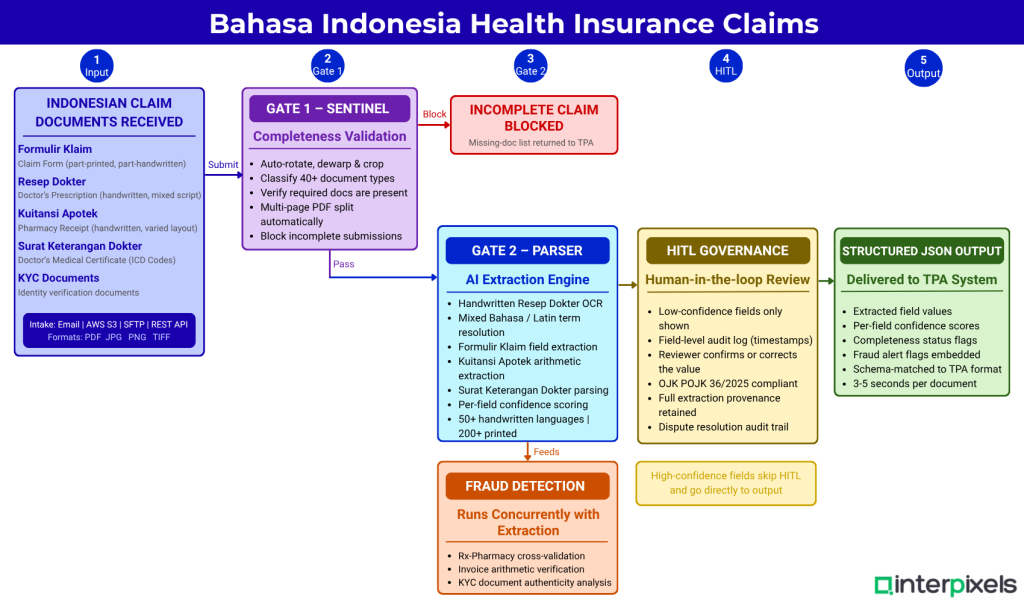
Figure 1. InterPixels AI two-gate architecture for Bahasa Indonesia health insurance claims processing. Gate 1 (Sentinel) validates completeness before extraction begins, blocking incomplete submissions early. Gate 2 (Parser) runs OCR and GenAI extraction, per-field confidence scoring, and three concurrent fraud detection layers simultaneously. Low-confidence fields are routed to HITL review with a full field-level audit trail, satisfying OJK POJK 36/2025 requirements. Structured JSON output is delivered to the TPA system in 3 to 5 seconds per document.
OCR Approach Comparison: Generic Engine vs Rules-Based IDP vs AI Claims Intelligence API
The table below compares the three approaches available to Indonesian TPA and insurer digital teams across the criteria that matter most in production health insurance claims processing.
| Approach | Key Strength | Best Used When | Bahasa Indonesia Health Doc Accuracy |
|---|---|---|---|
| Generic OCR (Tesseract, EasyOCR) | Free, fast setup, broad language support | Simple printed text in standard layouts; internal tooling prototypes | Low. No medical domain training; fails on handwritten Resep Dokter and non-standard pharmacy formats |
| Rules-Based IDP (template matching) | Reliable on fixed, known document layouts | High-volume processing of standardised, printed forms with consistent structure | Medium. Acceptable on printed Formulir Klaim; fails when layout deviates or handwriting is present |
| AI Claims Intelligence API (InterPixels AI) | Specialist-trained on 40+ health insurance document types; per-field confidence scoring; built-in fraud detection and HITL routing | Production health insurance claims processing across OPD, IPD, and KYC in APAC languages including Bahasa Indonesia | High. 97% confidence on handwritten Bahasa Indonesia prescriptions. Cross-document validation included. |
“In Indonesia, POJK 36/2025 has changed OCR accuracy from an IT metric to a regulatory obligation.”
OJK Regulatory Pressure Is Making OCR Accuracy a Compliance Issue, Not Just an Operational One
OJK’s POJK Number 36 of 2025, effective January 2026, mandates digital processing capabilities and utilisation review for all Indonesian health insurers. Inaccurate OCR now creates direct regulatory exposure, not just claim errors.
The Indonesian health insurance regulatory environment has shifted materially. OJK Regulation No. 8/2024 requires digital health insurance providers to meet operational standards for digital product delivery and includes provisions for product filing simplification and digital marketing authorisation. POJK 36/2025 extends this further, mandating medical governance, utilisation review, and demonstrable digital capabilities across all health insurers from January 2026. OJK’s strengthened reporting regime from Q2 2026 increases transparency requirements on claims performance across the sector.
For TPA tech teams and insurer digital teams, this regulatory trajectory has one practical implication: the document extraction layer that feeds adjudication must be auditable. Adjudication decisions made on incorrectly extracted data are not just operationally expensive. They are a compliance failure.
A HITL governance layer satisfies this requirement because it creates a field-level audit trail. Every extracted value carries its confidence score. Every human review decision is logged with a timestamp and change record. When OJK requests evidence of digital processing capability, the audit trail exists. When a claim dispute arises, the extraction provenance is available. When a fraud pattern is flagged, the source document fields and fraud logic are embedded in the JSON output returned to the TPA system.
InterPixels AI Accuracy Benchmarks for Bahasa Indonesia Health Documents
InterPixels AI achieves 97% per-field confidence on handwritten Bahasa Indonesia prescriptions, with per-field confidence scoring and automatic HITL routing for fields that fall below the configured threshold. Full benchmarks by language are published on the InterPixels AI platform page.
For Bahasa Indonesia, the published benchmark is 97% confidence in handwritten Paracetamol 500mg prescription extraction, higher than Thai (94%), Tamil (95%), or Mandarin (93%), and comparable to Tagalog (98%) and Hindi (96%). These are handwritten prescription benchmarks, which represent the hardest OCR task in Indonesian health claims processing, not print-quality results.
The platform processes 40+ health insurance document types, including the full set of Indonesian private insurance documents: Formulir Klaim, Resep Dokter, Kuitansi Apotek, and Surat Keterangan Dokter. For printed documents the system supports 200+ languages. For handwritten text it covers 50+ languages, with Bahasa Indonesia included in both.
Fraud detection runs concurrently with extraction. Three validation layers apply to every Indonesian claim: prescription-pharmacy cross-validation (catching quantity mismatches between Resep Dokter and Kuitansi Apotek), invoice arithmetic verification (confirming pharmacy receipt line items sum to the stated total), and document authenticity analysis (detecting tampering indicators in KYC documents submitted with a claim). All three run before a claim reaches an adjudicator.
McKinsey research has documented that digitalising the claims process can reduce claims costs by 25 to 30% and enhance customer satisfaction by up to 20% (McKinsey, claims management research). In production deployment, InterPixels AI reduced claim processing time from 40 minutes per claim to 5 minutes per claim an 8x improvement across more than 15,000 claims with a leading InsurTech services provider in India, according to the InterPixels AI case studies page. Indonesian TPAs processing Bahasa Indonesia documents through the same pipeline access the same extraction architecture.
What Implementation Looks Like for an Indonesian TPA Team
Indonesian TPA teams integrate the InterPixels AI Claims Intelligence API via REST in 4 to 6 weeks, with no changes to their existing claims management platform. Bahasa Indonesia documents are processed alongside other APAC languages within the same pipeline.
The integration model is API-first. Claim documents are submitted via existing channels: email, AWS S3, SFTP, or a direct REST API call, in PDF, JPG, PNG, or TIFF format. Multi-page PDFs are split automatically. No TPA platform changes are required. The structured JSON output, containing extracted field values, per-field confidence scores, completeness status, and fraud flags, is returned to the TPA system formatted to its own schema. SDK support is available for Python, Node.js, and Java.
Gate 1 Sentinel runs completeness validation first. For a standard Indonesian OPD claim, this means confirming that the Formulir Klaim, Resep Dokter, and Kuitansi Apotek are all present before extraction begins. A missing Resep Dokter is flagged with a specific missing-document notification. The claim is blocked before any extraction resources are consumed. Gate 2 Parser then runs extraction and all three fraud detection layers simultaneously.
The result for an Indonesian TPA team is that Bahasa Indonesia documents enter the same processing pipeline as Hindi, Thai, or Tagalog documents. There is no separate Indonesian language module to configure. The extraction engine is already trained on Indonesian health insurance documents. The HITL queue routes Indonesian-language low-confidence fields using the same confidence threshold framework as every other supported language.
“Teams building this typically find that the Bahasa Indonesia accuracy gap closes within the first two weeks of live processing, not months.”
Frequently Asked Questions
Why does generic OCR fail on Resep Dokter (Indonesian doctor prescriptions)?
Generic OCR fails on Resep Dokter because Indonesian prescriptions are handwritten in a shorthand that mixes abbreviated Bahasa Indonesia with Latin drug nomenclature. Generic engines have no training on this format. They read individual characters without understanding drug name structure, dosage notation, or frequency abbreviations. Errors appear as plausible-looking extracted text that is medically incorrect. A specialist AI engine trained on health insurance documents resolves this by learning the patterns at field level, not character level.
What Indonesian health insurance documents does AI OCR need to process?
The core document set for Indonesian private health insurance claims includes Formulir Klaim (claim form), Resep Dokter (doctor’s prescription), Kuitansi Apotek (pharmacy receipt), and Surat Keterangan Dokter (doctor’s medical certificate). Each has different format characteristics: the Formulir Klaim is partially printed and handwritten, the Resep Dokter is fully handwritten in mixed Bahasa/Latin script, the Kuitansi Apotek is arithmetic-heavy with non-standard layouts, and the Surat Keterangan Dokter contains diagnostic language requiring medical vocabulary mapping.
How does OJK’s POJK 36/2025 affect TPA document processing requirements in Indonesia?
POJK Number 36 of 2025, effective January 2026, mandates digital processing capabilities and utilisation review for all Indonesian health insurers. This makes the auditability of document extraction a regulatory requirement. TPAs need a pipeline that produces field-level confidence scores, maintains a human review audit trail, and can demonstrate document authenticity checks, standard features in an AI claims intelligence API, but absent from generic OCR tools.
What accuracy can Indonesian TPAs expect from AI OCR on Bahasa Indonesia handwritten documents?
InterPixels AI benchmarks 97% per-field confidence on handwritten Bahasa Indonesia prescriptions (Parasetamol 500mg example). Fields below a configured confidence threshold are automatically routed to human review rather than passed downstream. This means accuracy at the field level is governed, not assumed. The combination of high baseline confidence and HITL routing for exceptions maintains production-grade accuracy across the full range of handwriting quality and document condition that Indonesian claims processing involves.
How long does it take to integrate an AI claims processing API for Bahasa Indonesia documents?
Integration from API access to production takes 4 to 6 weeks for a typical TPA platform. The process requires no changes to the existing claims management system. Documents are submitted via existing intake channels (email, AWS S3, SFTP, or REST API), and structured JSON output is returned in the TPA’s own schema. SDK support is available for Python, Node.js, and Java. Bahasa Indonesia documents are supported within the standard multilingual extraction pipeline with no separate Indonesian language configuration required.
What Indonesian TPAs and Insurers Should Do Next
Three realities now define the Indonesian health insurance document processing landscape. Generic OCR produces silent errors on Bahasa Indonesia health documents that surface as claim disputes, fraud exposure, and audit failures. OJK’s POJK 36/2025 has made digital processing capability and auditability a regulatory requirement from January 2026, not a future ambition. AI claims intelligence APIs purpose-built for APAC health insurance documents deliver 97% confidence on handwritten Bahasa Indonesia prescriptions and integrate in 4 to 6 weeks without platform changes.
The operational gap between what generic OCR produces and what Indonesian claim adjudication requires is measurable. The regulatory timeline for closing that gap is defined. The integration path is established.
The question worth asking: how many of the claims your team processed last month contained a Resep Dokter that no system validated against the pharmacy bill?
Explore the InterPixels AI platform for Indonesian health insurance claims
Table of Content