
Claims adjudication is the process an insurer or TPA uses to decide how much of a submitted health insurance claim gets paid. It runs after intake and before settlement, checking eligibility, policy terms, coding accuracy, and billed amounts against payer rules. The outcome is one of three decisions: full payment, partial payment, or denial. Most claims move through this step automatically; the rest are pulled into manual review.
Claims adjudication is where cost control actually happens
Every health insurance claim eventually lands on someone’s desk, human or automated, for a decision. That decision is claims adjudication, and it is where a TPA either controls cost or bleeds it. Deloitte’s 2025 global insurance outlook (2024) notes that the recent surge in claims severity, driven by higher inflation and supply chain shortages, was waning heading into 2025, giving carriers some room to improve profitability. Even so, teams building adjudication workflows typically find that the biggest remaining cost driver isn’t claims volume itself. It’s the share of claims that can’t be resolved without a person opening the file.
Understanding adjudication matters because it sits at the center of three things TPAs are measured on: how fast members get paid, how accurately claims are settled, and how much it costs to process each one. Get the process right and claims move in minutes. Get it wrong and a single claim can sit in review for weeks.
How does the claims adjudication process work?
Adjudication runs through a fixed sequence: intake validation, eligibility check, policy and benefit matching, medical necessity and coding review, pricing calculation, and final determination. Each stage can approve, pend, or reject the claim before it reaches the next one.
The sequence starts the moment a claim document set arrives, whether that’s an outpatient bill, a hospital discharge summary, or a full inpatient bundle. The system first confirms the claim is complete: correct patient details, valid policy number, required supporting documents present. Incomplete submissions are rejected here, before any real adjudication logic runs, because processing an incomplete claim wastes downstream compute and staff time.
Once a claim passes intake, the system checks that the patient was covered on the date of service and that the treatment falls within the policy’s benefit structure. This is where sub-limits, waiting periods, and exclusions get applied. From there, coding and medical necessity checks confirm the procedure and diagnosis codes are consistent with each other and with the documentation submitted. Pricing then applies the negotiated rate, co-pay, and deductible before the system issues a final payment, partial payment, or denial decision.
Adjudication is not the same as claims processing. Processing is the broader umbrella: intake, document handling, adjudication, and payment disbursement together. Adjudication is specifically the decision-making stage inside that pipeline.
Auto-adjudication vs. manual adjudication
Auto-adjudication is when a claim moves through the entire sequence above without a person touching it. Manual adjudication is when a claim gets flagged, at any stage, for a human reviewer to resolve before it can proceed.
Claims-operations vendors and TPA benchmarking sources commonly cite a well-run auto-adjudication rate above 80 to 85 percent, with first-pass rates elsewhere in the industry ranging anywhere from 10 to 70 percent depending on plan complexity and document quality. These figures are widely repeated in the industry but are not tied to a single named regulatory or standards-body benchmark, so treat them as directional rather than precise. What’s less disputed is the direction of the cost gap: auto-adjudicated claims cost a fraction of what a manually reviewed claim costs once a reviewer has to open the file. McKinsey’s research on the future of claims work (2020) states that for simple claims, automation can handle the end-to-end technical adjudication. That frees claims handlers to focus on complex cases and direct member support instead of repetitive data checks.
A claim typically drops out of auto-adjudication when:
- Required documents are missing or illegible, especially handwritten prescriptions
- The claim amount exceeds a payer-defined dollar threshold
- Diagnosis and procedure codes don’t align with each other
- The provider or facility isn’t in the system’s contracted-rate table
- Prior authorization was required but not found on file
- Coordination of benefits applies and a second payer needs to be identified
Teams building adjudication workflows should track these factors when auto-adjudication rates fall short of target:
- Document completeness at the point of intake, not after processing has started
- Consistency between prescribed medication and dispensed pharmacy records
- Whether invoice line items add up arithmetically to the billed total
- How often the same missing-document reason recurs across claim types
- Whether manual review queues are growing faster than claim volume
Automation removes friction; it does not remove judgment from complex claims.
What errors keep claims stuck in manual review?
The most common reasons a claim escapes auto-adjudication are incomplete documentation, coding mismatches, and pricing discrepancies that the system can’t resolve on its own. Each of these has a distinct fix, and none of them get solved by simply adding more reviewers.
Incomplete documentation is the single largest driver of manual review in most TPA operations. A missing discharge summary or an illegible prescription doesn’t just delay one claim; it typically triggers a request back to the provider, adding days or weeks to the cycle. Coding mismatches happen when a billed procedure doesn’t logically connect to the diagnosis submitted alongside it, which either signals a genuine documentation gap or, less often, an attempt at upcoding. Pricing discrepancies show up when the billed amount doesn’t match the contracted rate on file, often because the rate table hasn’t been updated to reflect a recent contract renewal.
“The claims that stall in manual review are rarely the complex ones. They’re usually the incomplete ones.”
Where does AI fit into modern claims adjudication?
AI fits into adjudication at the document and validation layer, upstream of the actual payment decision, extracting structured data from documents, flagging inconsistencies, and routing only genuinely uncertain fields to a human reviewer. It does not typically replace the adjudication engine itself; it feeds that engine cleaner, faster, and more complete data.
Investment in this layer is accelerating faster than proven results, which is worth naming honestly. BCG’s 2026 research on AI-first P&C insurers found that AI spending as a share of revenue is set to triple in 2026 across property and casualty insurance. Yet only 38 percent of P&C insurers are generating value at scale from AI in core workflows like underwriting and claims. That figure is specific to P&C, not health insurance, but the underlying tension, heavy AI spend outpacing proven returns, shows up across insurance lines. On the health payer side, a Gartner-sourced summary published by Cohere Health reports that the share of organizations investing in new technology for business and IT transformation jumped from 15 percent in 2024 to 52 percent in 2025. Gartner’s original report is paywalled, so this figure should be read as a vendor’s summary of Gartner’s research rather than a direct primary citation. The pattern across both sources is consistent: AI applied narrowly to the document layer tends to work. AI applied as a wholesale replacement for the adjudication engine tends to stall.
Separately, a 2025 systematic review of AI and machine learning in claims adjudication synthesizing industry case studies and peer-reviewed literature from 2015 to 2025 found that AI and ML are increasingly used to automate claim reviews, detect anomalies, and support reimbursement decisions, while emphasizing that human oversight remains central to adjudication quality. That framing matches what most TPAs actually deploy: AI handles the repetitive extraction and validation work, while a human-in-the-loop layer catches the edge cases.
InterPixels AI, a health insurance claims intelligence API built by Clarion Analytics for TPAs across India, Malaysia, Indonesia, Singapore, Thailand, and the Philippines, is a working example of this pattern. It validates document completeness at intake, extracts structured data across 40-plus IPD, OPD, and KYC document types using OCR and generative AI, and applies three concurrent fraud checks: prescription-to-pharmacy cross-validation, invoice arithmetic verification, and document authenticity analysis. Fields the system isn’t confident about get routed to a TPA’s operations team through a human-in-the-loop layer, rather than blocking the whole claim. In one production deployment, with TrueCover India across more than 15,000 claims, this upstream automation cut document handling time from roughly 40 minutes to 5 minutes per claim, an 8x improvement, while leaving the underlying adjudication decision with the TPA’s existing system. In practice, this is the pattern most APAC TPAs are converging on: keep the adjudication engine and core platform unchanged, and automate everything upstream of it.
It’s worth being precise about what current research actually shows on the fraud-detection side. A 2025 arXiv paper on adversarial attacks against ML-based fraud detection demonstrated that a GAN-based method could generate fraudulent insurance claims that evaded existing machine-learning fraud detectors with a 99 percent success rate. Rather than proving ML catches more fraud than rule-based checks, this research is a reminder that ML-based fraud detection carries its own attack surface, and that layered checks (rule-based plus ML plus human review) are more resilient than relying on a single detection method. Separately, AutoML research for insurance applications shows that much of the model-building work behind these systems can now be automated rather than requiring a dedicated data science team for every use case, which lowers the bar for TPAs evaluating AI-assisted adjudication tools.
Adjudication architecture: from document to decision
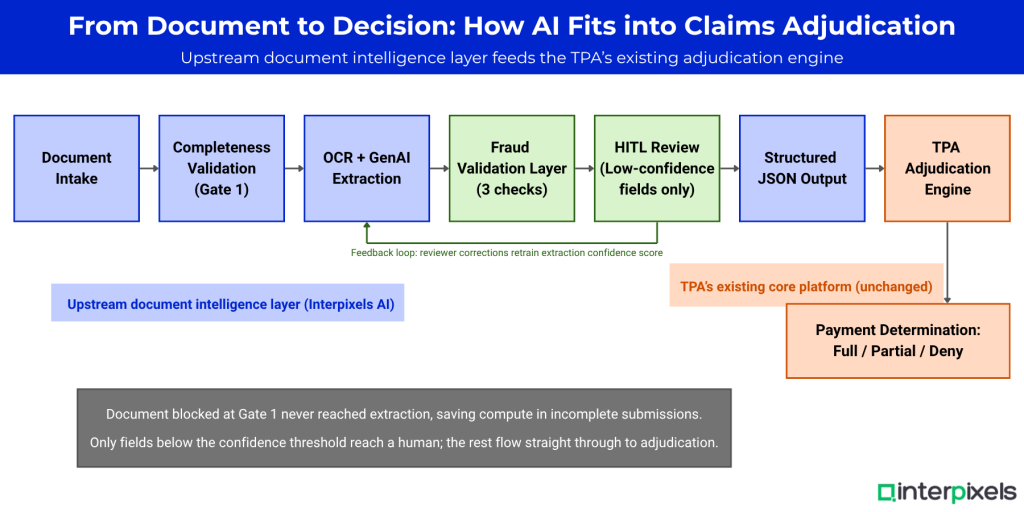
Caption: The upstream document layer, shown on the left, is where most automation investment now goes. Documents are validated for completeness before any extraction resources are spent, then routed through OCR and generative AI extraction with three fraud checks running concurrently. Only low-confidence fields reach a human reviewer. The TPA’s existing adjudication engine, shown on the right, receives structured JSON and makes the actual payment decision, meaning no platform migration is required. For teams working with the raw claim files underneath this layer, the open-source pyx12 and x12-parser projects are widely used references for parsing the X12 837 and 835 transaction formats that most claims still arrive in, and openIMIS’s AI-enabled claim module is a working example of a rule-based-plus-machine-learning adjudication engine running at national scale, currently supporting Nepal’s social health insurance scheme.
Comparing adjudication approaches
| Option | Key Strength | Best Used When |
|---|---|---|
| Rule-based auto-adjudication | Fast, predictable, fully auditable against fixed policy rules | Claim volume is high, benefit structures are standardized, and policy rules change infrequently |
| RPA-assisted adjudication | Bridges legacy core admin systems without a full platform rebuild | The core system can’t be modified but repetitive manual steps need automating |
| AI-augmented, HITL-governed adjudication | Handles document variability, multiple languages, and handwriting; routes only uncertain cases to humans | Document formats are inconsistent, claim volumes are growing, and fraud detection needs to run in real time |
“The goal isn’t zero human review. It’s making sure the claims that reach a human are the ones that actually need one.”
FAQ
What is claims adjudication in health insurance? Claims adjudication is the process an insurer or TPA uses to determine how much of a submitted health insurance claim will be paid. It checks eligibility, policy benefits, coding accuracy, and pricing against payer rules, resulting in full payment, partial payment, or denial.
How is claims adjudication different from claims processing? Claims processing is the full pipeline: intake, document handling, adjudication, and payment. Adjudication is specifically the decision stage inside that pipeline, where the system determines whether and how much to pay.
What is a good auto-adjudication rate? Industry sources commonly cite a strong auto-adjudication rate as above 80 to 85 percent, though this isn’t tied to one official benchmark. Many TPAs fall well short of that, with first-pass rates commonly cited anywhere from 10 to 70 percent depending on plan complexity and document quality.
Why do health insurance claims get stuck in manual review? The most common causes are missing or illegible documents, procedure and diagnosis codes that don’t align, and billed amounts that don’t match the contracted rate on file. Fixing document completeness at intake resolves the largest share of these cases.
How does AI improve claims adjudication? AI improves adjudication by automating the document and validation layer that sits upstream of the actual payment decision: extracting structured data, checking for fraud indicators, and flagging only low-confidence fields for human review, while the core adjudication engine keeps making the final call. Layered detection, rather than any single AI model, is what improves resilience against fraud.
The bottom line
Claims adjudication is the decision point in the health insurance claims lifecycle, and it’s where speed, cost, and accuracy either come together or fall apart. Strong auto-adjudication rates are achievable, but only when the documents feeding the system are complete and consistent. Incomplete documentation, not claim complexity, is what stalls most claims. AI’s clearest role right now is upstream of the adjudication decision itself, cleaning up the document layer so the adjudication engine a TPA already runs can do its job faster, while layered fraud checks (not any single model) provide the strongest defense.
If your team is measuring auto-adjudication rate as a single number, it’s worth breaking it down by document type and error reason first. That’s usually where the fastest gains are hiding.
Table of Content
- Claims adjudication is where cost control actually happens
- How does the claims adjudication process work?
- Auto-adjudication vs. manual adjudication
- What errors keep claims stuck in manual review?
- Where does AI fit into modern claims adjudication?
- Adjudication architecture: from document to decision
- Comparing adjudication approaches
- FAQ
- The bottom line