BNM health insurance claims processing compliance in Malaysia refers to the operational obligations that licensed insurers and their appointed third-party administrators (TPAs) must meet under the BNM Medical and Health Insurance/Takaful (MHIT) Policy Document (February 2024, BNM/RH/PD 029-66), the BNM Claims Settlement Practices Policy Document (July 2024, BNM/RH/PD 029-69), and the Personal Data Protection (Amendment) Act 2024. Obligations cover fair and prompt claims settlement, completeness validation, MyKad KYC standards, structured rejection reasons, bilingual document handling in both Bahasa Malaysia and English, and PDPA-aligned data governance across all claim types including panel IPD, panel OPD, and non-panel reimbursement.
Why 2026 Is the Year Malaysian TPAs Cannot Afford to Stand Still
BNM’s two landmark 2024 policy documents have set legally binding expectations for fair, transparent, and timely claims handling. According to the Life Insurance Association of Malaysia (LIAM), medical insurance claims in Malaysia reached RM 8.9 billion in 2024, representing the single largest component of industry payouts. With medical cost inflation running at 15% in 2024, the highest in the Asia-Pacific region and well above the global average of 10%, every processing delay now carries direct financial and regulatory consequences for TPAs.
Grand View Research (2024) values the Malaysia health insurance market at USD 915.44 million in gross written premium, projected to grow at a CAGR of 9.99% to 2030. That growth trajectory puts more claims into TPA systems every quarter. The document infrastructure handling those claims was built for a lower-volume, lower-scrutiny environment. BNM’s 2024 framework closes that gap, with formal expectations for digital adoption, fraud containment, and structured data governance.
For TPA compliance officers and COOs, pressure in 2026 comes from three directions. The MHIT Policy Document (February 2024) tightened health insurance underwriting and claims standards and introduced a central data submission mandate. The Claims Settlement Practices Policy Document (July 2024) set governance and audit expectations for general insurance claims settlement. And the PDPA Amendment Act 2024, rolled out across three phases from January to June 2025, made every claims data processing step a potential compliance event.
Malaysia’s medical cost inflation hit 15% in 2024, the highest in Asia-Pacific, and RM 8.9 billion in health claims means BNM’s compliance expectations land at scale on every TPA.
The BNM Framework Every TPA Compliance Officer Must Master
Two BNM documents shape TPA claims obligations in 2026. The MHIT Policy Document (February 2024) is the primary instrument for health insurance, covering product design, claims handling standards, KYC requirements, and the central claims data submission mandate active from January 2025. The Claims Settlement Practices Policy Document (July 2024) applies to general insurance claims and sets governance, audit, and digital adoption expectations. Together, and alongside BNM’s supervisory conduct expectations for all ITOs, they define the compliance standard Malaysian TPAs must meet.
MHIT Policy Document (February 2024): What Changed for Health Claims
BNM issued the MHIT Policy Document on 29 February 2024 under reference BNM/RH/PD 029-66, superseding multiple earlier instruments. It applies to all licensed insurers under the Financial Services Act 2013 and licensed takaful operators under the Islamic Financial Services Act 2013. For TPAs, the most operationally significant changes are three-fold.
First, from 1 September 2024, licensed ITOs must offer medical reimbursement products with co-payment options at point of sale or renewal. Second, from 1 January 2025, ITOs must submit MHIT claims data, including 2023 and 2024 historical data, to a central medical claims data platform established by the industry in collaboration with relevant associations. Third, BNM formalised that ITOs cannot unreasonably delay or deny medical claims, and cannot enforce exclusions not stated in policy documents.
That last point carries significant TPA implications. BNM confirmed in December 2025 that ITOs must observe fair and prompt settlement of claims and cannot unreasonably delay or deny claims without valid justification. BNM has not yet published specific TAT numbers for health claims, but the principle of prompt settlement creates an operational standard that manual document processing cannot reliably meet at volume.
Claims Settlement Practices Policy Document (July 2024): Governance Expectations for General Claims
BNM/RH/PD 029-69, issued 1 July 2024, sets the minimum standards for claims handling and assessment for general insurance and general takaful business. Per KPMG Malaysia’s factsheet on this document, it mandates regular compliance assessments and internal audit reviews, with a board-level governance expectation. Rahmat Lim & Partners confirmed its scope covers licensed insurers carrying on general business and licensed takaful operators carrying on general takaful business.
A stated objective of the document is promoting wider adoption of digital solutions by ITOs to reduce friction, enhance efficiency, and improve customer experience, directly linking digital adoption to fraud risk containment and claims cost management. While the document’s formal scope covers general insurance, the governance principles it establishes signal BNM’s broader expectations for all ITOs operating in Malaysia.
BNM explicitly links digital adoption to fraud containment in its 2024 policy documents, making automation a regulatory expectation for Malaysian TPAs, not just an efficiency option.
PDPA Amendment Act 2024: New Data Obligations Rolled Out in Three Phases
The Personal Data Protection (Amendment) Act 2024 came into force in three stages. Phase 1 (1 January 2025) introduced administrative changes. Phase 2 (1 April 2025) reclassified biometric data as sensitive personal data, introduced the “data controller” terminology replacing “data user”, and updated cross-border transfer rules. Phase 3 (1 June 2025) introduced mandatory DPO appointment, mandatory data breach notification within 72 hours, and data portability rights.
For TPAs, the most operationally significant changes are threefold. First, data processors, including TPAs processing claims data on behalf of insurers, are now directly obligated under the PDPA’s Security Principle, with independent liability for data protection failures. Second, MyKad fingerprint data is now classified as sensitive personal data under the biometric data definition, requiring stricter consent and security controls when extracted during claims processing. Third, TPAs meeting the volume thresholds for large-scale processing must appoint a registered DPO.
Maximum penalties for breaching the PDPA Principles now reach RM 1 million and/or three years imprisonment, up from RM 300,000. Every claims extraction workflow that processes MyKad data, clinical data, or policyholder records is a PDPA compliance event. Field-level audit trails are not optional.
Malaysian Document Types in Health Insurance Claims
Malaysian health insurance claims involve at least six core document categories: MyKad (KYC), Borang Tuntutan Perubatan (medical claim form), hospital main bill, discharge summary, prescription and pharmacy bill, and lab reports. Panel IPD claims require additional documents including operation theatre notes and break-up bills. All must be processed in both Bahasa Malaysia and English variants.
The table below maps required documents by claim type. A submission that fails this completeness check at intake cannot start processing and should be blocked with a clear list of missing items returned to the submitter.
| Document Type | OPD (Panel) | IPD (Panel) | Non-Panel Reimbursement |
|---|---|---|---|
| MyKad / KYC | Required | Required | Required |
| Borang Tuntutan Perubatan | Required | Required | Required |
| Prescription / Pharmacy Bill | Required | Contextual | Required |
| Hospital Main Bill | Not required | Required | Required |
| Discharge Summary | Not required | Required | Required |
| Lab / Diagnostic Reports | Contextual | Contextual | Required |
| OT Notes / Break-Up Bill | Not required | Required | Contextual |
In practice, teams operating Malaysian TPA claims workflows find that the non-panel reimbursement path generates the highest document variability. The policyholder submits documents after discharge, without the standardised EDI connectivity that panel hospitals use for cashless claims. Document quality, language mix, and completeness all vary significantly. Without automated completeness validation at intake, those claims enter the processing queue in a state that guarantees delays and manual queries.
Non-panel reimbursement claims are where Malaysian TPA document variability peaks. Completeness validation at intake is the only reliable way to prevent incomplete submissions from consuming adjudication resources.
MyKad OCR in Malaysian Health Insurance Claims: Why It Is Harder Than It Looks
MyKad OCR presents three specific challenges absent in standard document processing: laminated card surface reflections that degrade image quality under direct scanning light, variable print quality across card generations issued since 2001, and bilingual field layouts that require simultaneous Bahasa Malaysia and English field extraction. AI models trained on APAC health insurance documents, combining OCR and generative AI reasoning, achieve over 95% document classification accuracy on these document types.
Research from Cheng et al. (2026), Fullerton Health AI Team (arXiv:2601.01897) confirms that a hybrid architecture combining PaddleOCR, a Logistic Regression classifier, and the compact Vision-Language Model Qwen 2.5-VL-7B achieves 95%+ document-type classification accuracy and approximately 87% field-level extraction accuracy at under 2 seconds per document. The study was based on real APAC multi-market claims data across nine markets including Malaysia, Indonesia, Singapore, and the Philippines, processed by Fullerton Health. That accuracy threshold matters for PDPA compliance: a field extracted below confidence threshold must be flagged for HITL review, not silently forwarded to the adjudication system.
The three failure modes for MyKad OCR in health insurance claims are well-documented by practitioners. Reflective lamination creates image artifacts that standard OCR engines misread as character noise. Mixed Jawi/Rumi script in older-generation cards requires a multilingual model that handles Arabic-script Bahasa Malaysia. And the dual-side card format means address, IC number, and thumb-print data are spread across two image planes, requiring multi-page document assembly before extraction begins.
Open-source OCR engines such as PaddleOCR (47,000+ GitHub stars, actively maintained in 2025) and document understanding libraries such as doctr by Mindee address the multilingual and layout challenges. Production health insurance deployments layer these with a GenAI reasoning model, such as those accessible via Hugging Face Transformers, to resolve ambiguous field extractions before confidence scoring.
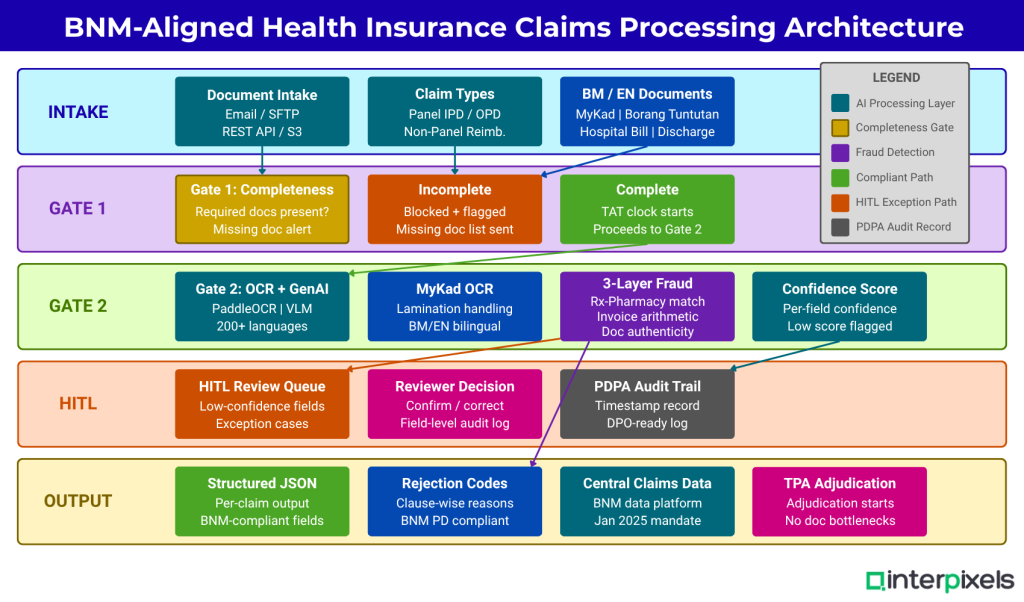
Figure 1: BNM-Aligned Health Insurance Claims Processing Architecture (InterPixels AI, 2026). Claims pass Gate 1 completeness validation, then Gate 2 OCR + GenAI extraction with 3-layer fraud detection. Low-confidence fields and exceptions route to HITL with a full PDPA-compliant audit trail. Structured JSON output feeds TPA adjudication and the BNM central medical claims data platform mandated from January 2025.
Panel Cashless vs Non-Panel Reimbursement: The Processing Difference
Panel hospital cashless claims require real-time guarantee letter (GL) issuance before or at discharge, driven by TPA-hospital EDI connectivity. Non-panel reimbursement claims require the policyholder to submit the full document bundle after discharge, placing the completeness validation and extraction burden entirely on the TPA’s intake process. BNM expects both to be handled fairly and promptly, without unreasonable delay or undisclosed exclusions.
For panel cashless claims, the TPA receives a pre-authorisation request from the hospital and must issue a GL decision promptly. The hospital submits the final bill at discharge, and the TPA issues final settlement authorisation. Every step in this flow is time-sensitive. Delays cause visible patient-impact events: a discharged patient waiting for GL approval is a direct source of complaints to BNM.
For non-panel reimbursement, the flow is slower but the document complexity is higher. The policyholder compiles and submits all documents after treatment. The TPA receives a variable-quality bundle, validates completeness, extracts structured data, and adjudicates. Under the MHIT Policy Document, BNM expects this process to result in fair and prompt settlement. TPAs whose manual processing averages 30 to 40 minutes per claim before adjudication even begins are structurally exposed to the expectation of promptness that BNM has made explicit.
According to McKinsey’s July 2025 analysis of AI in insurance, UK insurer Aviva deployed over 80 AI models to transform its motor claims domain, cutting complex liability assessment time by 23 days, reducing customer complaints by 65%, and saving more than GBP 60 million in 2024. The unit-economics principle applies directly to Malaysian TPAs: automation at the document intake layer removes the bottleneck that generates delays and the complaints that follow.
How Technology Supports BNM Compliance: The Regulatory-Technology Map
Technology does not replace compliance judgement. It creates the infrastructure within which compliant decisions can be made at the speed and scale BNM’s 2024 documents require. The table below maps each BNM requirement to the operational layer that addresses it.
| BNM Requirement | Regulatory Standard | AI / Automation Support |
|---|---|---|
| Fair and prompt health claims settlement | MHIT PD Feb 2024 (BNM/RH/PD 029-66): no unreasonable delay or denial | Automated completeness validation; structured JSON output per claim in under 5 minutes |
| MyKad KYC validation | MHIT PD Feb 2024: KYC completeness required at submission | MyKad OCR with GenAI field extraction; confidence scoring routes low-quality scans to HITL |
| Structured rejection reasons | MHIT PD Feb 2024 and BNM conduct expectations | Field-level rejection codes embedded in JSON; traceable to specific document and field |
| Claims data submission (from Jan 2025) | MHIT PD Feb 2024 para 12.2: submit to central claims data platform | Structured JSON output feeds directly into central data platform pipelines |
| Digital adoption for claims efficiency | Claims Settlement Practices PD July 2024 (BNM/RH/PD 029-69): promote digital solutions to reduce friction and contain fraud | AI-driven intake validation, extraction, and fraud scoring replaces manual document queuing |
| PDPA Amendment Act 2024 (phased Jan to Jun 2025) | Data processor obligations; biometric data (MyKad) as sensitive personal data from Apr 2025; DPO from Jun 2025 | HITL change log and field-level confidence records create audit-ready data trail; no unencrypted PII storage |
| Bilingual document handling | Industry standard for Malaysian market (BM and EN) | 200+ language OCR for printed text; 50 languages for handwritten text |
| Fraud detection | BNM CSP PD July 2024: promote digital solutions to contain fraud | 3-layer: prescription-pharmacy matching, invoice arithmetic verification, document authenticity checks |
InterPixels AI is a health insurance claims intelligence API purpose-built for TPAs across Asia-Pacific. Delivered via REST API with no changes to the TPA’s existing platform, it processes 40+ health insurance document types, returns structured JSON output per claim, and maintains field-level confidence scores and HITL change logs that satisfy BNM audit requirements. The system handles MyKad OCR with confidence scoring, supports Bahasa Malaysia and English document variants, and embeds the 3-layer fraud detection and PDPA-compliant data governance required for the Malaysian market in 2026.
Processing approach comparison for BNM-aligned Malaysian TPA operations:
| Approach | Key Strength | Compliance Risk | Best Used When |
|---|---|---|---|
| Manual Document Review | No technology dependency | HIGH: slow GL issuance, poor audit trail, PDPA data-handling risk | Claim volumes below 200 per day |
| Semi-Automated (RPA / Basic OCR) | Reduces printed-form data entry errors | MEDIUM: MyKad OCR accuracy unreliable; no fraud detection | Transitional stage with stable workflows |
| AI-Native Claims Intelligence API (e.g. InterPixels AI) | 8x faster; 94% auto-validation; 3-layer fraud detection; PDPA-aligned JSON output | LOW: automated completeness, structured rejection codes, HITL audit trail | 1,000+ claims per day targeting BNM compliance |
| Insurer In-House Platform | Direct data control | VARIABLE: depends on system maturity and PDPA governance | Large standalone insurers with IT investment |
Automation at the document intake layer is not a technology upgrade for Malaysian TPAs. Under BNM’s 2024 framework, it is a compliance upgrade. The two are now inseparable.
Frequently Asked Questions on BNM Health Insurance Claims Processing for Malaysian TPAs
What does BNM’s MHIT Policy Document require from TPAs on claims handling?
The BNM MHIT Policy Document (February 2024, BNM/RH/PD 029-66) requires licensed ITOs and their appointed TPAs to handle claims fairly and promptly, without unreasonable delay or denial, and without applying exclusions not stated in policy terms. From January 2025, TPAs must also support submission of MHIT claims data, including historical data from 2023 and 2024, to a central medical claims data platform. KYC completeness, including MyKad validation, is required at submission across all claim types.
How does panel hospital cashless processing differ from non-panel reimbursement in Malaysia?
Panel hospital cashless claims use TPA-hospital EDI connectivity for real-time guarantee letter issuance before or at discharge. The hospital submits the final bill directly to the TPA, and completeness validation runs against a known document set. Non-panel reimbursement requires the policyholder to compile and submit the full document bundle after discharge. Document quality and completeness are more variable, and completeness validation at TPA intake becomes the critical control point before the processing clock starts.
Why is MyKad OCR challenging for health insurance claims processing?
MyKad OCR presents three challenges specific to the Malaysian document format: laminated card surface reflections that degrade scan quality, variable print quality across card generations issued since 2001, and bilingual field layouts requiring simultaneous Bahasa Malaysia and English extraction. The card’s dual-side format also means IC number, address, and biometric data are spread across two image planes. Under the PDPA Amendment Act 2024 (Phase 2, effective April 2025), MyKad fingerprint data is classified as sensitive personal data, requiring that low-confidence extractions be routed to HITL review rather than processed automatically.
What does the PDPA Amendment Act 2024 mean for claims data handling in Malaysia?
The PDPA Amendment Act 2024 came into force across three phases between January and June 2025. It makes data processors, including TPAs directly obligated under the PDPA Security Principle, with fines up to RM 1 million for breaches. From April 2025, biometric data, including MyKad fingerprint data, is classified as sensitive personal data requiring stricter security controls. From June 2025, mandatory DPO appointment and 72-hour data breach notification apply to qualifying organisations. Every claims extraction workflow that processes MyKad data or clinical records is a PDPA compliance event requiring a field-level audit trail.
How can Malaysian TPAs automate BNM-aligned claims processing without changing their existing platform?
A REST API-delivered claims intelligence solution integrates between the TPA’s document intake channel and its existing claims management system. The TPA sends claim documents via email, SFTP, or direct API call, and receives structured JSON output containing extracted fields, confidence scores, completeness status, and fraud flags. No changes to the TPA’s platform, UI, or workflows are required. The JSON output maps to the TPA’s adjudication schema, eliminating the document bottleneck while keeping all existing systems in place. Integration typically takes four to six weeks.
Three Compliance Priorities Every Malaysian TPA Must Act On in 2026
BNM’s 2024 documents removed ambiguity from Malaysian health insurance claims compliance. Fair and prompt settlement is a legal expectation under the MHIT Policy Document. Digital adoption is a stated regulatory goal embedded in the Claims Settlement Practices Policy Document. Data governance under the PDPA Amendment Act is a direct obligation for TPAs as data processors. Three priorities determine whether a TPA’s operations stay ahead of the regulation or spend 2026 managing BNM queries and policyholder complaints.
First, implement completeness validation at intake. Claims that enter the processing queue without required documents, whether a missing MyKad scan or an incomplete Borang Tuntutan Perubatan, consume adjudication resources and generate delay. Gate 1 validation that blocks and flags incomplete submissions before extraction begins is the single highest-leverage control a TPA can add.
Second, build PDPA-compliant audit trails into the extraction workflow. Every claim that processes MyKad data or clinical records is a PDPA data processing event from April 2025 onwards, with biometric data now classified as sensitive. Field-level confidence scores, HITL change logs, and timestamp records are not administrative overhead. They are the evidence layer that satisfies both BNM’s governance expectations and the PDPA’s accountability requirements.
Third, prepare the claims data pipeline for BNM’s central claims data platform. The January 2025 submission mandate is live. TPAs whose extraction outputs are unstructured, or whose historical data is in non-submittable formats, face a growing compliance gap as BNM’s data monitoring capability matures.
What would BNM find if it audited your 50 most recent non-panel reimbursement claims tomorrow? The answer to that question is your 2026 compliance posture.
The three compliance priorities for Malaysian TPAs in 2026 are intake validation, PDPA-compliant audit trails, and readiness for BNM’s central claims data platform. Get one wrong and the other two will not save you.
Table of Content
- Why 2026 Is the Year Malaysian TPAs Cannot Afford to Stand Still
- The BNM Framework Every TPA Compliance Officer Must Master
- Malaysian Document Types in Health Insurance Claims
- MyKad OCR in Malaysian Health Insurance Claims: Why It Is Harder Than It Looks
- Panel Cashless vs Non-Panel Reimbursement: The Processing Difference
- How Technology Supports BNM Compliance: The Regulatory-Technology Map
- Frequently Asked Questions on BNM Health Insurance Claims Processing for Malaysian TPAs
- What does BNM’s MHIT Policy Document require from TPAs on claims handling?
- How does panel hospital cashless processing differ from non-panel reimbursement in Malaysia?
- Why is MyKad OCR challenging for health insurance claims processing?
- What does the PDPA Amendment Act 2024 mean for claims data handling in Malaysia?
- How can Malaysian TPAs automate BNM-aligned claims processing without changing their existing platform?
- Three Compliance Priorities Every Malaysian TPA Must Act On in 2026