
A phantom claim in health insurance is a fraudulent submission for medical treatment that never occurred. The patient did not visit the hospital, the procedure was not performed, and the prescription was never dispensed. Yet, a fully documented claim enters the insurer’s pipeline backed by forged discharge summaries, fabricated lab reports, or fictitious pharmacy receipts. Phantom claims are the hardest category of hard fraud to detect because each document appears legitimate on its own.
The Scale of the Problem in APAC
Phantom claims health insurance fraud is not an edge-case risk. Industry estimates cited in Ankura’s December 2025 analysis of India’s regulatory overhaul suggest that 15% of health insurance claims in India contain some element of fraud. IRDAI’s Annual Report 2023-24 shows health policy claims worth Rs 26,000 crore were disallowed or repudiated in FY24 alone, a 19.1% increase from Rs 21,861 crore the year before.
The problem is regional, not just national. Indonesia’s Corruption Eradication Commission (KPK) found in a July 2024 audit that three out of six hospitals examined had submitted false claims to the JKN national health programme, producing state losses of Rp 35 billion (approximately US$2.15 million). In Malaysia, the Malaysian Anti-Corruption Commission (MACC) exposed a healthcare cartel operating phantom billing across multiple private providers in 2024.
According to a global healthcare fraud survey cited in academic literature by Lu et al. (2023), approximately $260 billion is lost annually to health insurance fraud worldwide, equivalent to roughly 6% of global healthcare spending. In APAC markets with rapidly growing private health insurance sectors, phantom billing is disproportionately concentrated in the hospital and pharmacy segments.
“Phantom claims are hard fraud. Every document looks legitimate on its own. Detection requires connecting signals across documents, providers, and time.”
Five Phantom Claim Types Targeting APAC TPAs
APAC phantom claims do not follow a single pattern. They emerge from five distinct fraud structures, each requiring a different detection signal.
Phantom Claim Type Matrix
| Fraud Type | How It Works | APAC Market | Key Document Forged | Detection Signal |
|---|---|---|---|---|
| Phantom Hospitalisation | Patient never admitted; hospital generates full IPD document set for a fictitious stay | India (tier-2 city hospitals), Indonesia (JKN programme) | Discharge summary, hospital main bill | No corroborating OPD records; admission-discharge dates implausible |
| Forged Discharge Summary | Real patient, inflated or fabricated treatment records attached to a legitimate visit | India (corporate group health), Malaysia (private panel hospitals) | Discharge summary | Font inconsistency, MRZ mismatch, pixel editing artifacts |
| Non-Existent Lab Tests | Lab results fabricated for tests that were never run; invoice arithmetic does not match test panel | India, Indonesia, Philippines | Lab report, hospital break-up bill | Line-item total mismatch; test code cross-validation failure |
| Fake Pharmacy Receipts | Pharmacy bills submitted for drugs not prescribed or in quantities exceeding the prescription | Malaysia, Singapore, Thailand | Pharmacy bill, prescription | Prescription-pharmacy quantity mismatch |
| Doctor-Hospital Collusion Ring | Coordinated fraud where doctors, hospitals, and sometimes patients jointly fabricate a complete claim bundle | India (tier-2 cities), Indonesia (private market) | Full claim bundle: all documents forged consistently | Cross-claim provider pattern; same patient-date-hospital across multiple insurers |
In India, hospital collusion in government-funded schemes is the most documented phantom claim pattern. Parliamentary statements in 2025 confirmed that 1,114 hospitals had been cumulatively de-empanelled from the Ayushman Bharat PM-JAY scheme for fraudulent claims, including phantom billing, misuse, and incorrect entries, evidence that the collusion operates at institutional scale.
In Indonesia, a 2024 peer-reviewed analysis of the JKN programme identifies phantom billing and diagnosis manipulation as the two most damaging fraud types, compounded by weak cross-hospital data sharing between providers. In Malaysia, repeated claims submitted across hospitals exploit the absence of a unified TPA-level duplicate check.
Why Manual Review Fails Phantom Claims
Manual review is optimised for document-level spot checks. A reviewer examining a single discharge summary can verify that it looks professionally formatted. They cannot verify whether that patient was ever admitted, because that data sits in a different system at a different hospital.
The academic literature is explicit on this limitation. A 2023 paper by Lu et al. published in BMC Medical Informatics and Decision Making demonstrates that manual detection “cannot detect incidents of health insurance fraud consistently and automatically” and that fraud patterns are “complex and changing” in ways that document-level review cannot track. Their graph neural network model mapping relationships between patients, doctors, and hospitals consistently outperforms rule-based manual approaches.
The Deloitte 2024 APAC Integrity Survey found that the “uptake of AI and machine learning in investigative processes remains limited despite growing interest” across Asia-Pacific organisations. That gap is where phantom claims survive.
Hard fraud, the category phantom claims fall into, currently has a detection rate of only 40% to 80% with legacy methods, according to Deloitte’s 2025 analysis of AI in insurance fraud detection. Note that the 40% lower bound means that at minimum two in five phantom claim submissions can slip through undetected under manual processes.
“Manual review catches what one document hides. It cannot catch what a network of documents constructs together.”
How AI Detects Phantom Claims: The Four Signal Layers
AI systems detect phantom claims by running four concurrent signal layers during extraction itself — not as a post-settlement audit. Each layer targets a different vulnerability in the phantom claim architecture.
Layer 1: Document Authenticity Analysis
Every document in a claim bundle carries forensic signals that a human reviewer cannot reliably spot. Font inconsistencies within the same field, pixel-level editing artifacts around modified text regions, and mismatches between the Machine Readable Zone (MRZ) and printed data on identity documents are reliable indicators of manipulation. Research published in MDPI Symmetry (2025) demonstrates that edge-focused deep learning methods detect document forgery artifacts that conventional CNN models miss, with particular accuracy on fine-grained text boundaries where forgers most often introduce inconsistencies.
Layer 2: Prescription-Pharmacy Cross-Validation
The most common pharmacy phantom involves billing for a higher drug quantity than was prescribed. AI cross-references the drug name, quantity, and dosage extracted from the prescription against the corresponding pharmacy invoice line items within the same claim. A quantity mismatch, say, 30 tablets billed against a prescription for 10, is flagged at extraction. InterPixels AI applies this check during Gate 2 extraction, embedding the alert in the structured JSON before any claim reaches the adjudicator.
Layer 3: Invoice Arithmetic Verification
Phantom and inflated invoices frequently carry line-item totals that do not sum to the stated total. The inflated amount appears in the total field while individual line items reflect plausible charges. AI extracts every line item, sums them programmatically, and flags arithmetic mismatches automatically. This check runs on every invoice in every claim, not a sampled audit.
Layer 4: Hospital-Patient-Date Triangulation (Duplicate Detection)
Cross-claim triangulation is the signal layer that breaks collusion rings. The system compares the extracted patient identifier, treatment date, hospital name, and total claimed amount against the same fields from every previously processed claim in the TPA account. When all four match, the second submission is blocked automatically as a duplicate. Shekhar, Leder-Luis, and Akoglu’s research (NBER Working Paper 2023, subsequently published in Journal of Policy Analysis and Management 2026) validates provider-level pattern detection at national scale, demonstrating that unsupervised ML can identify anomalous provider billing patterns without requiring labelled fraud training data.
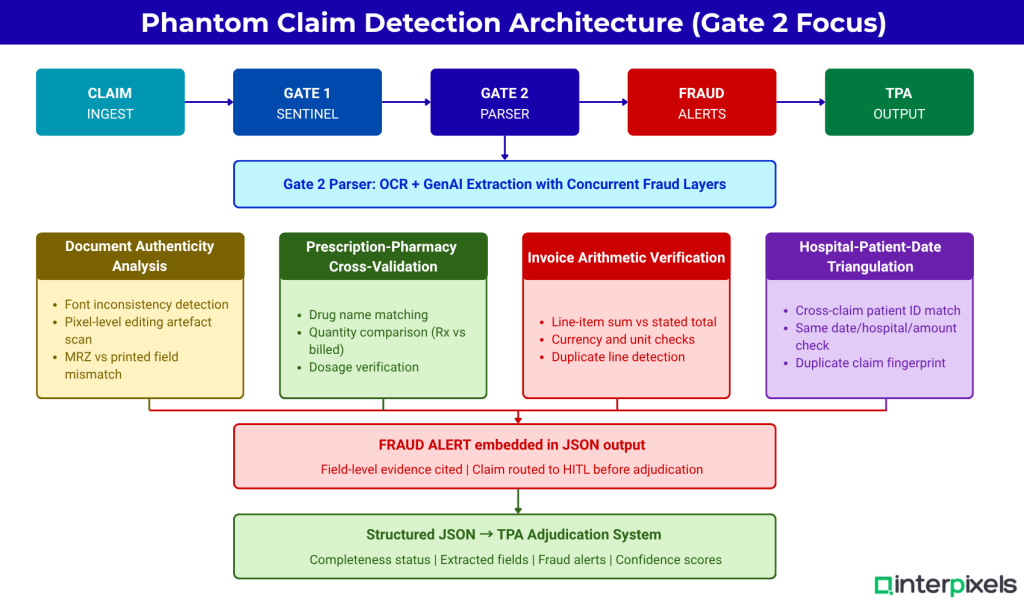
Caption: The architecture above shows how all four detection layers run concurrently during Gate 2 extraction. Document authenticity analysis, prescription-pharmacy cross-validation, invoice arithmetic verification, and hospital-patient-date triangulation each produce field-level alerts. All alerts are embedded in the structured JSON output returned to the TPA system, with specific fields and evidence cited for each flag. The claim is routed to a Human-in-the-Loop reviewer before reaching the adjudication stage, not after settlement.
“Fraud caught at extraction costs nothing to reverse. Fraud caught after settlement costs everything to recover.”
How InterPixels Gate 2 Flags Phantom Claim Indicators
InterPixels AI applies four real-time fraud detection layers during Gate 2 extraction itself, not as a post-settlement audit, embedding fraud alerts directly into the structured JSON output returned to the TPA system. The platform is purpose-built for health insurance TPAs across India, Malaysia, Indonesia, Singapore, Thailand, and the Philippines.
The four layers are: prescription-pharmacy cross-validation (drug name, quantity, and dosage matched against the pharmacy invoice), invoice arithmetic verification (line-item totals verified against stated grand totals), document authenticity analysis (font inconsistencies, editing artifacts, and MRZ mismatches detected in KYC and clinical documents), and duplicate claim detection (patient-date-hospital-amount cross-matched against all prior claims in the TPA account). Each layer runs concurrently during extraction and embeds its findings as field-level fraud alerts in the structured JSON output.
The Gate 2 Parser extracts fields from every document type in the claim bundle discharge summaries, hospital main bills, pharmacy receipts, lab reports, and KYC documents with per-field confidence scoring. Fields extracted below the configured confidence threshold are automatically routed to Human-in-the-Loop review. Reviewers see only the flagged fields, not entire documents, and every decision is logged to a full audit trail.
Deloitte’s 2025 analysis of AI fraud detection projects that deploying AI-driven technologies across the claims lifecycle could save property and casualty insurers between $80 billion and $160 billion by 2032, with 35% of insurance executives (June 2024 survey) already identifying fraud detection as a top-5 priority for generative AI implementation. While the Deloitte projections are P/C-focused, the underlying technology, multimodal extraction with concurrent fraud checks, is directly applicable to health insurance TPA operations in APAC.
Detection Approach Comparison
| Approach | Key Strength | Core Limitation | Best Used When |
|---|---|---|---|
| Manual Document Spot-Check | Catches obvious formatting errors and clear document inconsistencies | Cannot detect cross-claim patterns; limited to single-document scope; not scalable | Low claim volume; high-value claims only; last-resort escalation |
| Rule-Based Automated Flags | Fast, consistent, auditable; easy to configure for known fraud patterns | Fragile against novel fraud variations; high false-positive rate; requires constant rule updates | Established fraud patterns with stable characteristics; compliance baseline |
| ML/AI Extraction with Concurrent Fraud Layers (e.g. InterPixels Gate 2) | Runs four detection layers concurrently during extraction; catches cross-claim patterns; embeds alerts in JSON before adjudication | Requires API integration; per-field confidence scoring needs HITL governance layer for low-confidence extractions | Any APAC TPA processing IPD and OPD claims at scale; regulatory compliance under IRDAI 2025 framework |
“IRDAI’s 2025 Fraud Monitoring Framework makes one thing explicit: reactive fraud detection is no longer a compliant posture for Indian TPAs.”
What TPAs in India, Indonesia, and Malaysia Should Do Next
The regulatory urgency is no longer theoretical. IRDAI’s Insurance Fraud Monitoring Framework Guidelines 2025, effective from 1 April 2026, mandate that Indian insurers and their TPA partners move from reactive detection to proactive, intelligence-driven fraud prevention. The framework requires formalised Fraud Monitoring Committees, mandatory Red Flag Indicators, cross-organisation intelligence sharing, and quarterly reporting to risk management committees.
In Indonesia, the KPK’s 2024 audit findings on phantom billing, confirmed at three of six hospitals audited, with Rp 35 billion in state losses, have accelerated calls for mandatory cross-hospital claim data validation. In Malaysia, the MACC investigation into the healthcare cartel demonstrated that cross-hospital duplicate checking is the primary gap exploited by organised phantom billing rings.
For TPA Risk Managers and COOs evaluating their fraud detection posture, three immediate steps are actionable:
- Audit your current detection trigger point. If fraud flags are raised post-adjudication rather than during extraction, every flagged claim has already consumed settlement resources.
- Map your cross-claim duplicate checking capability. If your system cannot compare patient-date-hospital-amount across multiple claim submissions simultaneously, your collusion ring exposure is unquantified.
- Assess your document authenticity layer. Manual review cannot consistently detect pixel-level editing artifacts or MRZ mismatches in KYC documents. If your extraction process does not include automated authenticity signals, forged discharge summaries are passing without challenge.
Book a demonstration with the InterPixels team at interpixels.ai/contact.
Frequently Asked Questions
What is a phantom claim in health insurance?
A phantom claim is a health insurance submission for medical treatment that never occurred. No patient visited the hospital, no procedure was performed, and no prescription was dispensed, yet the claim arrives with a complete set of forged supporting documents, including discharge summaries, lab reports, and pharmacy receipts. Phantom claims are classified as hard fraud because they involve premeditated fabrication, not inflation of a legitimate claim.
How do phantom claims differ from inflated claims?
An inflated claim involves a real treatment event where the billed amount is exaggerated, a real procedure billed at a higher code, or a real pharmacy visit billed for more tablets than dispensed. A phantom claim involves no real treatment event at all. The patient-hospital interaction is entirely fabricated. Both are fraud, but phantom claims require a complete document fabrication operation, often involving provider collusion, while inflated claims can be submitted by individuals acting alone.
Can AI detect phantom claims in real time before a claim is settled?
Yes. AI systems like InterPixels AI run document authenticity analysis, prescription-pharmacy cross-validation, invoice arithmetic verification, and hospital-patient-date triangulation during the extraction stage before any claim reaches an adjudicator. Fraud alerts are embedded in the structured JSON output returned to the TPA system. The claim is routed to Human-in-the-Loop review before settlement, not after.
What fraud patterns are most common in India, Indonesia, and Malaysia?
In India, hospital collusion rings producing phantom IPD claims, particularly under government schemes like Ayushman Bharat PM-JAY, are the most documented pattern. In Indonesia, phantom billing within the JKN national health programme is confirmed by KPK audit findings in 2024. In Malaysia, organised healthcare cartels exploit phantom billing across multiple private panel hospitals, taking advantage of absent cross-hospital duplicate checking at the TPA level.
How does InterPixels AI flag phantom claim indicators during extraction?
InterPixels Gate 2 applies four concurrent fraud detection layers during data extraction: prescription-pharmacy cross-validation (comparing prescribed quantities against billed quantities), invoice arithmetic verification (summing line items against stated totals), document authenticity analysis (detecting font inconsistencies, editing artifacts, and MRZ mismatches in KYC and clinical documents), and duplicate claim detection (matching patient, date, hospital, and amount against all previously processed claims). All alerts are embedded in the structured JSON output with field-level evidence cited for each flag.
The Bottom Line
Three facts define the current fraud detection posture for APAC health insurance TPAs. First, phantom claims are a structured fraud operation, not opportunistic individual misconduct; detecting them requires cross-claim signal analysis, not document-level review. Second, hard fraud has a maximum detection rate of 80% under legacy methods, according to Deloitte (2025), meaning at minimum one in five phantom submissions can pass through undetected. Third, the regulatory window for passive approaches has closed: IRDAI’s 2025 Fraud Monitoring Framework (effective April 2026) and the KPK’s audit findings in Indonesia make pre-settlement detection a compliance requirement, not a cost-optimisation decision.
The question for every TPA is not whether to invest in AI fraud detection. The question is whether your current extraction process is running its fraud checks before or after the claim is paid.
Table of Content