
A hospital discharge summary is the primary clinical record produced at the end of an inpatient stay. It contains the patient’s diagnosis, procedures performed, medications prescribed, treatment timeline, attending physician details, and discharge instructions. In health insurance IPD claims, the discharge summary is the single document that anchors payment determination. Every other document in the bundle, the hospital bill, the operation theatre notes, and the room charge sheet is validated against it.
Why the Discharge Summary Is the Highest-Stakes Document in Any IPD Claim
The discharge summary determines what is payable. If the AI or the auditor reads it wrong, every downstream decision is wrong too. That is not hyperbole. It is the operational reality that every TPA team processing IPD claims in India, Malaysia, and across Asia-Pacific faces daily. McKinsey (2025) reports that health systems globally spend over $140 billion annually on revenue cycle processes, with manual document handling absorbing the largest share before adjudication even begins.
For a TPA processing thousands of IPD claims per month, the discharge summary is the document that connects the clinical event to the financial claim. It is the authoritative record of what happened to the patient, when, under whose care, and at what cost. No other document in the bundle carries that authority.
The challenge is that discharge summaries are also the most structurally complex document in the IPD bundle. They are semi-structured at best, partially handwritten in many cases, inconsistently formatted across hospitals, and packed with clinical terminology and ICD-10 codes embedded in free-text narrative. Traditional OCR engines were not built for this.
The discharge summary is not just one document in the IPD bundle. It is the document every other document is checked against.
What a Discharge Summary Actually Contains (And Why That Complexity Matters)
A discharge summary packs at least 12 distinct data categories into a single semi-structured document. Understanding each one is prerequisite to automating extraction reliably. The document is not a form. It is a clinical narrative with structured sections, and the boundary between those sections shifts from hospital to hospital.
The 12 Fields TPA Systems Must Extract
Patient name and admission/discharge dates establish the claim period. Primary and secondary diagnoses, typically expressed as ICD-10 codes in modern hospitals, determine coverage eligibility. Procedure codes identify what was done surgically or clinically. Medications prescribed at discharge affect pharmacy cross-validation. Attending physician details establish referral validity. Room charge summaries and total bill amounts anchor the financial audit. Discharge status recovered, referred, deceased, or left against medical advice affects the settlement calculation. These 12 fields are the minimum set for extraction. Many discharge summaries contain additional sub-fields, particularly in tertiary care hospitals.
Why Semi-Structured Format Makes Every Hospital’s Document Different
A public hospital in Chennai, a private hospital in Kuala Lumpur, and a corporate medical centre in Mumbai will each produce a discharge summary that looks nothing like the others. Section headers differ. Some hospitals use pre-printed forms with blank fields. Others produce free-text documents. Some embed ICD-10 codes in printed fields; others leave diagnosis as a narrative paragraph only. Research on ICD-10 extraction from discharge summaries (JMIR Medical Informatics, 2025) found that conventional rule-based ICD-10 systems consistently underperform when applied to free-text clinical narratives because they lack the granularity to interpret nuanced clinical language.
This layout variability is the core engineering problem. A system trained on one hospital’s format will fail on another’s. The only way to handle it at scale is to train on diverse real-world formats and pair OCR with a reasoning layer that understands clinical document context.
No two hospitals format a discharge summary the same way. That variability is not a minor inconvenience. It is the central engineering problem.
The Four Document Challenges That Break Traditional OCR
Standard OCR converts image pixels to text characters. That is all it does. A discharge summary requires far more: structured field identification, contextual ICD-10 parsing, handwriting recognition, and multi-page document assembly. Each of these breaks traditional OCR tools.
Handwritten Physician Notes
In hospitals across India and Malaysia, attending physicians frequently complete the clinical narrative sections by hand. A surgeon’s handwritten post-operative diagnosis or a physician’s handwritten medication instructions cannot be reliably extracted by a Tesseract-class OCR engine. These engines were trained on printed text. Medical handwriting, with its abbreviations, dosage shorthand, and regional script variations, is a fundamentally different input.
ICD-10 Codes in Narrative Context
ICD-10 codes are not always presented as discrete fields. A physician may write: “Patient admitted with acute appendicitis (K35.89) and underwent laparoscopic appendicectomy.” The code is embedded in prose. Extracting it correctly requires the AI to understand sentence structure and clinical terminology, not just character pattern matching. A 2023 study from Ramathibodi Hospital, Thailand (ScienceDirect) trained a CNN-PubMedBERT model on 15,329 discharge summaries to demonstrate that deep learning approaches substantially outperform traditional NLP for this exact problem.
Variable Layout Across Hospital Systems
Production AI systems processing real-world health insurance claim documents face document heterogeneity that extends from typed invoices to handwritten medical reports across multiple scripts and languages. A 2026 paper from Fullerton Health (arXiv 2601.01897), which processes tens of millions of claims annually across nine APAC markets, describes this as the central obstacle to automated parsing, requiring a multi-stage architecture combining traditional ML classifiers with Vision-Language Models to achieve over 95% document classification accuracy.
Low-Quality Scans and Multi-Page PDFs
Discharge summaries in reimbursement claims often arrive as mobile phone photographs of printed documents, third-generation photocopies, or scans from ageing hospital equipment. Image quality is inconsistent. Multi-page PDFs must be split and each page classified independently before fields can be assembled into a coherent extraction output. These pre-processing steps are not optional. They are prerequisites to any reliable data extraction.
An ICD-10 code written as free-text in a physician’s narrative is not a structured field. It requires the AI to understand clinical context, not just read characters.
How AI Handles Discharge Summary Extraction: The Technical Architecture
A production-grade discharge summary extraction system uses a two-gate architecture. Gate 1 runs before extraction begins. Gate 2 runs extraction, fraud detection, and cross-document validation. This separation is deliberate and operationally important.
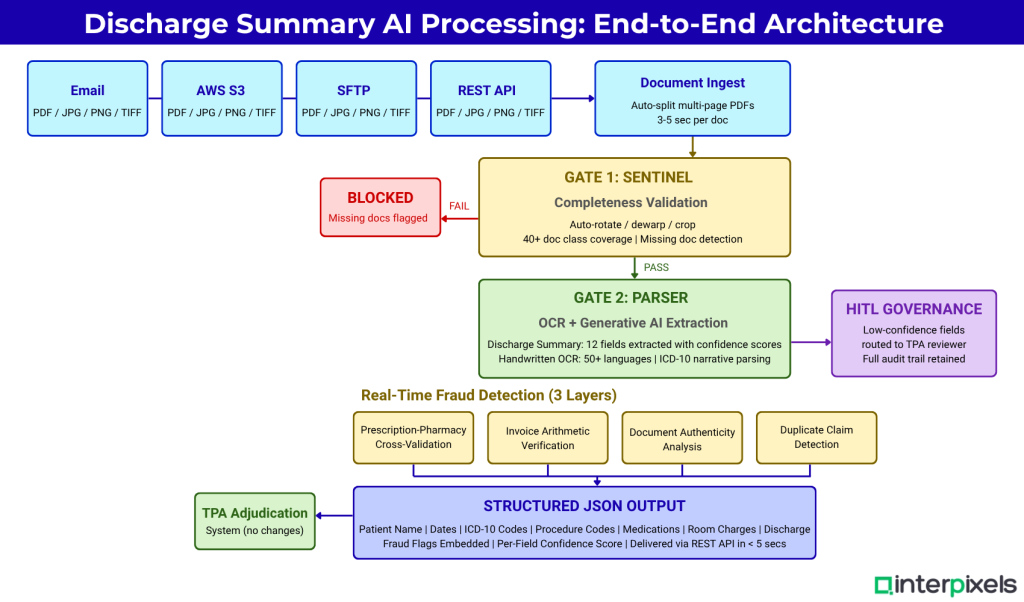
Figure: InterPixels AI two-gate architecture for IPD discharge summary processing. Gate 1 Sentinel validates document completeness before extraction begins. Gate 2 Parser runs OCR and Generative AI simultaneously, extracting 12+ fields from the discharge summary with per-field confidence scoring. Fraud detection runs concurrently. Low-confidence fields route to HITL review. Structured JSON is returned to the TPA system in under 5 seconds per document.
Gate 1 Completeness Check Before Extraction Begins
Every claim submitted to the system passes through Gate 1 Sentinel before a single extraction operation runs. The gate auto-rotates, dewarps, and crops all submitted documents, then classifies each file against 40+ document classes to determine what is present and what is absent. If the discharge summary is missing from an IPD claim bundle, Gate 1 blocks the submission immediately and returns a specific list of missing documents. No extraction compute is consumed on a claim that cannot be adjudicated.
OCR Plus Generative AI Working Simultaneously
Gate 2 runs OCR and a Generative AI reasoning layer in the same pass. The OCR engine handles printed and handwritten text across 50+ languages. The Generative AI layer identifies field boundaries, parses ICD-10 codes from narrative context, and resolves ambiguous abbreviations using clinical knowledge. Every extracted value carries a per-field confidence score, not a single document-level score, but a value specific to each field in the discharge summary.
The global Intelligent Document Processing market was valued at USD 2.44 billion in 2024 and is projected to reach USD 37.28 billion by 2033 at a CAGR of 35.4% (Straits Research, 2024). The growth is driven precisely by the need to move beyond single-pass OCR toward contextual AI extraction systems for complex document types like discharge summaries.
Per-Field Confidence Scoring and HITL Routing
Per-field confidence scoring is what makes Human-in-the-Loop governance operationally viable. When a specific field, for example, a handwritten medication dosage or an unclear ICD-10 code, falls below the configured confidence threshold, that field alone is flagged and routed to a TPA reviewer. The reviewer sees the specific field and the relevant document region, not the full document. High-confidence fields proceed automatically. This routing model allows TPA teams to focus attention where it is genuinely needed.
Routing only low-confidence fields to human review, not entire documents, is what makes AI-assisted claims processing economically viable at scale.
Cross-Document Validation: Discharge Summary Against the Full IPD Bundle
The discharge summary’s greatest value in AI processing is not extraction alone. It is what the extracted data enables: automated cross-validation against every other document in the IPD bundle. This is where claim leakage is caught and where fraud surfaces.
When the discharge summary states a length of stay of 5 days, the room charge sheet must reflect exactly 5 days of room fees. If it shows 7, that is an arithmetic discrepancy the system flags. When the discharge summary lists amoxicillin as the discharge medication, the pharmacy bill must show amoxicillin dispensed. If the pharmacy bill shows a different drug at three times the dosage, that is a prescription-pharmacy mismatch. Neither of these checks is possible without first extracting structured, machine-readable data from the discharge summary.
| Approach | Key Strength | Best Used When | Key Limitation |
|---|---|---|---|
| Manual re-keying by TPA staff | Human judgment on edge cases | Low claim volume, simple formats | Slow, error-prone, 40 min/claim average |
| Traditional OCR only (e.g. Tesseract) | Low cost, fast for clean printed docs | Standardised printed forms, single hospital | Fails on handwriting, mixed formats, ICD-10 narrative |
| AI IDP without cross-validation | Faster extraction than OCR alone | Single-document extraction tasks | No fraud detection; no cross-doc consistency checks |
| InterPixels AI two-gate pipeline | End-to-end: completeness + extraction + fraud | Multi-hospital IPD bundles, APAC TPA ops | Requires API integration (4-6 weeks) |
In practice, teams building cross-document validation find the most common discrepancy is between stated admission-to-discharge dates and room charge line items. McKinsey (July 2025) notes that Aviva’s deployment of 80+ AI models in its claims domain improved routing accuracy by 30% and reduced customer complaints by 65%, validating the value of systematic document cross-referencing at scale.
Prescription-pharmacy mismatches and inflated room charges only become visible when discharge summary data is cross-referenced against the hospital bill in real time.
Sample Structured JSON Output from a Discharge Summary
A production AI extraction system does not return a scanned PDF with highlighted fields. It returns a structured JSON object with every extracted field, a confidence score for each value, and an embedded fraud flag layer. The following is an anonymised sample output from a standard IPD discharge summary:
{
  "document_type": "discharge_summary",
  "patient_name":        { "value": "Rajesh Kumar",          "confidence": 0.98 },
  "date_of_admission":   { "value": "2025-11-04",            "confidence": 0.97 },
  "date_of_discharge":   { "value": "2025-11-09",            "confidence": 0.97 },
  "primary_diagnosis":   { "value": "Acute appendicitis",    "confidence": 0.95 },
  "icd10_primary":       { "value": "K35.89",                "confidence": 0.93 },
  "procedure_codes":     [{ "value": "47562",                "confidence": 0.91 }],
  "attending_physician": { "value": "Dr. A. Mehta",          "confidence": 0.96 },
  "medications_at_discharge": [
    { "drug": "Amoxicillin 500mg", "dosage": "TDS x 5 days", "confidence": 0.92 }
  ],
  "total_room_charges":  { "value": "INR 42,500",            "confidence": 0.94 },
  "discharge_status":    { "value": "Recovered",             "confidence": 0.99 },
  "fraud_flags": [],
  "hitl_review_required": false
}
This JSON output is delivered directly to the TPA platform via REST API in under 5 seconds per document. The fraud_flags array surfaces any cross-document discrepancies detected during Gate 2 processing. The hitl_review_required flag indicates whether any field fell below the confidence threshold.
How InterPixels AI Handles Discharge Summaries as One of 25 IPD Document Classes
InterPixels AI processes the hospital discharge summary as one of 25 IPD document classes, within a broader system covering 40+ health insurance document types across OPD, IPD, and KYC claim categories. The discharge summary extraction pipeline is purpose-trained on hospital document formats from India, Malaysia, Indonesia, Singapore, Thailand, and the Philippines, covering the specific header structures, section naming conventions, and handwriting patterns that appear in each market.
The system’s two-gate architecture applies Gate 1 completeness validation before any discharge summary extraction begins. Gate 2 runs OCR and Generative AI extraction simultaneously, with per-field confidence scoring returned for all 12 primary discharge summary fields. Fraud detection runs concurrently: invoice arithmetic checks verify that room charge totals are consistent with the stated length of stay. Prescription-pharmacy cross-validation matches discharge medications against pharmacy bill line items.
In production deployment with TrueCover India, processing time was reduced from 40 minutes to 5 minutes per claim across 15,000+ claims, an 8x improvement driven primarily by eliminating manual discharge summary review and re-keying. The InterPixels AI Claims Intelligence API integrates via REST API with no changes to the TPA’s existing adjudication platform. Integration takes 4 to 6 weeks from API access to production.
Frequently Asked Questions
What fields does AI extract from a hospital discharge summary for insurance claims?
AI extracts at least 12 fields: patient name, date of admission, date of discharge, primary and secondary diagnoses, ICD-10 and procedure codes, attending physician, medications at discharge, room charges, total bill amount, and discharge status. Each field is returned with a per-field confidence score so low-confidence values are automatically routed for human review before the claim reaches an adjudicator.
Why is the discharge summary more complex to process than other IPD documents?
Unlike a hospital bill or lab report, a discharge summary is semi-structured: it combines printed headers, free-text clinical narrative, and sometimes handwritten physician notes in the same document. ICD-10 codes often appear embedded in narrative paragraphs rather than discrete fields. Layout varies across hospitals, and multi-page PDFs arrive with varying scan quality, making rule-based OCR unreliable without an AI reasoning layer.
How does an AI system validate discharge summary data against the hospital bill?
Once the discharge summary is extracted, the AI cross-references the stated diagnosis, procedures, and length of stay against line items on the hospital bill. If room charges exceed the stated admission-to-discharge window, or if a procedure is billed that does not appear in the discharge summary’s procedure list, the system raises a cross-document mismatch flag. This validation runs at extraction time before any claim reaches an adjudicator.
What happens when a discharge summary has handwritten sections?
The AI applies a handwritten OCR model trained on medical scripts across 50+ languages including Hindi, Bahasa Indonesia, Thai, Tamil, and Mandarin. Each handwritten field is returned with its own confidence score. Fields that fall below the configured confidence threshold are routed to a Human-in-the-Loop reviewer who sees only those specific fields, not the full document.
How long does AI take to extract data from a hospital discharge summary?
An AI extraction pipeline returns structured JSON output in 3 to 5 seconds per document from submission to delivery. In production deployments, this compresses the full upstream document workflow for a standard IPD claim from 40 minutes of manual review to under 5 minutes, an 8x improvement. The discharge summary extraction itself, including fraud checks and cross-document validation, takes under 2 seconds in current systems.
Three Things Every TPA Tech Team Should Know About Discharge Summary Processing
First: the discharge summary is the only document in the IPD bundle that can anchor cross-validation of every other document. Getting its extraction right is not optional; it is the prerequisite for everything downstream.
Second: the challenges are not primarily technical limitations of AI. They are data problems: inconsistent hospital formats, mixed printed and handwritten content, and ICD-10 codes embedded in clinical narrative. Purpose-trained systems built on real-world APAC hospital document formats solve these problems in ways that generic OCR tools cannot.
Third: per-field confidence scoring combined with Human-in-the-Loop routing is the production model that makes discharge summary AI viable for regulated TPA environments. It is not about removing humans from the process. It is about directing human attention to exactly the fields where it adds value.
The question for every TPA team is not whether to automate discharge summary extraction. It is how to do it in a way that is accurate enough to trust, auditable enough to defend, and fast enough to matter.
Book a demo with InterPixels AI to see discharge summary extraction on your own IPD documents.
Table of Content