
Medical bill auditing in health insurance is the structured process of validating every line item on a hospital or pharmacy bill against prescribed treatments, network tariff rates, and procedural coding rules before a claim reaches an adjudicator. When powered by AI, the process extracts itemised data with OCR and Generative AI, cross-references prescriptions, validates charges against GIPSA or network rate tables, and flags discrepancies in real time before any settlement amount is committed.
The Scale of the Problem: Overbilling Is Not an Edge Case
In FY2024, IRDAI’s Annual Report 2023-24 shows India’s insurers disallowed and repudiated health claims worth Rs 26,000 crore combined, a 19.1 per cent jump year-on-year from Rs 21,861 crore in FY2023. Of the 3.26 crore health claims filed in FY2024, 72 per cent were settled through TPAs, with the remaining 28 per cent settled in-house. That means the majority of India’s entire claims volume and the billing discrepancies embedded in it flow through third-party administrators.
The problem is systemic. In FY2024, insurers specifically disallowed Rs 15,100 crore (12.9 per cent of total claims) and repudiated a further Rs 10,937 crore (9.34 per cent). Billing errors and overbilling drive a significant share of both categories. On the government health scheme side, the Union Health Ministry informed Parliament in March 2025 that, cumulatively under Ayushman Bharat, 3.56 lakh fraudulent claims worth Rs 643 crore had been rejected and 1,114 hospitals de-empanelled.
This is not a fraud problem at the margins. AI medical bill auditing exists precisely because the volume has outgrown what any manual team can handle.
Overbilling is not an edge case; it is a systemic cost embedded in every high-volume TPA claims operation that manual auditing cannot reach at scale.
Five Overbilling Types That Cost APAC TPAs the Most
Precise detection starts with precise categorisation. In practice, teams building AI auditing pipelines quickly find that five overbilling patterns account for the vast majority of financial leakage across both IPD and OPD claims.
| Overbilling Type | What It Looks Like in a Real Bill | AI Detection Method | Typical Accuracy |
|---|---|---|---|
| Duplicate line items | Same drug, consumable, or service billed twice on the same invoice | Exact-match deduplication across line items, dates, and quantities within a single claim | 95%+ |
| Upcoding | A routine consultation coded as a specialist procedure to attract a higher tariff | Diagnosis-to-procedure code mismatch analysis using ICD-10 and CPT/SNOMED cross-reference | 85-90% |
| Unbundling | A surgical package disaggregated into multiple individually charged components | Package-vs-line-item bundling rule validation against procedure grouping tables | 80-88% |
| Phantom charges | Medications or consumables listed on the bill that were never prescribed or administered | Prescription-to-pharmacy cross-validation matching prescribed items against dispensed items | 90-95% |
| Inflated room tariffs | Daily room charges exceeding the GIPSA or network-agreed ceiling for that room category | Tariff-table lookup with rate ceiling validation against network contract rates | 98%+ |
Accuracy ranges are indicative of production AI systems operating with HITL governance, as cited across published literature including IJSRA (2024) and ResearchGate (2023).
Why Manual Auditing Fails at Scale
A trained human auditor reviewing one itemised hospital bill takes approximately 40 minutes, including document retrieval, line-by-line cross-checking, tariff lookup, and exception logging. InterPixels AI’s production case study with TrueCover India documents this 40-minute per-claim baseline across 15,000-plus claims processed before automation.
A team of ten auditors working a full day can process fewer than 120 claims. A mid-sized Indian TPA handling 5,000 claims per day cannot audit more than 2.4 per cent of submissions manually. The remaining 97.6 per cent pass through on good faith.
Rule-based systems help but only partially. They catch known patterns: specific CPT code combinations that are always bundled, or room tariffs that exceed fixed ceilings. They fail when a hospital uses an unfamiliar code variant, introduces a novel line item, or inflates amounts just below the alert threshold. Research published in the International Journal of Science and Research Archive (2024) confirms that traditional rule-based systems cannot keep pace with evolving fraud patterns, whereas ML-based anomaly detection identifies suspicious patterns in real time. A separate 2023 ResearchGate study on AI in medical billing found that unsupervised ML applied to outpatient billing data achieved a 52 per cent improvement in fraud detection accuracy and reduced manual audits by 40 per cent.
A team of ten manual auditors can review fewer than 2.5 per cent of daily claims. The rest pass through unreviewed — that is where AI medical bill auditing operates.
How AI Medical Bill Auditing Works: The Five-Step Pipeline
The pipeline that InterPixels AI runs for APAC health insurance TPAs executes five steps from document intake to a structured discrepancy report, with no manual touch unless a field falls below confidence threshold.
Step 1: Document Intake and Completeness Validation
Every claim submission, pharmacy bills, hospital break-up bills, discharge summaries, prescriptions, and KYC documents enter a Gate 1 completeness check. The system classifies document types across 40-plus health insurance document categories and verifies that every required document for that claim type (IPD, OPD, or KYC) is present. Incomplete submissions are blocked before any extraction resources are consumed.
Step 2: OCR and GenAI Extraction
For each document in the bundle, OCR combined with Generative AI extracts structured data. The system reads printed and handwritten text across 200-plus languages for printed documents and 50 languages for handwritten prescriptions. Every extracted field carries a confidence score. Fields below threshold are queued for HITL review rather than passed downstream.
Step 3: Cross-Reference Validation
This is where medical bill auditing begins in earnest. The extracted pharmacy bill line items are matched against the prescription. Every medication, dosage, and quantity is compared item by item. If the pharmacy bill lists five medications but the prescription authorises three, the two unmatched items are flagged as potential phantom charges immediately. Duplicate items within the bill are caught by exact-match deduplication. Diagnosis codes are compared against billed procedure codes to detect upcoding.
Step 4: Tariff Validation
Every charge is validated against the network tariff table. For PSU insurer claims in India, this means checking against GIPSA package rates, the standardised tariff structure negotiated between India’s four major public sector insurers and their preferred partner network hospitals. Room tariff ceiling checks compare daily room charges against the contracted rate for that room category at that hospital. Invoice arithmetic is verified to ensure line-item totals match stated amounts.
Step 5: Discrepancy Scoring and JSON Output
Each claim receives a discrepancy risk score. Flagged items carry the flag type (phantom charge, upcoding, tariff breach), the specific field and evidence, and the relevant line item. The full output is returned as structured JSON, ready for adjudication, with no reformatting required by the TPA system.
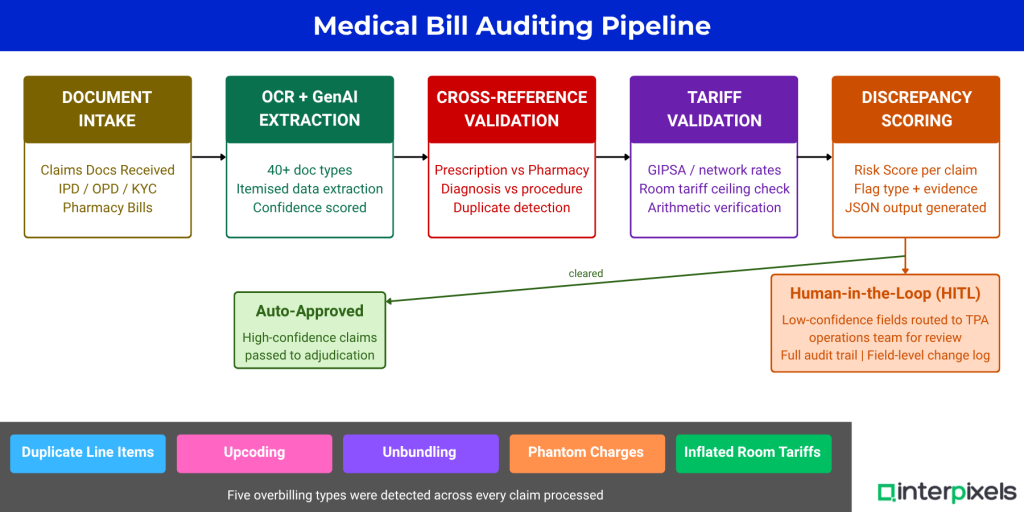
Caption: The InterPixels AI pipeline moves from document intake through OCR extraction, prescription cross-reference, GIPSA tariff validation, and discrepancy scoring. High-confidence claims route directly to adjudication. Low-confidence fields and flagged discrepancies route to the TPA operations team via HITL for review, with a full audit trail and field-level change log retained at every step. The five overbilling types detected are shown at the base of the diagram.
When a pharmacy bill lists five medications but the prescription authorises three, AI flags the two phantom items within seconds before any claim amount is committed to settlement.
Manual vs. Rule-Based vs. AI Auditing: Which Approach Fits When
Not every TPA needs the same approach, and no single method works across all claim types. Here is how the three models compare.
| Approach | Key Strength | Limitation | Best Used When |
|---|---|---|---|
| Manual auditor review | High contextual judgment; handles ambiguous or novel clinical situations | Slow (approx. 40 min per claim), unscalable, inconsistent across auditors | Low-volume, very high-value claims requiring expert clinical interpretation |
| Rule-based system | Fast, deterministic, auditable; catches known, stable fraud patterns | Fails on novel code variants; static rules require constant maintenance | Known fraud patterns with well-defined, rarely-changing rules |
| AI bill auditing with HITL (InterPixels AI) | Scalable, adaptive, catches novel patterns, processes 40+ document types, IRDAI-aligned audit trail | Requires quality training data and integration timeline | High-volume TPA operations with diverse document types, multilingual submissions, and regulatory audit requirements |
HITL Governance: Where AI Stops and Humans Decide
IRDAI’s Insurance Fraud Monitoring Framework Guidelines (2025) require that insurers maintain systematic fraud governance with board-level oversight, mandatory participation in the IIB Fraud Monitoring Technology Framework, and full audit trails. HITL is the mechanism that keeps AI auditing compliant with this standard.
In the InterPixels AI pipeline, HITL does not mean a human reviews every document. It means that only low-confidence field extractions and discrepancy-flagged items are routed to a TPA operations team member. The reviewer sees the specific field, the document image context, and the reason for the flag. They confirm or correct the field, and the claim proceeds. The entire interaction is logged at the field level.
In practice, 94 per cent of fields auto-validate without human touch. Staff review only exceptions, not entire documents. This is what allows a TPA to process thousands of claims per day without proportional headcount growth, while still satisfying the audit trail requirements that regulators and internal compliance teams require.
94 per cent of fields auto-validate. HITL does not slow the pipeline; it targets human attention precisely where confidence is lowest, preserving accountability without creating a bottleneck.
FAQ: AI Medical Bill Auditing in APAC Health Insurance
What is medical bill auditing in health insurance?
Medical bill auditing in health insurance is the process of checking every line item on a hospital or pharmacy bill against prescribed treatments, procedure coding rules, and agreed tariff rates before a claim is settled. In AI-powered systems, this happens automatically at intake, with discrepancies flagged before any claim amount is committed. For APAC TPAs handling thousands of daily IPD and OPD claims, automated auditing is the only way to achieve consistent coverage at scale.
How does AI detect phantom charges in a pharmacy bill?
InterPixels AI detects phantom charges by running prescription-to-pharmacy cross-validation during the extraction step. Every item on the pharmacy bill is matched against the linked prescription. Items on the bill that have no corresponding prescription line are flagged as potential phantom charges, with the specific item, quantity, and amount cited in the discrepancy output. This check runs before any settlement amount is approved.
What is upcoding and how does AI catch it?
Upcoding is when a hospital bills a higher-value procedure code than the treatment actually performed, for example, billing a specialist consultation when only a routine one occurred. AI detects upcoding by cross-referencing diagnosis codes in the discharge summary or consultation record with the procedure codes on the bill, using ICD-10 and clinical coding rule sets. Mismatches above a defined severity threshold are flagged for HITL review.
How does GIPSA tariff validation work in TPA claims?
GIPSA (General Insurance Public Sector Association) is the standardised tariff structure negotiated between India’s four PSU insurers and their network hospitals, covering procedures, room categories, and consumables. GIPSA tariff validation works by comparing each charge on the hospital bill against the GIPSA package rate for that procedure and room category. Any charge exceeding the contracted ceiling is flagged as a tariff breach before the claim reaches an adjudicator.
Is AI medical bill auditing compliant with IRDAI guidelines?
Yes, when implemented with a proper HITL governance layer. IRDAI’s Insurance Fraud Monitoring Framework Guidelines (2025) require systematic fraud detection, board-level governance, audit trails, and mandatory participation in the IIB Fraud Monitoring Technology Framework. AI auditing platforms like InterPixels AI satisfy these requirements by maintaining field-level change logs, routing flagged items to human reviewers, and generating structured discrepancy reports that support regulatory audit submissions.
Three Things Every TPA Finance Team Should Know
First, overbilling in APAC health claims is a systemic cost, not an occasional exception. IRDAI’s FY2024 Annual Report shows Rs 26,000 crore in combined disallowed and repudiated health claims, with TPAs handling 72 per cent of total claim volume. Any manual process reviewing fewer than three per cent of those claims leaves the rest unaudited.
Second, AI medical bill auditing does not replace human judgment; it directs it. Deloitte’s 2025 report on AI and insurance fraud found that soft fraud (inflating legitimate claims) accounts for 60 per cent of all fraud incidents and currently has a detection rate of only 20 to 40 per cent with traditional methods. AI-assisted auditing, with HITL routing only the flagged exceptions, can push that rate significantly higher without adding headcount.
Third, the market is moving fast. The global healthcare fraud detection market is forecast to reach $8.7 billion by 2030 at a 26.5 per cent CAGR, according to ResearchAndMarkets (2024). Insurers globally that have deployed AI fraud detection are already generating 20 to 40 per cent potential savings on fraudulent claims, according to Deloitte. TPAs that build AI auditing capability now will hold a structural cost and compliance advantage over those that wait.
The question for every TPA finance and risk team is not whether AI can detect overbilling. The evidence shows it can, with higher consistency and at lower cost than manual review. The question is how many claims are slipping through while the decision is still pending.
Book a demo with InterPixels AI to see the pipeline running on your own document types.
Table of Content
- The Scale of the Problem: Overbilling Is Not an Edge Case
- Five Overbilling Types That Cost APAC TPAs the Most
- Why Manual Auditing Fails at Scale
- How AI Medical Bill Auditing Works: The Five-Step Pipeline
- Manual vs. Rule-Based vs. AI Auditing: Which Approach Fits When
- HITL Governance: Where AI Stops and Humans Decide
- FAQ: AI Medical Bill Auditing in APAC Health Insurance
- Three Things Every TPA Finance Team Should Know