
Health insurance document classification in APAC is the automated process by which an AI pipeline identifies, labels, and routes insurance documents, cashless claim forms, KYC records, pre-authorization letters, prescriptions, and pharmacy receipts based on their document type, language, and regulatory jurisdiction. Across India, Malaysia, and Indonesia, this classification must operate accurately across at least three regulatory regimes, two major scripts, and multiple handwriting styles simultaneously.
The Classification Problem No Single Pipeline Can Solve
Health insurance document classification in APAC fails when teams treat India, Malaysia, and Indonesia as one market. Each country runs a distinct regulatory regime, a distinct document taxonomy, and distinct language and script requirements.
According to McKinsey (2025), AI-driven claims automation can reduce processing time by 50 to 70%. That number assumes the system can first correctly identify what it is reading. A pre-authorisation letter, a pharmacy receipt, and a KYC document all arrive as image files. Without accurate health insurance document classification, the automation never starts.
The pressure is regulatory as well as operational. IRDAI’s 2024 Master Circular mandates that Indian cashless pre-authorisations be decided within one hour. Bank Negara Malaysia’s 2024 MHIT Policy Document requires standardised bilingual terminology across all claim documents. OJK’s Circular Letter 7/2025 governs Indonesian health insurance IT systems with new third-party administrator requirements. Three regulators. Three document taxonomies. Three language contexts. One pipeline cannot handle all three.
According to Coherent Market Insights (2025), Asia Pacific is the fastest-growing region for intelligent document processing, projected to reach 18.5% of the global IDP market in 2026. The BFSI segment leads adoption at 32.7% market share. The infrastructure investment is arriving. The classification layer that makes it work is what most teams underestimate.
“A system that cannot distinguish an AYUSH prescription from an allopathic referral will fail the IRDAI 1-hour rule every time.”
India: Aadhaar, AYUSH, and the 1-Hour Clock
India presents the highest regulatory clock pressure in APAC: IRDAI mandates cashless pre-authorisation decisions within 1 hour and final discharge authorisation within 3 hours, leaving zero margin for manual document sorting.
Since January 2023, IRDAI mandates Aadhaar-based KYC for all health insurance policies. This means every claim intake pipeline must classify a submitted document as either a KYC document, a claim form, a pre-auth letter, or a supporting clinical record before routing it. If the system mistakes an Aadhaar-based KYC submission for a medical report, the downstream fields extracted will be wrong, the routing will fail, and the 1-hour window closes.
India adds a second layer of classification complexity that most international OCR vendors miss: the AYUSH prescription. India’s health insurance framework covers Ayurvedic, Yoga, Unani, Siddha, and Homeopathy treatments. These prescriptions are formatted differently from allopathic ones. They often mix English drug names with Devanagari preparation terms on the same page. A classifier trained only on English-language insurance documents will label an AYUSH prescription as an unstructured note or unknown document type.
The third Indian-specific document class is the GIPSA tariff sheet. The General Insurance Public Sector Association publishes standard rates, and TPAs use these sheets to cross-check hospital billing. An AI pipeline must recognise this document as a rate reference, not a claim. In practice, teams building Indian health insurance automation find that document type taxonomy alone requires at least seven distinct classes: Cashless Claim Form, Aadhaar KYC, AYUSH Prescription, Allopathic Prescription, Pre-Auth Letter, GIPSA Tariff Sheet, and Discharge Summary.
According to data shared in India’s Lok Sabha (December 2025), 86.88% of cashless pre-auth cases were processed within the 1-hour window between August 2024 and May 2025. That figure is only possible if document classification happens at ingestion, not after human review.
Malaysia: MyKad OCR, BNM Bilingualism, and Format Divergence
Malaysia’s BNM requires licensed insurers to use standardised bilingual (Bahasa Malaysia and English) terminology across all MHIT documents from 2025, making bilingual classification a compliance requirement, not an optional feature.
The BNM MHIT Policy Document (February 2024) introduces the Glossary of Terms (GOT) requirement: all licensed insurers and takaful operators must adopt standardised policy wording in both Bahasa Malaysia and English. From a classification perspective, this means a Malaysian AI pipeline must handle documents where the same field may be labelled in either language depending on whether the document was issued by a government hospital or a private insurer.
MyKad, the Malaysian national identity card, is the primary KYC document for health insurance in Malaysia. Unlike Aadhaar, which uses a standard barcode and text format, MyKad carries embedded biometric chips and a holographic overlay that creates visual noise for standard OCR engines. A classification system must first identify the document as a MyKad (not a driving licence or passport) before the OCR layer attempts field extraction.
The government versus private hospital format gap is the second major Malaysian challenge. Ministry of Health (KKM) hospitals use standardised claim formats with BM field labels. Private hospitals, particularly those catering to corporate group plans, issue claims in English with their own proprietary layouts. The same patient at the same hospital can generate documents in both formats if they move between outpatient (private billing) and inpatient (insurance panel) wards.
“BNM’s bilingualism requirement is not a formatting detail. It is a classification architecture constraint.”
Indonesia: Apotik Receipts, OJK, and the Handwriting Problem
Indonesian apotik receipts, the pharmacy documents required for drug reimbursement claims, are frequently handwritten in informal Bahasa Indonesia and represent the highest-difficulty document class in the APAC health insurance context.
Apotik (apotek) is the Indonesian word for pharmacy. Unlike the printed receipts generated by hospital pharmacies, community apotik receipts are often handwritten on pre-printed templates where the patient name, drug name, dosage, and price fields are filled by hand. The 2024 comprehensive review of handwriting recognition techniques (Alhamad et al., Symmetry/MDPI) confirms that OCR accuracy is directly dependent on the quality and type of material processed, and that handwriting recognition remains one of the key unsolved classification problems in AI. An apotik receipt with a pharmacist’s cursive Bahasa Indonesia challenges every model trained primarily on printed Latin text.
The OJK Circular Letter 7/2025 now requires insurance companies operating in Indonesia to have IT systems capable of handling third-party administrator workflows. This brings Indonesian private insurers closer to the BPJS Kesehatan infrastructure model, where standardised claim data formats are expected. Private insurers selling supplementary products alongside BPJS coverage, a common model for middle-income Indonesians, now receive documents that are partly BPJS-formatted and partly in private insurer templates, often submitted together.
The Bahasa Indonesia formality gap adds another dimension. Official OJK-compliant documents use formal Bahasa Indonesia. But when a patient writes their own referral note or a small clinic generates a handwritten consultation record, the language shifts to informal registers with abbreviations and colloquialisms. A classifier must handle both without confusion.
“The apotik receipt is the document that humbles every OCR model trained only on clean, printed Latin text.”
The Architecture of a Country-Aware Classification Pipeline
A compliant APAC health insurance classification pipeline requires five discrete layers: ingestion normalisation, script detection, OCR engine selection, multilingual NLP classification, and country-specific compliance routing.
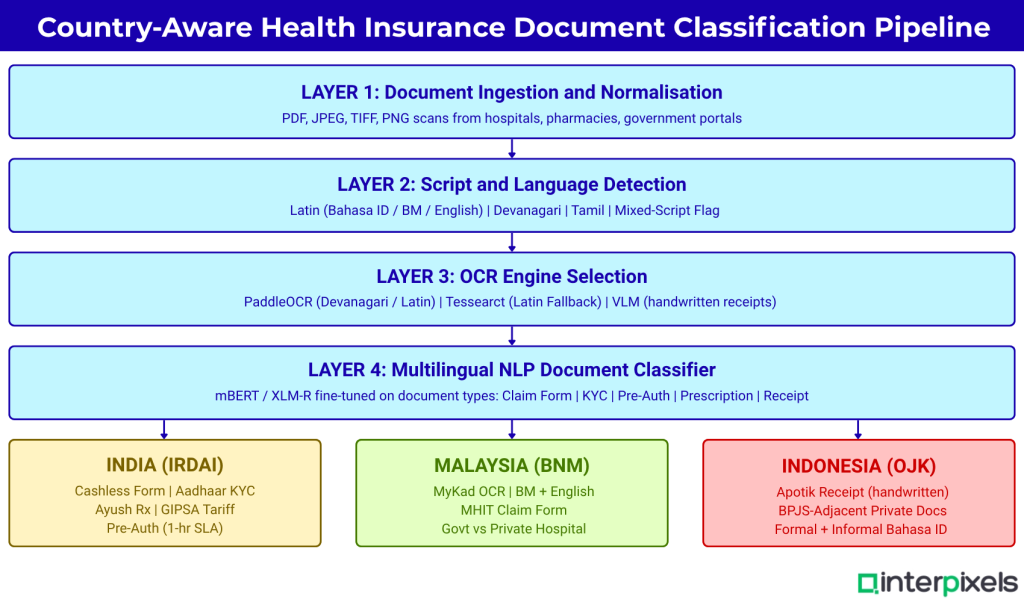
Figure: Country-Aware Health Insurance Document Classification Pipeline. Documents enter at Layer 1 (ingestion). Layer 2 detects script and language. Layer 3 selects the appropriate OCR engine. Layer 4 applies a multilingual NLP classifier. Layer 5 routes the classified document to country-specific compliance handling for India (IRDAI), Malaysia (BNM), or Indonesia (OJK). All layers must execute within IRDAI’s 1-hour pre-auth window at the outer boundary.
Layer 1 handles format normalisation: converting TIFF scans from hospital systems, JPEG photos from mobile submissions, and PDF documents from TPA portals into a uniform grayscale image array. Layer 2 runs a lightweight script classifier often a convolutional network trained on character-level patches to detect Devanagari, Latin, Tamil, or mixed-script content. This is the fork that routes Indian documents with Devanagari text to a different OCR path than a standard Bahasa Malaysia claim form.
Layer 3 selects the OCR engine based on Layer 2 output. PaddleOCR (PaddlePaddle/PaddleOCR) now supports 109 languages including Latin, Devanagari, Arabic, and Tamil, making it a strong candidate for the primary engine across all three markets. For handwritten Indonesian apotik receipts, a Vision Language Model (VLM) such as PaddleOCR-VL provides better results than template-based recognition, as the research by the ItechUS IDP team (IJSRA, 2025) confirms: IDP systems integrating VLMs reduce error rates by up to 90% compared to rules-based OCR alone.
Layer 4 applies multilingual NLP document classification. The HMDE architecture (Ogaloglu et al., arXiv 2023) demonstrates that hierarchical multilingual encoders generalise to languages unseen during document-level pretraining. This enables a single classifier to handle Bahasa Indonesia, Bahasa Malaysia, and Tamil-transliterated drug names without three separate models. Layer 5 then routes the output to country-specific compliance logic: IRDAI’s cashless form fields in India, the BNM GOT field labels in Malaysia, or OJK-compliant TPA data fields in Indonesia.
“Country-aware routing is not a feature. In APAC health insurance, it is the foundation.”
Comparing Classification Approaches for APAC Health Insurance
Three approaches dominate APAC health insurance document classification: template-based OCR, hybrid OCR plus transformer NLP, and VLM-first pipelines. Each has a distinct fit depending on document type and country.
| Approach | Key Strength | Key Weakness | Best Used When |
|---|---|---|---|
| Template-Based OCR (e.g., Tesseract with field maps) | High speed, low cost, predictable on standardised forms | Breaks on layout variation, handwriting, and bilingual fields | Documents follow a fixed government-issued format (e.g., specific IRDAI cashless forms) |
| Hybrid OCR + Transformer NLP (PaddleOCR + mBERT/XLM-R) | Handles multilingual text; classifies at document level not field level | Requires labelled training data per country; latency higher than template OCR | Mixed-language environments: Malaysia BM+English, India AYUSH+Allopathic |
| VLM-First Pipeline (PaddleOCR-VL, GPT-4o Vision) | Best accuracy on handwriting and complex layouts; no template dependency | Higher compute cost, latency, and risk of hallucination on low-confidence fields | Indonesian apotik receipts, handwritten consultation records, mixed-quality scans |
Classification Accuracy by Language: What the Data Shows
Printed Bahasa Malaysia and Bahasa Indonesia documents achieve significantly higher OCR accuracy than handwritten equivalents, while mixed-script Indian prescriptions combining Devanagari and English in a single line represent the most difficult classification case in this market.
In practice, teams building APAC health insurance pipelines consistently find a three-tier accuracy pattern. Printed, single-language documents in Latin script, a typed Bahasa Malaysia BNM claim form or a printed Bahasa Indonesia hospital invoice perform well with hybrid pipelines, typically exceeding 95% character recognition accuracy with PaddleOCR. Printed but structurally variable documents, private hospital forms with varying layouts, GIPSA tariff sheets with merged table cells drop to the 85 to 92% range. Handwritten or mixed-script documents fall the furthest, often into the 60-75% range without fine-tuning.
The Deloitte Center for Financial Services (June 2024) found that 76% of insurance executives have already integrated generative AI into at least one business function. The gap between that adoption figure and the accuracy rates on handwritten APAC documents is precisely where TPA teams should focus their fine-tuning investment. A model achieving 75% on handwritten Bahasa Indonesia apotik receipts is a liability at scale, not an asset.
The karmatta Medical Documents Classifier (GitHub) demonstrates this with 40,000 scanned medical insurance images: an ensemble of document layout, content, and expert consensus was required to reach production accuracy across five document classes. A single model strategy did not work. APAC health insurance demands the same ensemble logic applied across country boundaries.
FAQ: Health Insurance Document Classification in APAC
What types of documents does an AI classify in a health insurance claim?
An AI classifier in health insurance must handle at least seven document types: cashless claim forms, KYC identity documents (Aadhaar in India, MyKad in Malaysia, national ID in Indonesia), pre-authorisation letters, allopathic prescriptions, AYUSH prescriptions (India only), pharmacy receipts, and discharge summaries. Each country adds jurisdiction-specific variants of these classes.
Why does OCR accuracy drop for Bahasa Indonesia insurance documents?
OCR accuracy drops on Bahasa Indonesia documents primarily when those documents are handwritten, such as apotik pharmacy receipts filled by pharmacists. Most commercial OCR models are trained on printed Latin text. Handwritten Bahasa Indonesia contains informal registers, abbreviations, and varied character forms that standard models have not seen in sufficient volume. Fine-tuning on Indonesia-specific document datasets is required to recover accuracy.
How does IRDAI’s 1-hour rule affect document classification systems in India?
IRDAI’s Master Circular on Health Insurance Business 2024 requires insurers to decide on cashless pre-authorisation requests within 1 hour. This forces document classification to happen at ingestion, not after human triage. A pipeline that routes documents manually before classification cannot meet this timeline at the volume Indian TPAs process. Automated classification is effectively mandated by the regulatory clock.
What is the difference between how Malaysia and Indonesia regulate insurance document formats?
Malaysia’s BNM mandates a Glossary of Terms for standardised bilingual (Bahasa Malaysia and English) field labels across all MHIT policy documents from 2025, creating a known vocabulary AI classifiers can target. Indonesia’s OJK governs health insurance IT systems through Circular Letter 7/2025 but does not yet standardise field-level terminology, meaning Indonesian documents show far more format variability across issuers.
Can one AI model handle health insurance documents across India, Malaysia, and Indonesia?
A single flat model cannot do this reliably. A hierarchical architecture can: one shared backbone for OCR and script detection, one shared multilingual NLP classifier for document type, and separate country-specific routing and field-extraction layers for India, Malaysia, and Indonesia. The shared layers benefit from cross-country training data. The country-specific layers enforce regulatory compliance.
InterPixels is a document AI company specialising in intelligent document processing for health insurance and financial services across India, Malaysia, and Indonesia.
Building Classification That Works Across Borders
Three conclusions emerge from this country-by-country breakdown. First, regulatory clocks determine your architecture: IRDAI’s 1-hour rule means classification must be automated at ingestion in India. There is no room for a human sorting step before the OCR layer runs. Second, language detection is a prerequisite, not an afterthought: without accurate script and language identification at Layer 2, every downstream component operates on false assumptions. Third, handwriting is the accuracy floor: any APAC health insurance pipeline that has not been fine-tuned on handwritten Bahasa Indonesia apotik receipts has a known, unaddressed failure mode at the point where Indonesian claims are most likely to carry errors.
The APAC health insurance market is consolidating around AI-powered claims infrastructure. According to McKinsey (2025), claims processing will be the most critical insurance function by 2030. The TPAs and insurers that build country-aware classification now will carry that infrastructure advantage forward. The question worth asking is not whether to build multilingual health insurance document classification it is whether your current system can tell the difference between a BNM-compliant MHIT form and a handwritten apotik receipt when both arrive in the same claims batch.
Table of Content
- The Classification Problem No Single Pipeline Can Solve
- India: Aadhaar, AYUSH, and the 1-Hour Clock
- Malaysia: MyKad OCR, BNM Bilingualism, and Format Divergence
- Indonesia: Apotik Receipts, OJK, and the Handwriting Problem
- The Architecture of a Country-Aware Classification Pipeline
- Comparing Classification Approaches for APAC Health Insurance
- Classification Accuracy by Language: What the Data Shows
- FAQ: Health Insurance Document Classification in APAC
- Building Classification That Works Across Borders