
AI prescription fraud detection in health insurance is the use of machine learning and rules-based engines to compare prescription records, pharmacy bills, and clinical data in real time, flagging mismatches such as inflated tablet quantities, undated prescriptions, or drug name substitutions before a claim is paid. For APAC TPAs, it is the difference between stopping a fraudulent payout and funding one.
Why Pharmacy Bill Fraud Is APAC’s Fastest-Growing Claims Leak
Pharmacy bill fraud in APAC health insurance exploits the gap between paper prescriptions and digital claim submission. India’s IRDAI reported that Rs 26,000 crore in health claims were disallowed or repudiated in FY2023-24, a 19.1% year-on-year rise. Of all settled claims in that period, 72% were processed through TPAs, making the TPA channel the single most exposed point in the system.
Across the broader APAC region, industry estimates place some element of fraud in 15% of health insurance claims in India alone. The LexisNexis True Cost of Fraud Study 2023 (APAC) found that 93% of Indian organisations now invest in multiple fraud solution types, yet pharmacy-level prescription fraud persists because most tools target billing codes rather than the prescription document itself.
A 2025 global scoping review in Archives of Public Health confirmed that Asian and Middle Eastern fraud patterns concentrate in pharmaceutical supplier fraud and false claims, unlike the upcoding-dominant patterns seen in Western markets. That distinction matters enormously for how APAC TPAs configure their detection logic.
Fraud is not an operational nuisance. In APAC health insurance, it is a strategic financial leak that compounds every quarter.
Scenario 1 — Quantity Mismatch: The 30-to-90 Tablet Swap
A quantity mismatch occurs when the dispensed tablet count on the pharmacy invoice exceeds what the doctor prescribed. AI flags this gap in milliseconds by comparing OCR-extracted prescription values against billed line items, something a manual queue reviewer processing hundreds of claims per day simply cannot do consistently.
How It Happens
A network pharmacy receives a valid 30-tablet prescription for a chronic-condition medication. The pharmacist bills for 90 tablets, either colluding with the patient or acting unilaterally. The prescription document, if submitted at all, shows the correct quantity. The invoice does not. In a paper-heavy environment, this discrepancy is invisible to a claims processor comparing only total invoice value.
Financial Impact
At a mid-range per-tablet cost of Rs 50, a single 30-to-90 swap generates Rs 3,000 in excess billing on one claim. Multiplied across a network of 500 active cashless pharmacies filing 20 such claims per day, the monthly leakage reaches Rs 3 crore, or approximately Rs 36 crore per year, from this pattern alone. The Deloitte 2024 multimodal fraud report estimates soft fraud inflates claim costs in 60% of all fraud incidents, and quantity manipulation is one of its most common forms.
How AI Detects It
The AI system uses optical character recognition to extract the prescribed quantity from the doctor’s script and compares it field-by-field against the pharmacy bill’s dispensed quantity. A threshold rule triggers on any delta above a configurable tolerance, typically zero for acute medications and a small buffer for chronic ones. The ML layer also scores the pharmacy’s historical behaviour, giving higher fraud probability to outlets with repeated discrepancy patterns.
Action Triggered
First-occurrence discrepancies at known pharmacies route to a human-in-the-loop (HITL) flag. The investigator contacts the pharmacy, requests the physical prescription, and compares it against the scanned copy. If the discrepancy is confirmed, the claim is rejected and the pharmacy’s risk score is elevated. A second confirmed mismatch within 90 days triggers an auto-reject rule and a network audit referral.
Scenario 2 — Phantom Prescription: A Claim With No Valid Script
A phantom prescription claim is submitted with either a forged document or no prescription at all. AI cross-references the claim date against the prescribing doctor’s consultation records and the insured member’s hospitalisation log, flagging orphan claims that have no clinical anchor.
How It Happens
A pharmacy submits a reimbursement claim for a high-value antibiotic course. The prescription reference number on the claim either does not exist in the doctor’s records or belongs to a different patient. In some documented Indonesia cases flagged by the national health insurance fraud review, IDR 35 billion was traced to precisely this model where hospitals and pharmacies jointly fabricated medication records.
Financial Impact
Phantom prescriptions carry the highest per-claim value because perpetrators target premium medications. Biologics, specialty oncology drugs, and branded antivirals can generate Rs 50,000 to Rs 5 lakh per fraudulent claim. Unlike quantity mismatches, these claims have no legitimate base to dilute the fraud value.
How AI Detects It
The system queries a shared prescription registry or the doctor’s e-consultation records via API. If no matching consultation exists within a clinically plausible window before the prescription date, the AI flags the claim as an unanchored submission. The 2024 systematic review in Artificial Intelligence in Medicine found that cross-referencing provider activity records with claim submissions was among the highest-accuracy detection strategies for pharmacy fraud in Asian datasets.
Action Triggered
Phantom prescription claims trigger an immediate auto-reject because there is no legitimate scenario in which a valid prescription does not trace back to a registered consultation. The TPA logs the rejection, flags the pharmacy and the referenced doctor for review, and files a report to the insurer’s fraud cell under IRDAI’s 2025 mandatory reporting guidelines.
A phantom prescription exists because no system was watching the space between the clinic and the pharmacy. AI closes that gap.
Scenario 3 — Pharmacy-Rx Mismatch: When the Drug Name Does Not Match
A pharmacy-Rx mismatch occurs when the drug name or formulation on the pharmacy bill differs from what the doctor prescribed. The most common version substitutes a cheaper generic while billing for the premium brand-name price, or swaps to a different molecule entirely within the same therapeutic class.
How It Happens
A doctor prescribes Amoxicillin 500mg. The pharmacy bills for Augmentin (Amoxicillin-Clavulanate) 625mg, a higher-cost combination drug. The molecule is related, the clinical rationale sounds plausible, and no quantity discrepancy exists. A human reviewer without clinical training approves the claim. AI with a drug name normalisation layer recognises the substitution immediately.
Financial Impact
Brand-name to combination-drug substitutions can inflate per-claim costs by 200-400%. In a high-throughput TPA processing 10,000 pharmacy claims per month, even a 3% mismatch rate at a Rs 2,000 average uplift generates Rs 60 lakh in excess monthly payouts. Annualised, that is Rs 7.2 crore from a single fraud variant.
How AI Detects It
Natural language processing normalises drug names from both the prescription and the pharmacy bill to their International Nonproprietary Name (INN) and compares therapeutic class, salt, strength, and formulation type. A mismatch on any of these dimensions, outside approved substitution protocols, raises a flag. The ML model weighs the pharmacy’s formulary compliance history and the doctor’s prescribing pattern to calibrate the fraud probability score.
Action Triggered
Pharmacy-Rx mismatches route to a HITL queue because some substitutions are clinically valid, such as generic equivalents dispensed when a brand is out of stock. The investigator verifies whether the substitution was documented and authorised. Undocumented substitutions with a billing uplift are rejected. Pharmacies with three or more such events in a rolling 6-month window are escalated to a network audit.
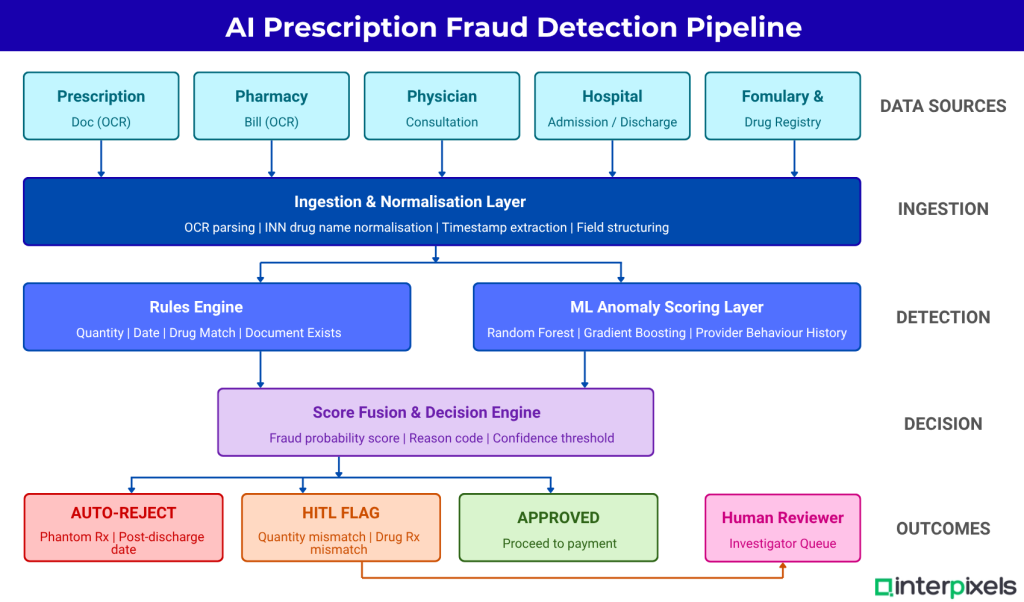
Caption: The AI prescription fraud detection pipeline ingests OCR-parsed prescription data, pharmacy bills, and physician consultation records into a multi-layer validation engine. The rules engine runs structured field comparisons (quantity, drug name, dates) while the ML layer scores anomaly probability. High-confidence fraud routes to auto-reject; borderline cases go to a human-in-the-loop (HITL) queue for investigator review. Cleared claims proceed to payment.
Scenario 4 — Date Manipulation: The Post-Discharge Prescription
A post-discharge prescription fraud occurs when the prescription date on the submitted document falls after the patient’s hospital discharge date. A hospitalised patient cannot visit a doctor post-discharge and receive a prescription that is then backdated into the admission period to claim reimbursement.
How It Happens
A patient is discharged from hospital on 10 March. The pharmacy submits a reimbursement claim for medications with a prescription dated 14 March, four days after discharge. In a paper-based workflow, this inconsistency requires cross-referencing the discharge summary and the prescription, a manual step that rarely happens at scale. AI timestamps both documents and compares them in under one second.
Financial Impact
Post-discharge prescription fraud is particularly common for high-cost post-operative medications: immunosuppressants, specialty wound care, and oncology supportive drugs. Per-event losses range from Rs 20,000 to Rs 3 lakh depending on the drug class. Because these claims often accompany legitimate inpatient claims, they pass initial scrutiny unless the date logic is automated.
How AI Detects It
The AI system extracts the patient’s admission and discharge dates from the hospitalisation record and compares them against the prescription date on every pharmacy claim linked to the same episode of care. Any prescription dated after the discharge date is flagged as a logical impossibility. The system also flags prescriptions dated before admission if the drug is specifically indicated for inpatient conditions.
Action Triggered
Date manipulation claims trigger an auto-reject because no legitimate clinical scenario produces a valid in-episode prescription post-discharge. The rejection is logged with timestamps from both source documents, producing an audit-ready evidence trail. IRDAI’s 2025 Fraud Monitoring Framework mandates that such audit trails be retained and made available for regulatory review, a requirement that AI-generated logs satisfy natively.
A prescription dated after discharge is not an administrative error. It is a timestamp that tells the entire fraud story.
The AI Detection Architecture Behind These Four Scenarios
In practice, teams building this kind of system deploy it in two layers. The rules engine handles the four structured fraud types described above. It is fast, fully explainable, and easy for compliance teams to audit. The ML layer sits behind it, scoring anomalies that rules cannot capture cleanly, such as a pharmacy with a suspiciously uniform claim-to-rejection ratio or a doctor whose prescription volume spikes every weekend.
The two layers feed a unified case management queue. Each flagged claim receives a fraud probability score, a plain-language reason code, and a recommended action. Investigators see only the cases the system could not close automatically, which McKinsey research (2024) shows reduces manual review workloads by 30-50%, while AI cuts fraudulent payouts by up to 40%.
| Fraud Type | Detection Method | AI Action | Best Used When |
|---|---|---|---|
| Quantity Mismatch | OCR field comparison + threshold rules | HITL flag (first offense); auto-reject (repeat pattern) | High-volume pharmacy networks with digital billing |
| Phantom Prescription | Document existence check + consultation record cross-reference | Auto-reject | Cashless hospital claims where prescription linkage is mandatory |
| Pharmacy-Rx Mismatch | NLP drug name normalisation + formulary matching | HITL flag | Complex formulary environments with brand-generic substitutions |
| Date Manipulation | Timestamp logic check against admission/discharge records | Auto-reject | Inpatient discharge billing with structured EHR integration |
Implementing AI Prescription Fraud Detection in a TPA Environment
Teams building this typically find that the biggest friction is not the AI itself, it is data standardisation. Prescription data arrives as scanned PDFs, handwritten scripts, and partially digitised pharmacy management system exports. Before any ML model runs, an OCR and normalisation pipeline must convert those inputs into structured fields. That data plumbing usually takes more time than the model training.
The deployment sequence that consistently works: start with the rules engine for the four scenarios above, connect it to the existing claims adjudication workflow, and measure false positive rates for 60 days. Then layer the ML model on top, using the rules engine’s verified decisions as training signal. This avoids building a model on dirty labels.
India-specific deployments also need to account for IRDAI’s Insurance Fraud Monitoring Framework Guidelines 2025, effective from April 1, 2026, which mandate participation in the IIB Fraud Monitoring Technology Framework. AI-generated fraud flags, when properly structured, feed directly into that reporting requirement, turning compliance into a byproduct of good detection rather than a separate workstream.
The TPA that deploys AI for prescription fraud does not just reduce leakage. It builds the audit trail that regulators are starting to require.
Frequently Asked Questions: AI Prescription Fraud Detection in Health Insurance
What is AI prescription fraud detection in health insurance? AI prescription fraud detection is the automated comparison of prescription records, pharmacy invoices, and clinical data using machine learning and rules-based engines. It identifies anomalies such as quantity inflation, phantom scripts, drug substitutions, and date manipulation before a claim is paid, replacing manual spot-checks with systematic, real-time coverage of every submitted claim.
How does an AI system detect a phantom prescription claim? The system queries the prescribing doctor’s consultation registry or EHR via API. If no consultation record exists within a clinically plausible window before the prescription date, the claim is flagged as unanchored. It then cross-checks the prescription reference number against the insurer’s records. A prescription with no traceable consultation triggers an immediate auto-reject.
What is the difference between a HITL flag and an auto-reject in claims fraud? An auto-reject applies when the AI identifies a logical impossibility, such as a post-discharge prescription date, where no legitimate scenario exists. A human-in-the-loop (HITL) flag applies when the anomaly could have a valid explanation, such as a brand-to-generic drug substitution. HITL routes the claim to an investigator who verifies context before a final decision is made.
How much does pharmacy bill fraud cost health insurers in India? India’s IRDAI reported that health claims worth Rs 26,000 crore were disallowed or repudiated in FY2023-24, a 19.1% year-on-year increase. Industry estimates suggest 15% of all health insurance claims contain some element of fraud. A significant portion of this leakage runs through pharmacy billing, particularly quantity inflation and post-discharge medication claims.
Is AI fraud detection compliant with IRDAI’s 2025 fraud guidelines? Yes, when properly implemented. IRDAI’s Insurance Fraud Monitoring Framework Guidelines 2025, effective April 1, 2026, require insurers and TPAs to participate in the IIB Fraud Monitoring Technology Framework and maintain auditable fraud records. AI detection systems that log fraud flags with timestamps, reason codes, and source documents produce exactly the evidence trail these guidelines require.
Three Truths Every TPA Risk Manager Needs to Act On
Pharmacy bill fraud in APAC health insurance concentrates in four detectable patterns: quantity inflation, phantom prescriptions, drug-name substitution, and date manipulation. Each has a known AI detection method, a clear financial signature, and a defined TPA response. None of them require speculative technology.
Regulators are raising the bar. IRDAI’s 2025 framework and Indonesia’s Ministry of Health Regulation No. 16 of 2019 both signal that fraud detection is becoming a compliance obligation, not a discretionary investment. TPAs that build AI-powered detection now generate the audit trails regulators are already asking for.
The McKinsey and Deloitte data converge on the same point: AI reduces fraudulent payouts by up to 40% and cuts manual review costs by 30-50%. For a TPA processing thousands of pharmacy claims monthly, that arithmetic is not a pilot project business case. It is an operational imperative.
The question for your team is not whether to deploy AI prescription fraud detection. It is whether you can afford another quarter without it.
Table of Content
- Why Pharmacy Bill Fraud Is APAC’s Fastest-Growing Claims Leak
- Scenario 1 — Quantity Mismatch: The 30-to-90 Tablet Swap
- Scenario 2 — Phantom Prescription: A Claim With No Valid Script
- Scenario 3 — Pharmacy-Rx Mismatch: When the Drug Name Does Not Match
- Scenario 4 — Date Manipulation: The Post-Discharge Prescription
- The AI Detection Architecture Behind These Four Scenarios
- Implementing AI Prescription Fraud Detection in a TPA Environment
- Frequently Asked Questions: AI Prescription Fraud Detection in Health Insurance
- Three Truths Every TPA Risk Manager Needs to Act On